
Updated ,first published
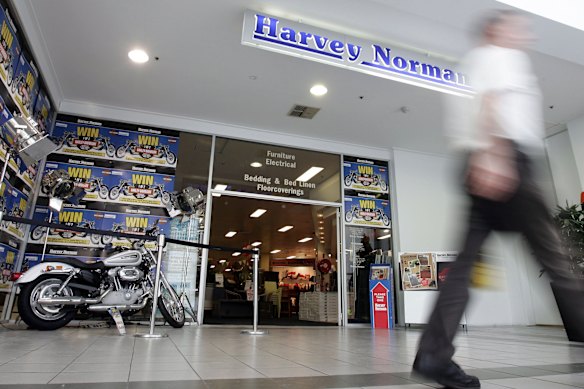
Harvey Norman is bracing for a worsening economy after reporting lower foot traffic and plunging profits as Australians pull back from buying household goods.
Veteran retailer and executive chairman Gerry Harvey said fewer customers were visiting the whitegoods retail chain, which suffered a 47 per cent fall in profits before tax in the four months between July and October compared to the same period previously.
“There’s no one in the shop,” Harvey told this masthead. “Every retailer I talk to is in a similar situation … And if they’re under pressure now, it’s only going to get worse next year.
“The likelihood of it improving is probably zero.”
Sound systems, speakers and television sales have fallen, as have lounges, kitchenware and bedding, while essential whitegoods like fridges and washing machines are holding up, Harvey said. Robot vacuums, lawn mowers and window cleaners are selling strongly, as are computers and laptops, which have increased in price amid skyrocketing computer chip prices exacerbated by the AI boom.
“Robot window cleaners [have] really caught on. It’s quite big,” Harvey said. “We’re selling thousands.”
Business costs, including wages, electricity, petrol, and cybersecurity costs have risen across the board, he added. “We’ve got 12 people employed just in cybersecurity because we’ve got to protect our business,” Harvey said. “It’ll cost you a lot of money to exist.”
The 87-year-old is expecting the upcoming Black Friday and Christmas sales period to be “very good”, but he anticipates the spike will die down in the new year. “From February on next year, it’s going to be very difficult,” he said. “I don’t see any way it’s not going to get worse.”
Shoppers have curtailed their spending following five interest rate rises this year, bruising retailers from Bunnings to furniture sellers. Australian fashion chains in particular are struggling to stay afloat, with the recent collapses of David Jones and General Pants Co. the latest in a string of high-profile retailers falling into administration.
Harvey Norman shares tumbled as much as 6.6 per cent on Wednesday morning after issuing the profit warning, which also flagged a 26.8 per cent slide in like-for-like sales in the United Kingdom. Harvey Norman operates 121 stores around the world across New Zealand, Asia and Europe, on top of 195 franchised stores in Australia.
The 47 per cent earnings slump this financial year so far is much worse than the 13 per cent decline analysts had been predicting, with Barrenjoey’s head of consumer research Tom Kierath signalling this implied “considerable margin pressure”.
“The 47 per cent [profit] decline includes property earnings which are likely stable, which could imply retail profitability is down 60 per cent,” Kierath wrote in a note to clients.
Furniture sellers are taking a hit. Nick Scali issued a profit warning in October after revealing orders fell by 15 per cent and showroom traffic dipped 10 per cent in the first quarter of its financial year. Online retailer Temple & Webster’s revenue fell 8 per cent between early July and October 19 as it reduced deep discounting to improve margins.
Bunnings, JB Hi-Fi, and Super Retail (which runs Rebel Sport, BCF and Macpac) have all flagged or recorded slowing sales momentum as cash-strapped shoppers hold out for Black Friday and Christmas deals.
Accent Group, which operates clothing and footwear chains like Hype DC, Platypus Shoes and The Athlete’s Foot, reported a 3.9 per cent fall in like-for-like sales over the first 19 weeks of the new financial year.
Household budgets have come under pressure this year from five interest rate rises and rising consumer prices. Annual inflation soared to 4.9 per cent in October, its highest level since the beginning of the war on Iran, the Australian Bureau of Statistics said on Wednesday.
Transport costs, which lifted 2 per cent in October and are up 10.6 per cent over the year, have been a key culprit in pushing up prices across the broader economy: petrol and diesel prices have spiked 32.5 per cent over the past 12 months due to the war in the Middle East.
Prices for clothing and footwear, plus household goods, both increased by 1.2 per cent. The cost of eating out has climbed by 4.1 per cent, while fruit and vegetable prices lifted by 7.5 per cent, driven in particular by fruit prices, which jumped 10.9 per cent over the year.
The Business Briefing newsletter delivers major stories, exclusive coverage and expert opinion. Sign up to get it every weekday morning.
 Jessica Yun is a business reporter covering retail and food for The Sydney Morning Herald and The Age.Connect via X or email.
From our partners
Disclaimer : This story is auto aggregated by a computer programme and has not been created or edited by DOWNTHENEWS. Publisher: www.smh.com.au