
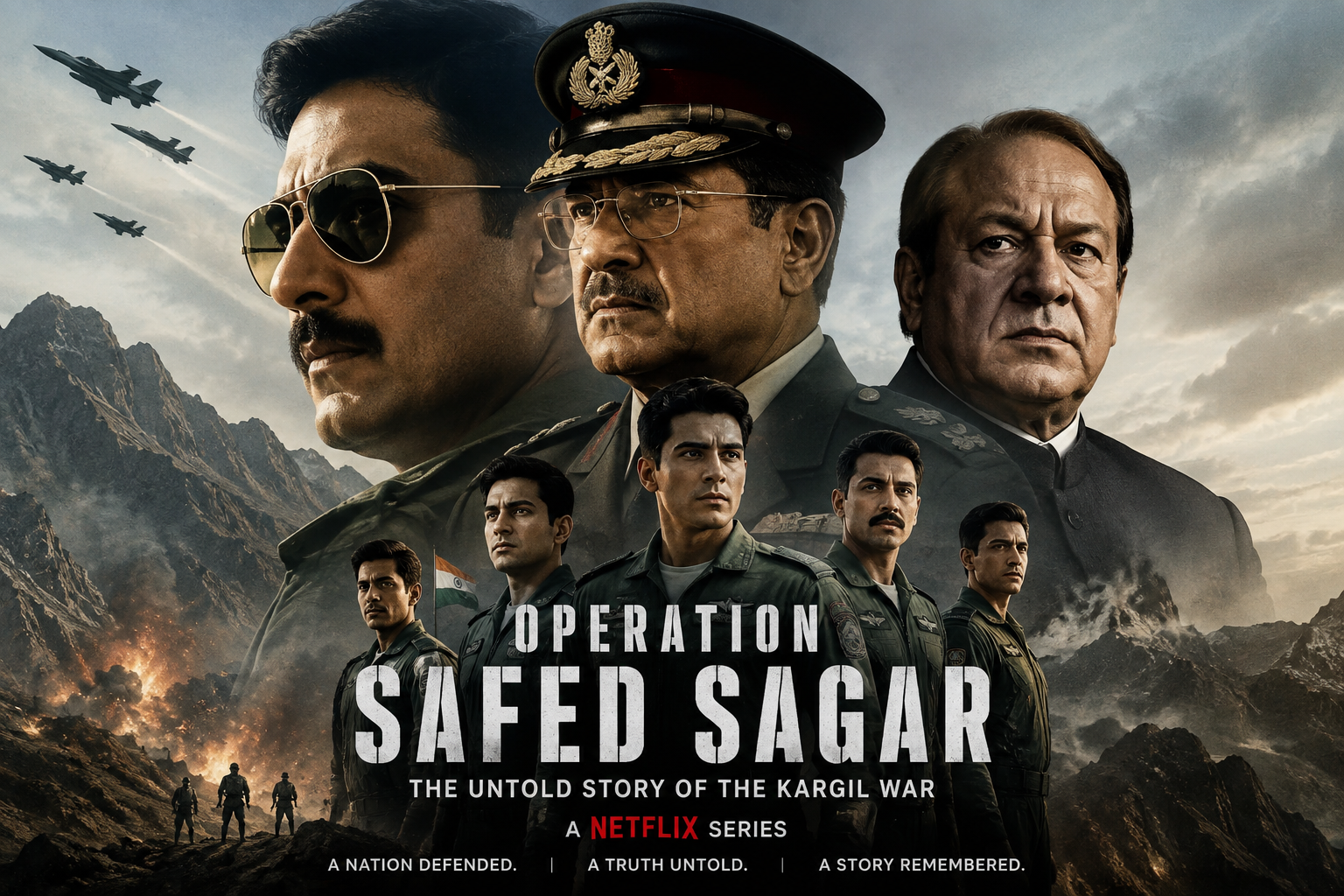
There is no shortage of patriotic cinema in India, particularly when it comes to stories about war. But patriotism does not always have to arrive with gunfire, explosions and heroic one-liners.
Operation Safed Sagar: The Untold Story of the Kargil War takes a quieter and considerably more detailed approach to one of India’s most significant military conflicts. The Netflix series revisits the 1999 Kargil War, focusing on the Indian Air Force’s Golden Arrows while also examining the political and military tensions within Pakistan.
Created by Kushal Srivastava and Abhijeet Singh Parmar and directed by Oni Sen, the series attempts to remain close to the historical events instead of turning the conflict into an exaggerated action spectacle.
And that is precisely what makes it interesting.
Compared with the aggressive, action-driven treatment seen in films such as Dhurandhar, Operation Safed Sagar is more interested in what happened behind the battlefield.
The series explores how Pakistan’s military leadership planned the Kargil operation and how the country’s political establishment responded once the consequences became clear. General Pervez Musharraf and Nawaz Sharif become important figures in this political narrative.
Manu Rishi Chadha’s portrayal of Musharraf is one of the show’s highlights. His interpretation moves away from the flamboyant public image associated with the former army chief and instead presents a man whose decisions had enormous consequences for Pakistan.
Vinay Pathak’s Nawaz Sharif is equally interesting because the character is not presented as a straightforward antagonist. The series explores the tension between Pakistan’s civilian government and its powerful military establishment, adding another layer to the story.
On the Indian side, the series focuses on the courage and discipline of the armed forces. Siddharth plays Squadron Leader Ajay Ahuja, while Jimmy Sheirgill appears as B S Dhanoa. The younger cast members bring the Golden Arrows to life, with Abhay Verma, Mihir Ahuja and Harssh A Singh playing key roles.
The show also gives space to the families behind the soldiers. These moments prevent the officers from becoming merely cinematic symbols of bravery and allow viewers to see them as individuals with relationships, responsibilities and fears.
Another important aspect is India’s decision not to cross the Line of Control. Despite the provocation, the Indian military remained within the limits laid down by the political leadership. The series presents this restraint as a significant strategic decision rather than a sign of weakness.
The narrative also acknowledges the challenges faced by India during the conflict, including resource limitations and operational difficulties. It raises questions about the role of the United States and the broader international response to the war.
That balance is what separates the series from conventional nationalist dramas.
There is no constant attempt to manufacture anger. There is no need to turn every Pakistani character into a caricature. Instead, the series allows political decisions, military mistakes and historical circumstances to create the tension.
And sometimes, that approach can be more powerful than spectacle.
Dhurandhar may have generated greater buzz and delivered the kind of intense action that attracts mass audiences. Operation Safed Sagar, however, appears more interested in establishing a historical narrative that can travel beyond the Indian audience.
Its greatest weapon is not violence.
It is context.
By combining military history with political intrigue and personal stories, Operation Safed Sagar presents the Kargil War as more than a battle. It becomes a story about leadership, restraint, institutional power and the consequences of decisions made behind closed doors.
Disclaimer : This story is auto aggregated by a computer programme and has not been created or edited by DOWNTHENEWS. Publisher: deccanchronicle.com





