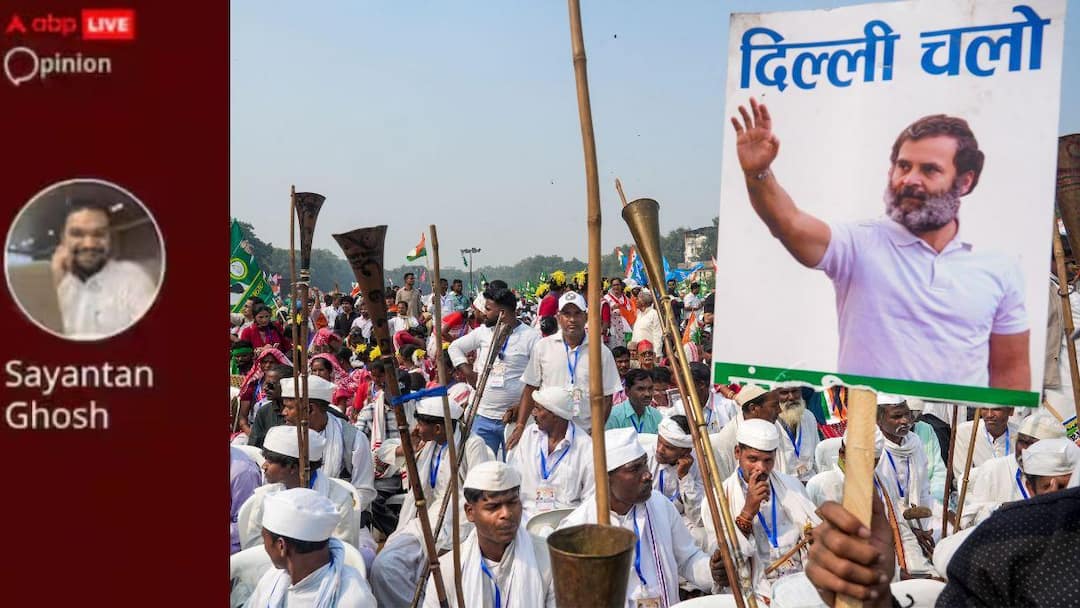
An important political question today is about the Cockroach Janata Party and its political future. It is important to acknowledge who the supporters of the CJP are. For the second time in Mumbai, when the CJP organised a Tiranga march, the number of people who actually turned up told its own story. Before that, at Shivaji Park, a lot of people gathered, but there the presence of celebrities and supporters of other political parties was also present. In Delhi, the protests called by the CJP witnessed mostly participants from the left and NSUI student organisations. Therefore, the question of the political future of the CJP is very important. How the Rahul Gandhi-led Congress associates itself with the CJP, and vice versa, will, at the end, determine the future of the CJP.
A political pressure group sounds fascinating in any kind of politics, but how much time can the CJP spend talking about reforms, the system, and staying away from it? This kind of experiment has taken place in India before, with the Anna Hazare movement, but its sustainability is really under question. The expectation that Gen Z will support the CJP in every cause, every political cause they raise, is an overexpectation. Therefore, the question of the relevance of the CJP will join with how the opposition political parties, most importantly the Congress Party, engage with them.
CJP As A Pressure Group
The CJP may remain a pressure organisation rather than evolve into a recognised political party. Its immediate strength lies in its protest politics and ability to mobilise public opinion. At this point, the CJP is all about Abhijeet Dipke, Ashutosh Ranka, Saurav Das, and the people associated with it. While the CJP is raising important issues, the question is: what about the organisation?
To become a pressure group that lasts, either they will have to form their own organisation which will work as the pressure group. This organisation cannot be a group of 10 to 15 to 20 people, but an organisation which will have the strength to mobilise. Or the organisation will have to be so credible that any call by this organisation will be able to mobilise hundreds to thousands of people. With this, the organisation can evolve from a pressure group to a political party.
Till the time this transformation is happening, the pressure from outside the government is a difficult thing to sustain because the BJP at this point is massively together. They are preparing themselves to sustain the pressure from the opposition. After the NEET protest against the paper leak, which forced Dharmendra Pradhan to resign, they have realised that it is time for them to be able to prepare to sustain this pressure.
It is also important to understand that, in this shape, with this kind of a name, the Election Commission of India will not easily accept this formation as a political party. Therefore, this experiment is something to watch out for.
AAP Precedent
Here, the history of the Aam Aadmi Party is also important. When the India Against Corruption movement began under the leadership of Arvind Kejriwal, Anna Hazare, and others, this group was very stringent that they would never join politics. But at the end of the day, they had to come inside the system and form the AAP. Anna Hazare never ever supported the formation of the political party, but from the history of the Aam Aadmi Party, it became very clear that they wanted to maintain an equal distance from the Congress and the Bharatiya Janata Party.
This kind of a neutral position or this kind of a dissociated position doesn’t work in the Indian political space. The pressure groups, at the end of the day, have an expiry date, and that’s why political transformation became necessary for the AAP. That is why this political history and precedent is also important for the CJP. They cannot be credulous to either the opposition or the BJP.
It is also important to understand that the largest protest by the CJP, which is the Jantar Mantar protest during the NEET paper leak, also received support from the opposition in different ways. Not only the political parties extended their support, but also their supporters joined that. Of course, there is no doubt that some sections of people, mostly youth who were earlier close to the idea of the BJP but disenchanted, also joined the protest. Therefore, choosing a side will become important somewhere or the other.
Rahul’s Opportunity And Risk
Rahul Gandhi now faces a clear choice. Should he try to bring the CJP’s leadership and its supporters into the Congress fold? Doing so might help the party reconnect with sections of the electorate, particularly younger voters, who are searching for an alternative political platform that speaks in a language they understand. Congress has struggled for years to regain the confidence of Gen Z, and the CJP has, for the moment, captured some of that imagination.
At the same time, absorbing the CJP carries real risks. It could strengthen Congress by adding energy and fresh faces to its ranks. Or it could undermine the movement’s independent credibility. If the CJP begins to look like an extension of an established political party, it may lose the very appeal that allowed it to draw people who were sceptical of traditional parties in the first place. Many of those who joined the NEET protests or the later agitations were not looking for another Congress-led campaign. They were looking for something that felt different.
The same tension has already appeared. When Rahul Gandhi placed Neha Bora of AISA at the forefront of an opposition protest, it created unease inside the Congress’s own student organisation, NSUI. A similar reaction is possible if the party tries to elevate CJP leaders and let them lead. The Congress wants to bring different groups together, yet the CJP has so far kept a deliberate distance. That distance is part of what has given the movement its edge. Closing it might bring short-term political advantage, but it could also flatten the very thing that made the CJP visible in the first place.
Whether Gen Z will accept a traditional party once it starts speaking their language, or whether they still want a completely alternative platform, remains an open question. Both the Congress and the CJP will have to wait and watch how that plays out. For Rahul Gandhi, the opportunity is real, but so is the danger of turning a protest that claimed to stand outside party politics into just another arm of the opposition.
Implications For The BJP
An explicit association between the Congress and the CJP would present the BJP with both a problem and an opportunity. It could create a broader opposition mobilisation, especially if it succeeds in bringing more young people onto the streets under a common banner. At the same time, it would give the BJP a ready narrative that the protests were never independent and were always an opposition project. The ruling party has already shown it can absorb street pressure and reorganise after setbacks. After Dharmendra Pradhan’s resignation, it moved quickly to prepare itself for the next round of pressure. An open Congress-CJP tie-up would fit neatly into that preparation.
The BJP would almost certainly use any such association to argue that the CJP has lost its claim to stand outside party politics. Once the movement is seen walking with the Congress, the space it had occupied as something different from traditional parties begins to shrink. That is useful for the BJP, even if the protests themselves grow larger for a while. A bigger mobilisation that can be labelled as Congress-driven is often easier to manage than a smaller one that still carries the appearance of independence.
For the CJP, the choice remains the same one that faced the India Against Corruption movement years ago. Stay outside and risk fading once the immediate issue cools, or enter the political system and risk becoming just another face in an existing party. How Rahul Gandhi and the Congress handle that choice, and how Abhijeet Dipke and the CJP respond, will decide whether this remains a pressure group with a short life or becomes something more lasting in Indian politics. The BJP, for its part, will be watching the same calculation and preparing to turn whichever decision is made into its own advantage.
(Sayantan Ghosh is the author of two books, Battleground Bengal and The Aam Aadmi Party, and teaches at St. Xavier’s College (Autonomous), Kolkata.)
Disclaimer : This story is auto aggregated by a computer programme and has not been created or edited by DOWNTHENEWS. Publisher: abplive.com