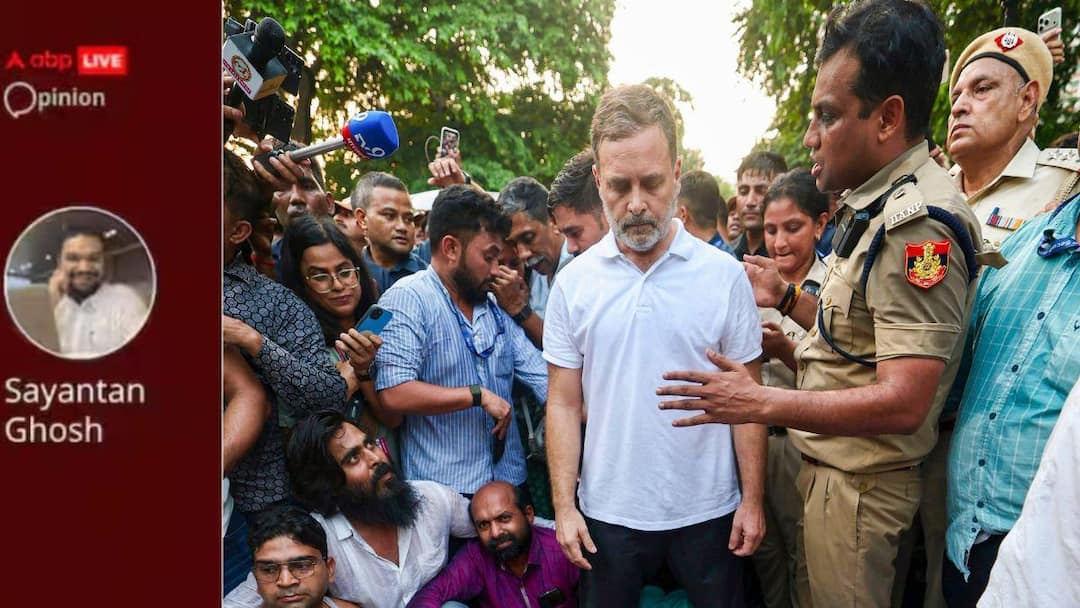
The streets of Delhi have turned into the principal stage for the opposition’s challenge to the Election Commission. Protests against Chief Election Commissioner Gyanesh Kumar over the Special Intensive Revision of electoral rolls have drawn not only established parties but also youth formations such as the Cockroach Janta Party and assorted civil society groups. At the centre of this mobilisation stands Rahul Gandhi, Leader of the Opposition in the Lok Sabha. He has marched from Parliament towards Nirvachan Sadan, climbed barricades while waving the tricolour, staged sit-ins at Akashvani Bhawan, endured repeated detentions, hosted alliance partners and student leaders at his residence, and led a march to the Supreme Court to file a joint petition. The demands remain consistent: resignation of the CEC, scrapping of the revision exercise, and restoration of names allegedly deleted from rolls.
For years the Congress leader faced a familiar set of jibes. Critics called him abrupt, absentee, and unserious. The Bharatiya Janata Party and its allies reduced him to a figure of ridicule. That pattern of dismissal has not vanished, yet the present phase looks different in texture. Gandhi is not merely issuing statements. He is coordinating backroom talks, negotiating with allies, addressing youth gatherings, and remaining physically present through long hours of confrontation with police. The image is of someone who treats the charge of electoral manipulation as a matter that requires sustained presence rather than occasional intervention. Politics, after all, is not conducted solely through social media posts or carefully staged press conferences. It also requires the willingness to occupy public space when institutions themselves are under question.
This shift matters, but it does not dissolve older difficulties. The Congress party continues to carry organisational deficits that predate the current protests. Leading demonstrations in the capital is one thing. Converting that energy into durable structures across states is another. The larger contest against the Narendra Modi government, aimed at 2029, will be decided in constituencies far from Delhi’s barricades. Whether the opposition, under Gandhi’s visible leadership, can mount a coherent national challenge remains an open question. At this stage the gaps are more visible than the bridges.
Strengths: Presence, Language, And The Street As Arena
The most immediate strength of this phase is the consistency of physical presence. Gandhi has treated the protests as a continuous engagement rather than a series of isolated events. He has brought together INDIA bloc parties, student groups, and civil society figures under a single set of demands. In doing so he has projected the role of Leader of the Opposition as something more than a parliamentary designation. Fighting a well-entrenched government requires more than critique from a distance. It requires the capacity to occupy the street without losing the ability to negotiate. On that narrow measure the present effort has registered.
There is also a broader political context. Anti-incumbency against the Modi government has not disappeared, particularly among younger voters who express dissatisfaction over employment, education, and the fairness of institutional processes. Traditional parties, including both the Bharatiya Janata Party and the Congress, have long struggled to speak in the registers that younger citizens recognise as their own.
Messaging has often remained formal, hierarchical, and distant. Gandhi’s recent interventions have attempted to narrow that distance by adopting a more direct, conversational tone and by remaining open to groups that operate outside formal party structures. Whether this represents a lasting change in political style or a temporary adaptation to the moment is not yet clear. What is visible is an effort to treat youth dissatisfaction as a resource rather than a problem to be managed.
Weaknesses: State Structures, Alliance Ambiguities
The principal weakness remains organisational. Delhi protests can be assembled with relative speed when national leaders and urban activists converge. The same density does not exist in most state units of the Congress. In states heading toward assembly elections in 2027, including Uttar Pradesh and Punjab, party machinery has not shown comparable intensity. Gandhi himself has been largely occupied with the capital-centred agitation. Sustained campaigns at the booth level, cadre training, and local leadership development have received less public attention.
A national contest cannot be won by concentrating effort in one city, however symbolic.
The INDIA bloc’s internal condition adds another layer. Smaller partners face their own erosion of support and organisational capacity. Coordination among them has improved during the present protests, yet underlying disagreements over seat sharing, regional priorities, and leadership remain unresolved.
Questions about whether the alliance will eventually project a single face against Narendra Modi are routinely deflected. Modi’s personal appeal continues to outstrip that of any single opposition figure. Voters who remain undecided will want to see a concrete alternative, not merely a collective critique. Until that question is addressed with greater clarity, the opposition’s claim to offer a governing alternative stays incomplete.
Opportunities: Regional Realignment And The Test Of State Elections
The present moment also contains openings. Several regional parties that once kept a careful distance from Gandhi’s leadership have found reasons to stand closer. Mamata Banerjee, after the Bharatiya Janata Party’s decisive victory in West Bengal, has joined the Delhi protests and coordinated with Congress leaders on the Election Commission issue. Similar shifts are visible among other parties that have lost ground in their home states. If these forces can be drawn into a more durable arrangement without subordinating local interests entirely, the opposition gains additional organisational reach.
State elections scheduled for early 2027 offer a practical test. Results in Uttar Pradesh, Punjab, and other states will shape perceptions of the opposition’s seriousness well before the next Lok Sabha contest. A campaign that remains confined to institutional grievances in Delhi will not automatically translate into votes in those states. At the same time, younger voters appear less attached to personality-centred politics than earlier generations. An opposition that can present itself as a platform for collective accountability rather than the projection of any single leader may find a receptive audience. Gandhi has gestured toward this framing. Converting the gesture into sustained organisational practice will determine whether the opportunity is used or lost.
Threats: Message Dilution, Unmanaged Allies
The most immediate threat is the risk of the core demand being overtaken by broader and more contested claims. When figures associated with the protests, including senior advocate Prashant Bhushan, state that the agitation is also a fight for regime change, the BJP gains an opening to shift the public argument away from the specific allegations about electoral rolls. Bhushan’s own political trajectory has included earlier associations that remain contested. If such voices receive equal prominence, the narrower institutional critique can be portrayed as part of a larger attempt to delegitimise the elected government. Careful selection of platforms and individuals becomes necessary if the original issue is to retain focus.
A second threat lies in the gap between protest intensity and electoral performance. Without stronger state units and credible results in the 2027 assembly elections, the visibility gained in Delhi will remain episodic. Regional parties present their own constraints. In West Bengal the Trinamool Congress and the Left have shown limited willingness to coordinate seats even when they share a common adversary. Same story will be in Kerala between Congress and Left.
Managing these relationships while maintaining a national narrative requires constant negotiation. The BJP’s organisational depth and communication machinery remain formidable. Any opposition effort that leaves internal contradictions unresolved will be exploited. The present phase has demonstrated that Rahul Gandhi can lead a street mobilisation. Whether that capacity can be extended into the harder work of party building and alliance management will decide if the new avatar produces lasting political effect.
(Sayantan Ghosh is the author of two books, Battleground Bengal and The Aam Aadmi Party, and teaches at St. Xavier’s College (Autonomous), Kolkata.)
Disclaimer : This story is auto aggregated by a computer programme and has not been created or edited by DOWNTHENEWS. Publisher: abplive.com