- Quad transitions from dialogue to operational security grouping.
- Leaders announced first military exercise, enhancing maritime security.
- India dropped resistance due to China’s aggression, US pressure.
The Quad, consisting of India, United States, Japan and Australia, has finally put on the uniform. Manila did what Wilmington could not: it securitised the Quad. For almost two decades, the Quadrilateral Security Dialogue has lived a double life. In public, it was a grouping of democracies delivering vaccines, building undersea cables, tracking illegal fishing, and talking about a “free, open, inclusive and resilient Indo-Pacific.”
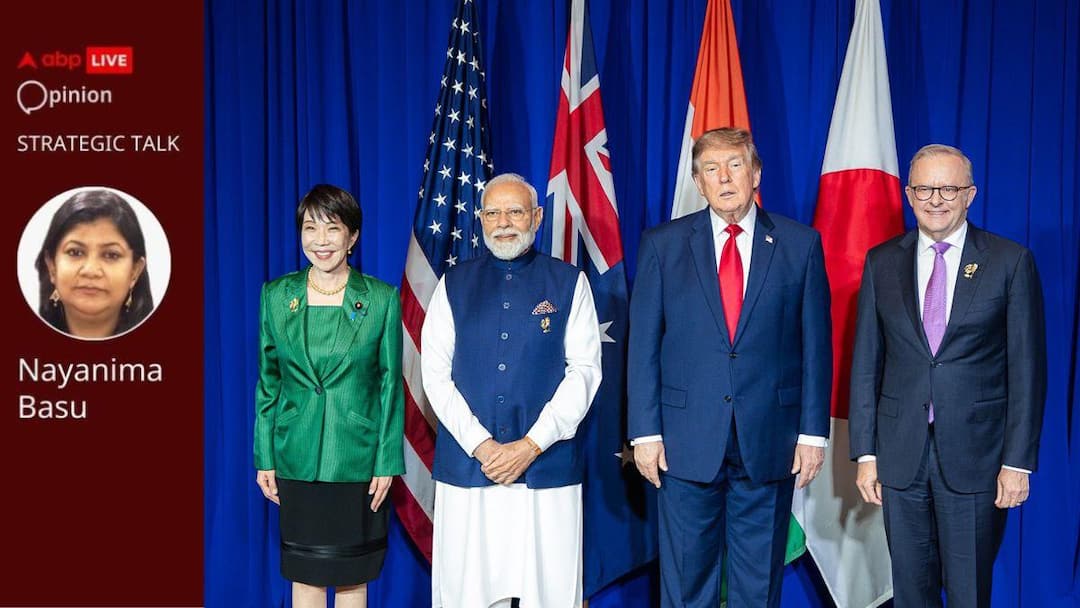
In private, everyone knew what it was really about: China. On 17 November 2026, in Manila, that fiction finally cracked. For the first time in over two years, the leaders of India, the United States, Japan and Australia-Narendra Modi, Donald Trump, Sanae Takaichi and Anthony Albanese-met for a Quad leaders’ summit on the sidelines of the ASEAN summit.
And for the first time, they put a military exercise in a Quad context.
“In 2027, our respective P-8 and P-3C patrol aircraft are scheduled to fly in a maritime exercise for the first time in a Quad context, making our seas safer,” the joint press statement said. That one sentence changes the Quad. It is no longer just a dialogue. It is now, however cautiously, an operational security grouping.
The aircraft matter. The P-8-India flies the P-8I, the US and Australia fly the P-8A-and Japan’s P-3C Orion are not humanitarian platforms. They are built to hunt submarines, track surface fleets, and conduct surveillance and reconnaissance.
To fly them together, under a Quad banner, is to practise anti-submarine warfare together. The Quad maritime exercise is expected to be explicitly linked to the new Indo-Pacific Maritime Surveillance Collaboration (IPMSC), a mechanism to enhance information-sharing and maritime domain awareness.
No country resisted this moment more consistently than India. New Delhi’s inhibition was never unknown. It was structural. Unlike Japan, Australia or the United States, India shares a 3,488-km disputed land border with China.
It has fought a war with Beijing in 1962, lost soldiers in Galwan in 2020, and since then has had to maintain a much larger troop presence along a border that External Affairs Minister S. Jaishankar has described as “more alive.”
A maritime provocation in the South China Sea or the Indian Ocean could be answered by Beijing on land, in Ladakh or Arunachal Pradesh, where India is most vulnerable.
India has long insisted that the Quad is not a security alliance and not aimed at China. Under this dialogue, India sought American technology, Japanese capital and Australian minerals, but not an American war plan. That is why, for years, India kept the real military work outside the Quad label.
The Malabar naval exercise began as an India-US exercise, later included Japan and then Australia, but the official narrative always stated that this particular exercise in the high seas is not part of the Quad. The Quad could do vaccines, supply chains, and critical minerals. Malabar could do war fighting. Never the twain would meet.
New Delhi has long feared that militarising the Quad would permanently fuse China and Pakistan into a single two-front threat. If New Delhi joined an overt anti-China bloc, Beijing would have every incentive to arm Islamabad more aggressively, share more intelligence, and coordinate pressure on both fronts.
Strategic ambiguity, in this view, was not weakness. It was insulation. Beijing understood this perfectly and exploited it. Chinese state media repeatedly urged India to preserve its strategic autonomy, arguing that New Delhi was unlikely to undermine improving ties with China by joining efforts to contain it. For a long time, that caution worked-or at least, it seemed to.
So What Changed?
The premise of Indian restraint was that if India did not provoke Beijing, Beijing would not escalate. That premise has collapsed. China has widened its naval footprint across the Indo-Pacific, including the Indian Ocean Region, deployed survey vessels and submarines, built dual-use ports from Djibouti to Gwadar to Hambantota, and continued to press on the Himalayan border even as it talked about stabilisation.
Restraint did not buy restraint in return. Additionally, China’s backing of Pakistan during Operation Sindoor in May 2025 made New Delhi realise that it gained little by self-censoring its Quad cooperation with the US, Japan and Australia.
And, the foremost factor in this was US President Donald Trump’s return to the White House. Trump had already skipped the Quad Summit India had planned to host last year, amid uncertainty over his travel and tensions with New Delhi over a trade deal.
The message was clear: if the Quad was going to survive Trump 2.0, it had to deliver something Trump could call “peace through strength.” Trump himself framed the Manila announcement in exactly those terms, describing the Quad as “very important and special” and announcing the first exercise featuring maritime patrol aircraft.
Also Read: OPINION | Dhaka’s Dangerous Stalemate
For India, the choice was stark. Agree to a modest, carefully bounded securitisation-a patrol aircraft exercise, not a mutual defence treaty, not joint patrols in the South China Sea, not a Quad navy-or risk Trump walking away from the Quad altogether and cutting a grand bargain with Chinese President Xi Jinping and Vladimir Putin, President of Russia, in Shenzhen two days later. New Delhi chose the former. It was not enthusiasm.
That is why the Manila statement is so revealing in its omissions. Unlike the expansive 2024 Wilmington Declaration, it does not explicitly mention the South or East China Sea, even as it “strongly oppose[s] any destabilising or unilateral actions that seek to change the status quo, including by force or coercion”.
It talks about “economic coercion, including through arbitrary export restrictions”-a clear reference to Beijing’s rare-earths leverage- without naming Beijing. India got the exercise; it also got the ambiguity.
However, the Quad is still not quite the ‘Asian NATO’ as Beijing prefers to call it. It has no charter, no secretariat, no Article 5, no automatic military obligation. The 2027 exercise does not create one. When four navies practise hunting the same submarines, using interoperable aircraft, sharing real-time maritime domain awareness through the new Surveillance Collaboration, they are building the sinews of an alliance even if they refuse the name.
Interoperability is policy. Data-sharing is trust. And trust, once built for surveillance, can be repurposed for warfighting in a crisis.
India has now crossed a psychological threshold with Beijing. The next time a Chinese submarine is tracked by a Quad P-8 in the Indian Ocean, Beijing will not see four separate national aircraft. It will see a Quad hunt. New Delhi should expect retaliation-more pressure on the border, more support to Pakistan, more economic coercion, more attempts to peel off India’s neighbours in the Indian Ocean.
India has tied itself more closely to an American president whose commitment to the Indo-Pacific is transactional and who just concluded a trilateral with Xi and Putin.
If Trump eventually cuts a deal with Xi, India could be left holding the Quad bag. India has raised expectations it may not be able to meet. If the Quad looks like containment of China, ASEAN will distance itself. If it looks like theatre, Beijing will mock it.
The Quad must now prove that securitisation delivers actual security-safer sea lanes, faster domain awareness, credible deterrence-not just a photo-op in Manila.
India did not agree to the 2027 exercise because it suddenly loves alliances. It agreed because it finally accepted that ambiguity had stopped protecting it, and because Trump forced it to choose between a securitised Quad and a hollow one. That is the real story of Manila.
Not that India overcame its fear of China. But it decided that its fear of irrelevance-and of being left alone between a China-Pakistan axis and an America that might deal over its head-was greater.
The Quad has finally put on the uniform. The question now is whether it knows how to wear it.
Also Read: OPINION | Six Years Longer, Still No Promise For Agniveers
[Disclaimer: The opinions, beliefs, and views expressed by the various authors and forum participants on this website are personal and do not reflect the opinions, beliefs, and views of ABP News Network Pvt Ltd.]
Disclaimer : This story is auto aggregated by a computer programme and has not been created or edited by DOWNTHENEWS. Publisher: abplive.com