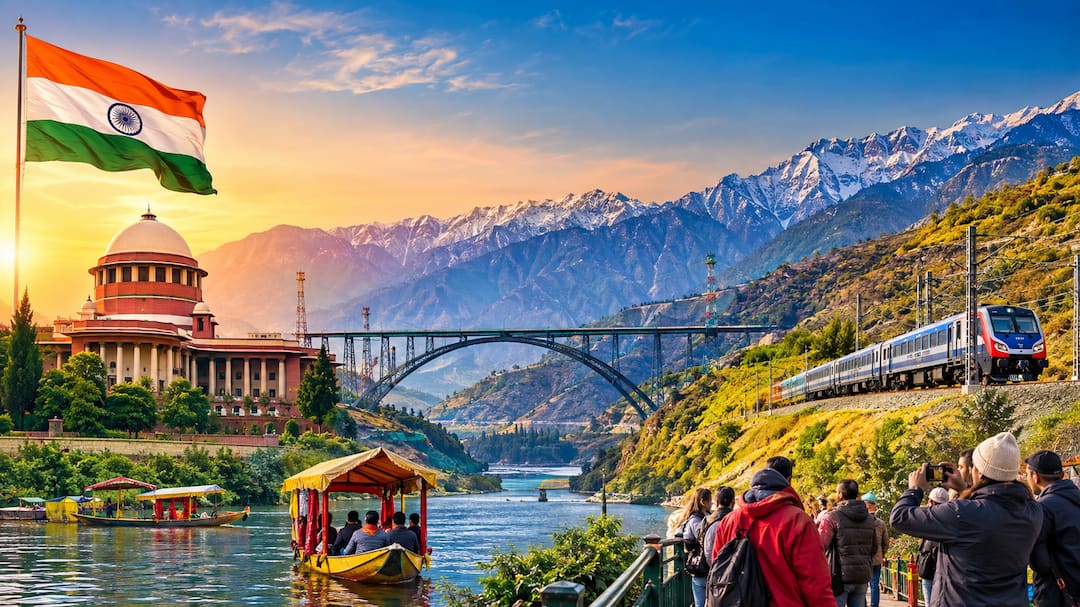
- India revoked Article 370, integrating Jammu and Kashmir.
- The region saw improved infrastructure, GSDP, and tourism.
- New investments in industry created jobs and fostered growth.
- Some local parties still demand Article 370 restoration.
On August 5, 2019, the Government of India revoked the special autonomous status of the then state of Jammu and Kashmir, temporarily granted to it under Article 370 of the Constitution. In taking that step, Jammu and Kashmir was bifurcated into two Union Territories (UTs)-Jammu and Kashmir and Ladakh under the Jammu and Kashmir Reorganisation Act of 2019.
Yesterday marked the seventh anniversary of that decision that holistically integrated this region with India. Was the move beneficial or detrimental in terms of its political and socio-economic impact? While opinion may vary, this writer is sanguine that abrogation of Articles 370 and 35A has brought about a significant change for the better for the people of Jammu, the Kashmir Valley and Ladakh.
Prior to Article 370 revocation, the region was in the vice-like grip of separatist-led violence, terrorist strikes and civil unrest that caused a significant deterioration in the law and order situation. High levels of administrative corruption further created a hostile environment for commercial activities and dissuaded potential investors, leading to socio-economic stagnation and burgeoning unemployment.
Has the revocation delivered on the government’s promises of integration, development, and improved security? A dispassionate assessment of the post-Article 370 abrogation scenario clearly indicates that indeed, it has.
Infrastructure and Development
The revocation of Articles 370 and 35A in 2019 has brought Jammu and Kashmir in line with India’s broader developmental framework. Today, we are witnessing the opening of new vistas for trade and investment.
The region’s improved connectivity with other states has done wonders for its economic growth, i.e., GDP. GSDP growth in the period between 2011 and 2019 stood at an abysmal 4.81 per cent, whereas in FY 2025-26, it achieved an estimated real growth rate of 5.82 per cent, or approximately Rs.2.86 lakh crore (USD 33 billion) in nominal terms and Rs.1.50 lakh crore in real terms.
Once marred by underdevelopment, frequent shutdowns and terrorism, the region now boasts of improved infrastructure, especially in the context of its national highways, railway and road links connecting better with the rest of India.
For FY 2026-27, the Chief Minister of J&K, and its Finance Minister, Omar Abdullah, have projected a GSDP growth of Rs.3,15,822 lakh crore, amounting to a growth of 9.5 per cent over the revised estimates of 2025-26. In 2025-26, agriculture, manufacturing and services sectors contributed an estimated 20, 19 and 61 per cent respectively to Jammu and Kashmir’s economy.
Completion of the long-delayed Udhampur–Srinagar–Baramulla Railway line and construction of the world’s highest railway bridge over the Chenab River between 2019 and 2025 have been a source of national and regional pride.
Electrification projects in remote villages have brought electricity to many homes for the first time in over 70 years. These initiatives are now empowering people to launch businesses and create jobs for the unemployed. Solar and hydroelectric projects are also being fast-tracked as part of the development matrix, while simultaneously enhancing sustainability. The expansion of the telecommunication infrastructure has facilitated greater digital access, especially for Gen Next.
With improved connectivity and security, tourism, the key driver of the J & K economy, has surged. In 2024, Kashmir welcomed a record 23.5 million domestic and over 65,000 foreign tourists—a ten-fold increase from 2019. However, following the terror strike in Pahalgam, which claimed 26 lives, the visitor metrics dropped from that record high to about 11,16,043 tourists in 2025. Of these, 10, 93, 050 were domestic tourists, while 22,993 were foreign visitors.
That being said, development in the tourism sector has generated income, created jobs and instilled a renewed sense of pride among local communities. Winter tourism has also taken off following the active promotion of winter sports in Gulmarg and approvals for investment in the hospitality sector in Pahalgam and Sonmarg, thus underscoring new avenues for generating revenue and local employment opportunities.
ALSO READ | ‘Forced Normalcy In J&K Post Article 370 Abrogation’: Omar Abdullah On Security Situation In UT
According to the Economic Survey 2025–26, this sector contributes nearly seven per cent to GSDP as of date and supports the livelihood of around five lakh people directly and indirectly through hospitality, transport, handicrafts and adventure tourism.
In 2026-27, the UT administration has allocated several hundred crores toward upgrading 21 distinct tourism development authorities and monetising nearly 200 tourism assets. Current visitor numbers until mid-2026 are showing a strong recovery, heading toward numbers matching or breaking past pre-2025 records, as confidence to undertake travel to J&K returns.
The regional economy continues to be majorly services-based and agro-oriented. With varied agro-climatic conditions, the scope for horticulture continues to be significantly high in J&K. An ideal climate also provides the required fillip for food processing and floriculture opportunities.
As of March 2026, Jammu and Kashmir had a total installed power-generation capacity of 3479.45 MW, comprising 1917.23 MW under central utilities, 1372.9 MW (state/UT utilities) and 189.25 MW (private utilities). Jammu and Kashmir’s total installed power generation capacity stood at 3, 607.09 MW, comprising 2345.88 MW from hydropower, 706.22 MW from thermal power, 2678.10 MW from renewable sources, and 95.13 MW from nuclear power.
Over the last seven years, 2,227 industrial units with investments of Rs.15,940 crore (USD 1.80 billion) have become operational in J & K, boosting the UT’s industrial base and investment activity. Until December 2025, it attracted investments worth Rs.5,260 crore (USD 59.52 million), with 184 industrial units generating employment for 7,431 persons.
In the sericulture sector, nearly 27,000 families have produced around 800 metric tonnes of bivoltine cocoons annually, contributing significantly to rural livelihoods and women’s participation in economic activities.
The strong emphasis on highway development can be seen in the form of road construction projects valued at USD 23.31 billion, which includes the construction of 105 tunnels. Additionally, the construction of the Zojila Tunnel, recognised as Asia’s longest for sub-zero temperatures, is ongoing, with an estimated investment of around Rs.6,000 crore (USD 699 million).
In June 2025, the Centre approved a Rs. 4,224 crore (USD 488.49 million) for 316 rural road projects covering 1,781 kilometres.
As of FY 2025- 26, 29 projects with an outlay of Rs.5,013 crore (USD 567.24 million) were under implementation under the Holistic Agriculture Development Programme (HADP) to transform the regional agriculture sector over five years. The programme is projected to create 2.88 lakh jobs and benefit nearly 13 lakh families.
In FY 2025-26, 19 national highway projects worth Rs.10,637 crore (USD 1.20 billion) were sanctioned to improve regional connectivity and urban mobility
Prime Minister Mr Narendra Modi has inaugurated, dedicated, and laid the foundation for numerous development projects worth over Rs.46,000 crore (USD 5.32 billion) in Jammu, spanning sectors like connectivity, aviation, healthcare, infrastructure, and petroleum.
According to the Telecom Regulatory Authority of India, J&K had 13.27 million wireless subscribers and a tele-density of 96.89 per cent, as of March 2026.
The Kashmir Valley is known for its horticulture industry. In 2023-24, the total production of vegetables and fruits in the UT was estimated at 1,996.18 thousand metric tonnes and 2,643.24 thousand metric tonnes, respectively.
J&K has an industrial policy that offers attractive incentives along with a single-window clearance mechanism.
Politics of Discontent
Despite the host of visible positives, leaders of certain local political parties continue to demand the restoration of statehood and the revocation of Articles 370 and 35A. Some even go overboard, terming August 5 a “Black Day” and organising protests over what they call the “unconstitutional and unilateral abrogation of Jammu and Kashmir’s constitutional guarantees.”
However, after witnessing how local political parties have been exploiting public sentiments in Kashmir Valley to further their own motivated agendas and suffering on this account, the majority of the people today reject any move that vitiates the environment as this would adversely impact their livelihood.
Most importantly, the people of Jammu and Kashmir have realised that those opposing Article 370 abrogation are shedding tears over abstract issues like loss of special status that mean little in practical terms. They have also understood that with the Centre doing away with the discriminatory Article 370, a floodgate of opportunities has been opened for the people of Jammu and Kashmir.
The reality is that though New Delhi may have terminated Article 370, it’s the people of Jammu and Kashmir who have buried it for good!
(The author is Editor of Brighter Kashmir, author, TV commentator, political analyst, and columnist. Views expressed in the above piece are personal and solely those of the author.)
Disclaimer: The opinions, beliefs, and views expressed by the various authors and forum participants on this website are personal and do not reflect the opinions, beliefs, and views of ABP Network Pvt. Ltd.
Before You Go
Uttar Pradesh Politics: Yogi Government Launches ‘Mission Gen-Z’ Ahead of 2027 UP Assembly Elections
Disclaimer : This story is auto aggregated by a computer programme and has not been created or edited by DOWNTHENEWS. Publisher: abplive.com