Whatever the ins and outs of the protests, Germany’s youth have every right to be angry, writes columnist Brian Melican. They may have it slightly better than their counterparts elsewhere around Europe, but that doesn’t mean they have it good.
On Friday November 20th, Germany’s youth once again took to the streets again to protest.
Alongside the cringeworthily-named “GenZ regelt” (which translates roughly to “GenZ’ll fix it!”), Germany’s National Students’ Conference and the “Strike against conscription” (Streik gegen Wehrpflicht) groups joined in articulating the discontent of those below the 30 threshold.
READ ALSO: Gen Z protests in Germany: What to expect on Friday November 20th
The first big demonstration, which came on October 31st, was inspired by what was happening in France – as has ever been the case in post-war Germany.
The Student Movement that swept the country in 1968 is a case in point: while the use of “Alt Achtundsechziger” to describe the once-angry, now-mellowed firebrands of that time is so typical in German language that many think it started here, that’s not the case.
Actually, it was the French who first blockaded educational institutions and manned the barricades. Then, as now, there are plenty of observers who look at Germany’s youth and say: “Copycats! And plus, compared to the French, they’ve got no reason to be angry. What a load of codswollop…”
And, at least on some measures, they’re right.
Youth unemployment is, depending on the statistics you take, far higher in France; accommodation is much pricier, the passage into higher education is utterly labyrinthine.
And what sparked the protests in France in first place was a lack of teachers, large classes and a tangible decrease in the quality of French school buildings in the last ten years.
We don’t have that problem in Germany for several reasons: firstly, German kids (still) only really spend half the day in schools, so poor teaching and crap buildings affect them less.
READ ALSO: Why do children have to go to school so early here?
What is more, there can’t have been a decrease in the quality of school buildings. Why? Because it’s been terrible for a long time already!
A lack of teachers? That’s long been the order of the day in many parts of Germany, and especially in rural and deprived areas, substitute pedagogues with little understanding of crucial topics such as maths are now routinely teaching through until Abitur.
So actually, yes, German schoolchildren certainly have every reason to be angry.
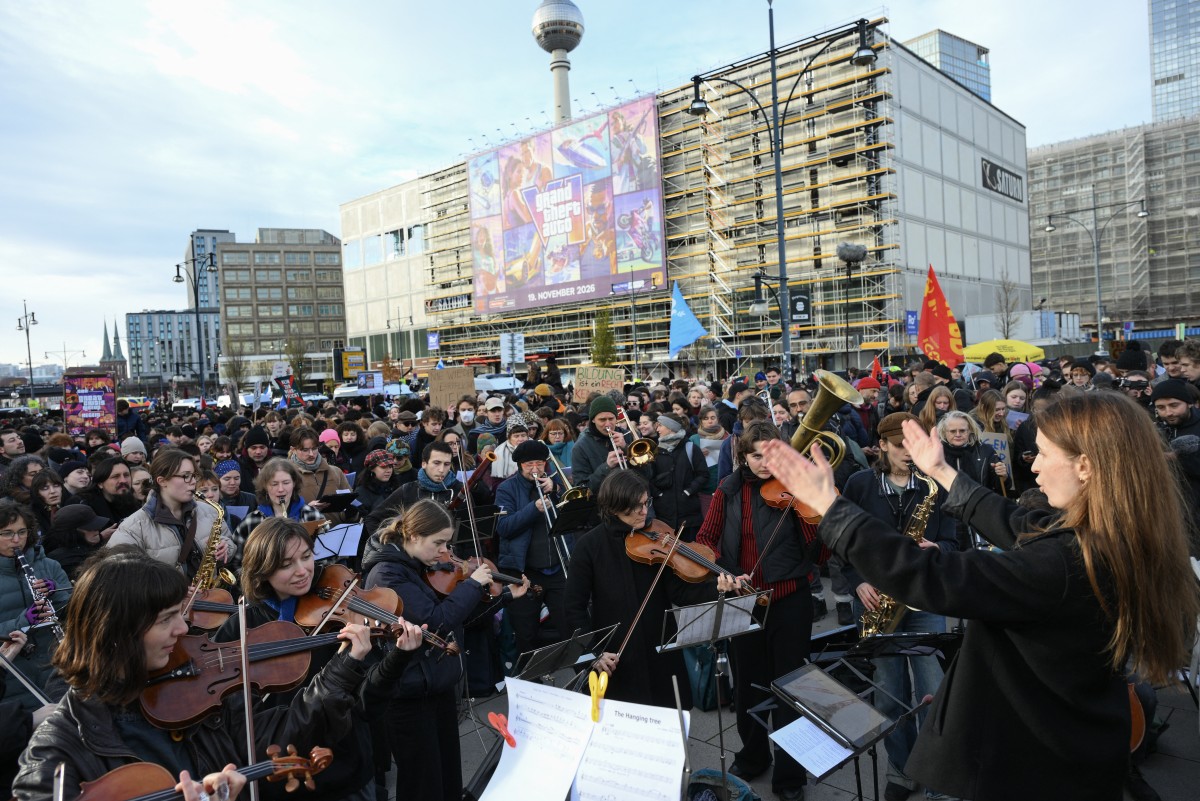
An orchestra performs during a “GenZ regelt!” demonstration in Berlin. (Photo by RALF HIRSCHBERGER / AFP)
Students and trainees, though, and those in their 20s? On the face of it, certainly less.
After some ill-fated experiments with tuition fees in the 2000s, all German states now once again provide free university teaching.
Germany’s profusion of educational institutions means that those looking to pursue a degree – or, indeed, something else – are spoiled for choice, especially if they’re willing to move.
And for all the complaints: yes, there are still flatshare rooms to be had (maybe just not in the trendiest areas).
READ ALSO: The German cities with the most and least expensive student housing
Then again, everything in life is relative. And if you look at all the indicators, things have been getting worse for school-leavers and twenty-somethings for a good few years now.
The fact that the decline is starting from high levels of state funding and personal choice doesn’t make it any easier for those on its sharp end. And “sharp” is just the word for the cuts facing colleges and universities – Bochum, the brutalist symbol of Germany’s optimistic post-war expansion in higher education, is apparently nearing bankruptcy.
Then there are job prospects after graduation or training: while still better than in France – or indeed most neighbouring countries – they are declining.
Youth unemployment in Germany is double what it was before Covid…and Ukraine…and AI.
Once again, the fact that it’s doubled from “only” around 2.5 percent to north of “just” five percent, while it’s double-digits in many European countries, doesn’t make it any better for those missing a good start into working life.
Especially not those who have done everything right and are now facing problems they never thought they’d have. Because, yes, even those with degrees are now having trouble as AI eats away at entry-level knowledge worker positions.
READ ALSO: Are young people in Germany better off in a traineeship or university programme?
And here, the anger of those under 30 really is utterly justified.
Of course none of us can stop the march of technology. But the choices being made in organisations – like ‘Why hire a trainee when we can just use ChatGPT?’ – are taken by those of my age (40-ish) and older.
It feels like a classic case of “I’m alright Jack, pull up the ladder”, or as it is said in German: “Nach mir die Sintflut!” (Literally, “After me, the flood”).
Speaking of floods, another totally understandable source of generational tension is the climate.
I will probably be alive to see the polar ice caps melt completely in summer – and that’s bad enough. On current projections, though, there’ll still be ice on Greenland and sea-levels within a couple of yards of where they are today when I shuffle off this mortal coil.
Anyone planning to potentially be alive much past 2075, though – i.e. anyone under 30 now – had better have their rainboots and flotation devices ready.
READ ALSO: Germany can expect more intense weather extremes, warns climate expert
And as if that weren’t dystopian enough, they’re coming of age within a few hundred clicks of a warzone. Hence why what was once Greta Thunberg’s “school strike for climate” has now become a school strike against military conscription (Streik Gegen Wehrpflicht).
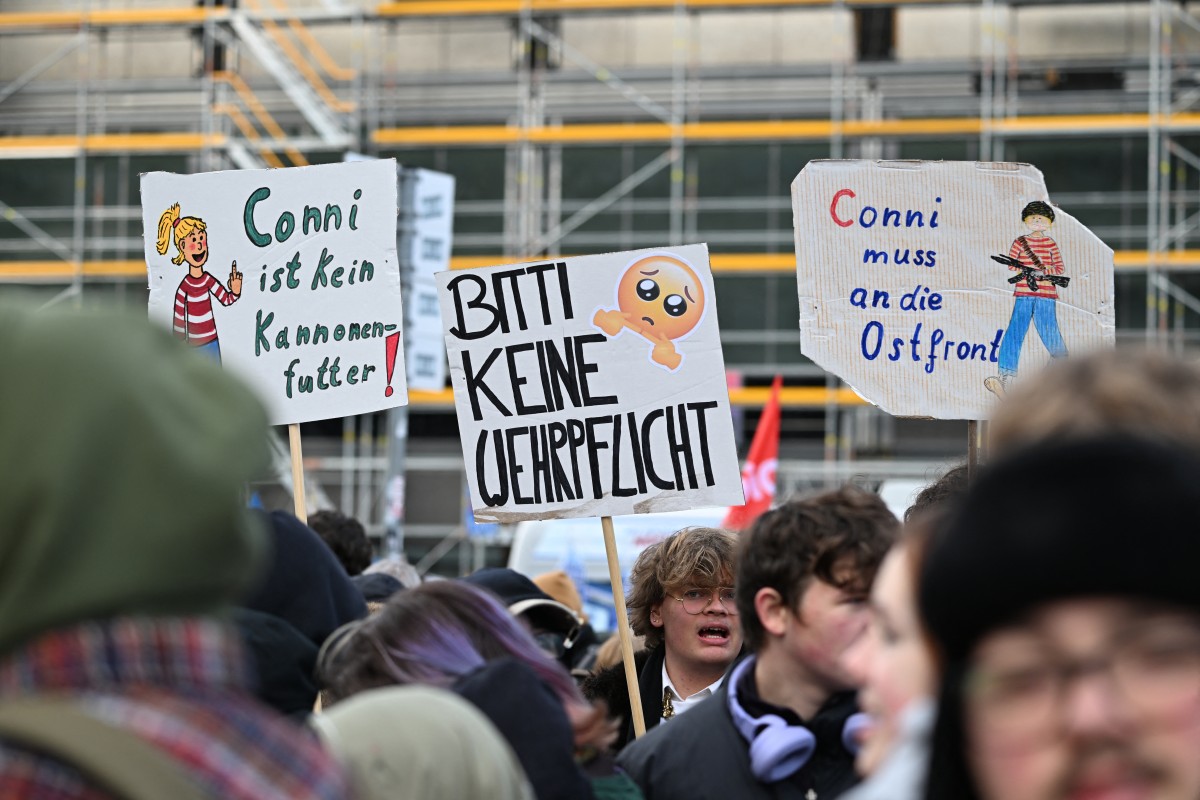
Protesters hold placards reading (L-R) “Conni is not cannon fodder”, “Please no conscription” and “Conni has to go to the Eastern front” at a demo in Berlin on November 20th. (Photo by RALF HIRSCHBERGER / AFP)
Of course these kids don’t want to be forced into uniform and onto the drill ground! Who would? Many of those out demonstrating today will say something along the lines of: “Why should I be asked to die defending a country that doesn’t look after me?”
My personal take there is that’s a quite limited way of looking at things. If you want to see a country that really doesn’t give two hoots about its Gen-Z, try Russia. Anyone who doesn’t want to do military service might consider what life under a Europe dominated by Vladimir Putin and his ilk would look like.
Then again, it’s now my privilege to say that: conscription, historically, has been limited primarily to those under the 40-mark. So it’s easy to say that I’d willingly take up arms: I’ve got a bad back and a gammy hip now. How much use would I be?
All of which to say, I’ll be wishing good luck to the demonstrators today. If I were their age, I’d also be angry.
And as long as they keep their France-inspired protest to rousing choruses – rather than, say, burning down town halls – I might just join them next time. That’ll make me something of an Alt-Zweitausendsechsundzwanziger, I guess. Operative word: “alt”.
Disclaimer : This story is auto aggregated by a computer programme and has not been created or edited by DOWNTHENEWS. Publisher: thelocal.de