- Vijay’s choices could reshape Tamil Nadu’s political landscape.
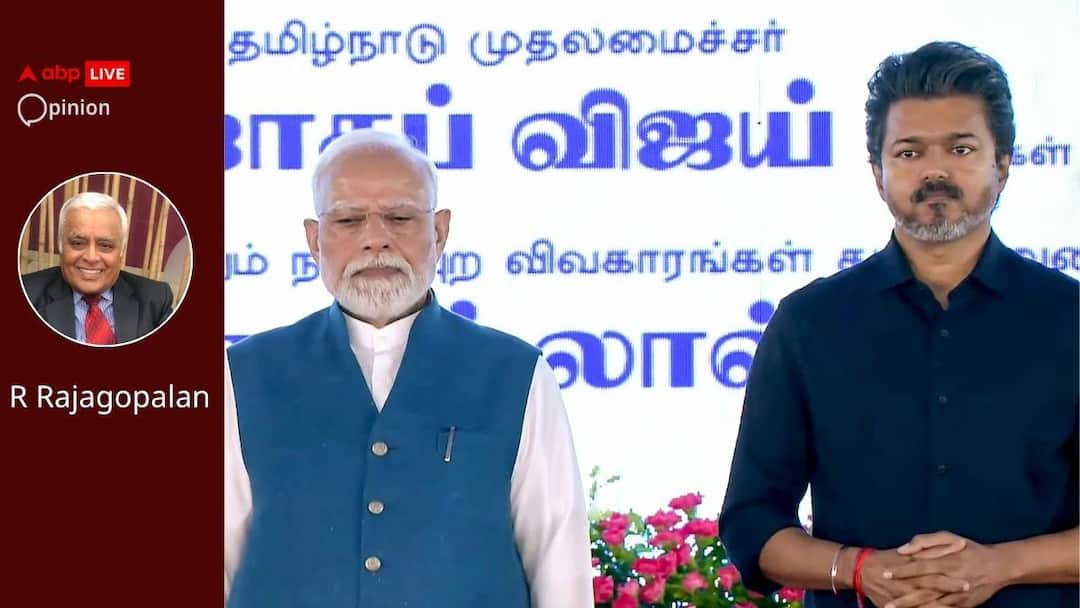
In the span of three days, Tamilaga Vettri Kazhagam (TVK) leader and Tamil Nadu Chief Minister C Joseph Vijay interacted with three prominent figures in Indian politics: Prime Minister Narendra Modi, Leader of the Opposition Rahul Gandhi and Andhra Pradesh Chief Minister N Chandrababu Naidu, a key National Democratic Alliance (NDA) leader.
These interactions could offer Vijay Joseph valuable insights into national politics, with perspectives drawn from the country’s top political leadership. Whether these conversations will encourage him to expand his political ambitions beyond Tamil Nadu remains an important question.
Rahul Gandhi may have discussed the Congress party’s opposition to the BJP-led Union government’s positions on issues such as delimitation and the Uniform Civil Code (UCC). Modi, meanwhile, would have offered his perspective on dealing with the Opposition and its political strategies. Chandrababu Naidu, with his experience in coalition politics and administration, could provide Vijay with a different set of political lessons.
Vijay Joseph’s Quiet Political Strategy
For Vijay, these exchanges could serve as a political booster, particularly as a fourth political force seeks to establish itself in Tamil Nadu. An image-building exercise also appears to be taking shape in the Hindi-language media in northern India.
Vijay has largely avoided aggressive political posturing. His quiet, measured and non-confrontational approach, along with his conduct during his first 150 days in office and in the state Assembly, could become political assets. His sharp responses to his principal rival, former Deputy Chief Minister Udhayanidhi Stalin, also form part of his political profile.
These attributes have emerged through Vijay’s own political journey. His larger ambition, however, appears to extend beyond challenging the DMK. By establishing a formidable political alternative led by a personality from the film industry, he could also be setting a precedent for future leaders emerging from cinema.
Kollywood’s Growing Influence On Tamil Nadu Politics
The growing dominance of film personalities in Tamil Nadu politics is a phenomenon that Vijay has helped revive. His political rise has reopened the question of whether a party outside the traditional Dravidian political framework can govern the state.
Vijay’s approach has two broad objectives. The first is to challenge the influence of the DMK’s first family over the Tamil film industry. Red Giant Movies, associated with the family, has operated across film production, financing and distribution. Its influence has also been a subject of discussion in the industry’s distribution and theatrical exhibition networks.
The second objective is to weaken the DMK’s political dominance. Digital platforms, over-the-top (OTT) services and social media have given film personalities new ways to reach audiences directly, reducing their dependence on traditional industry networks. These changes have proved particularly useful to Vijay in building his public profile and challenging rivals.
ALSO READ | ‘Victory Is Certain’: Vijay Takes Swipe At DMK After Maduranthakam, Dharapuram Bypoll Wins
Film Stars Turn Towards Social Welfare
Tamil Nadu’s political future could increasingly revolve around the influence of cinema personalities. Several established actors, including Ajith Kumar, Dhanush, Vijay Sethupathi, Suriya, Sivakarthikeyan, Sarathkumar, Karthi and Vikram, have been associated with discussions about public service and social welfare initiatives beyond their film careers.
Such initiatives include support for educational institutions, hospitals and financially disadvantaged families in remote villages. The growing emphasis on social outreach reflects the approach Vijay has adopted to build a public following beyond his film audience.
Even during the late 1990s, when Rajinikanth and Kamal Haasan dominated Tamil cinema, Vijay had begun helping students pursue higher education. That commitment attracted attention and offered a model for newcomers to the film industry, many of whom later used their fan clubs to organise welfare activities.
The next generation of Kollywood personalities could therefore reshape the state’s political landscape, potentially challenging the dominance of Dravidian ideology and limiting the space available to national parties such as the Bharatiya Janata Party (BJP) and the Congress. The question is whether Tamil Nadu is moving towards a political culture increasingly driven by cinema and its stars.
From MGR To Vijay: A Familiar Political Route
Tamil Nadu has a long history of film stars entering politics. M G Ramachandran, popularly known as MGR, formed the All India Anna Dravida Munnetra Kazhagam (AIADMK) on October 17, 1972, after breaking away from the DMK. His political appeal rested heavily on welfare measures for the poor and the principles of Dravidian politics.
More than five decades later, actor-turned-politician C Joseph Vijay launched the Tamilaga Vettri Kazhagam on February 2, 2024. His entry raises a question that has followed Tamil Nadu politics for decades: does the growing attraction of film personalities to political power signal a decline in the appeal of the state’s six-decade-old Dravidian political tradition?
If the TVK government consolidates its position, established political leaders such as M K Stalin and Edappadi K Palaniswami, along with their party organisations, could face a significant challenge. Some senior DMK and AIADMK leaders are concerned about the prospect of cinema personalities occupying an expanding share of the political space traditionally held by party cadres and established leadership.
ALSO READ: OPINION | One Protest, Many Fault Lines: Can INDIA Bloc Survive Till 2029?
Is Dravidian Ideology Losing Its Hold?
The rise of cine politics also raises a broader ideological question: could the influence of cinema culture weaken both Dravidian and Hindutva politics? The answer, from this perspective, is yes.
The Justice Party, formally known as the South Indian Liberal Federation, emerged in the Madras Presidency around the beginning of the 20th century. Its central concerns included the advancement of non-Brahmin communities, social justice and communal representation. These ideas helped shape the political tradition that later evolved into Dravidian politics.
Over time, however, the ideological framework underwent significant changes. E V Ramasamy, popularly known as Periyar, established the Dravidar Kazhagam. Later, C N Annadurai, the DMK’s founding leader, moved away from the demand for a separate Dravidian state. MGR’s formation of the AIADMK in 1972 introduced another political strand, while his emphasis on welfare and religious practices also influenced the state’s political culture.
The subsequent political phases under J Jayalalithaa and, later, M K Stalin further changed the relationship between Dravidian politics, religion and public life. During Stalin’s tenure, even DMK cadres have been seen visiting temples. Vijay’s political emergence now presents another challenge to the traditional ideological framework.
Vijay’s Cabinet And The Question Of Religious Identity
Vijay has also inducted two Brahmin faces into his ministry, while the TVK’s policy document is described as accepting the worship of God, a departure from the traditional position associated with Dravidian rationalism.
This raises another question: could the shift towards a more flexible political identity encourage other film personalities to embrace Hindutva? Rajinikanth has been associated with such a political trajectory, while Dhanush, his estranged son-in-law, is directing a Tamil film titled Om. His style of greeting and references to ‘Om Namah Shivaya’ have also drawn attention.
Vijay’s political influence, viewed from these different perspectives, extends beyond his own electoral ambitions. His emergence has prompted fellow film personalities to reconsider their relationship with politics, social welfare and the ideological traditions that have shaped Tamil Nadu for decades.
The larger question is whether Vijay Joseph will remain focused on consolidating his position in Tamil Nadu or eventually seek a role on the national political stage. His interactions with Modi, Rahul Gandhi and Chandrababu Naidu may provide useful lessons, but the direction of his ambitions will ultimately determine whether he becomes a state-level challenger or a national political force.
(R Rajagopalan is a veteran journalist based in New Delhi)
[Disclaimer: The opinions, beliefs, and views expressed by the various authors and forum participants on this website are personal and do not reflect the opinions, beliefs, and views of ABP News Network Pvt Ltd.]
Disclaimer : This story is auto aggregated by a computer programme and has not been created or edited by DOWNTHENEWS. Publisher: abplive.com