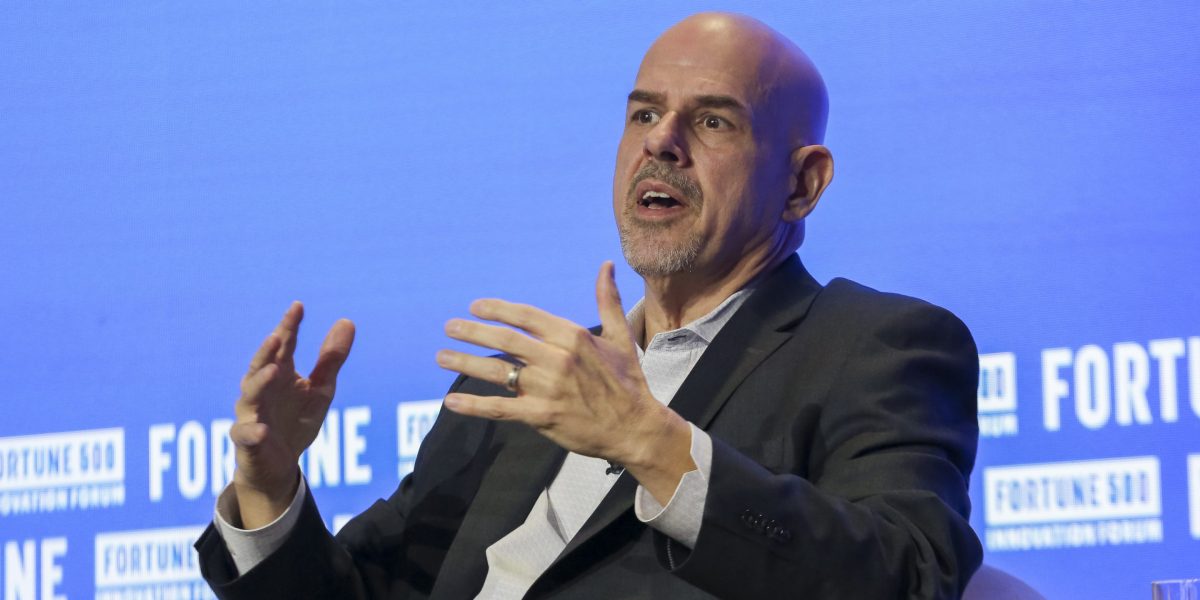
Good morning on Day 2 of the Fortune 500 Innovation Forum in Detroit. You can check out the videos of yesterday’s on-stage interviews here.
One theme that ran through many conversations was the need to invest in infrastructure. That means the physical kind, from data centers and factories to the wires and networks that have failed spectacularly in recent days, with major banks being the latest to experience outages yesterday. It also means investing in the policies, talent, education, research and other forms of infrastructure that build trust and conditions for growth.
On the physical side, the diagnoses varied. Honeywell CEO Vimal Kapur blamed decades of layered automation, saying “humans are not able to keep up with it.” Delta CEO Ed Bastian pinned Friday’s ground stop on “a combination of faulty equipment, coupled with human error.” Kraft Heinz CEO Steve Cahillane talked about another physical reality, which is the need to “be hyperlocal” in its supply chains, building in redundancy amid tariffs, local tastes and the reality that “Brand America is not as strong as it once was.”
Of course, one of the biggest challenges to building out the physical infrastructure around AI is the public backlash against it. People voted overwhelmingly against data center development in local ballot contests. Oracle co-CEO Mike Sicilia said the tech industry made a “classic mistake” in how it sold data centers to the towns asked to host them by “flying people in to say, ‘I’m from HQ, and I’m here to help.’ That’s not how we’re gonna win hearts and minds.”
On policy, the message for Washington is that government needs to get to work to tackle tough problems. Sen. John Hickenlooper (D-Colo.) told me the midterms weren’t a mandate for Democrats but “more of a to-do list, almost an audition.” He wants American AI to be “the best in the world,” with guardrails like those for airplanes. U.S. Steel CEO David Burritt urged Democrats to “work on what people think is important” rather than get mired in battles with the president. Michigan Governor-elect Jocelyn Benson said she hopes to work with Trump on tariffs on Canadian imports, which she says have cost the average Michigan household $5,600. Neil Bradley, the top policy officer at the U.S. Chamber of Commerce, is concerned that the affordability crisis may prompt a political push for damaging price controls.
The Trump administration does know how to move fast. Airbnb co-founder Joe Gebbia, now the U.S. chief design officer, said his small team took a federal retirement process that stored mountains of paper files in a mine and moved it online for $1.5 million. The potential to transform government, industry, and society at a rapid pace right now can be breathtaking. It’s never been easier to move fast. One reason we invited Kraft Heinz’s Cahillane, NYSE President Lynn Martin, and Stanley Black & Decker CEO Chris Nelson to kick off the forum with this debate about how they’re innovating iconic brands is that the true test of innovation is whether you can last.
Contact CEO Daily via Diane Brady at diane.brady@fortune.com
Top leadership news
Nvidia faces first earnings report since Huang’s departure
Nvidia is expected to report $109.3 billion in quarterly revenue Tuesday, up about 92% from a year earlier, in its first earnings report under interim CEO Colette Kress. Investors will be watching whether the company maintains its growth forecast and how Kress addresses the controversial management changes, rising chip costs, and Nvidia’s investments in its own customers.
Goldman Sachs says AI job losses are delayed, not avoided
Goldman Sachs expects layoffs to remain low through 2027, per an outlook published over the weekend, with AI having a bigger effect on jobs in later years. Its economists argue that companies are more likely to replace workers with technology during an economic slowdown, though they are not forecasting a recession next year.
Democrats face pressure to act on data center backlash
After winning control of Congress, Democrats face pressure to tackle complaints about data centers’ electricity costs, water use, and job impacts. Options include construction pauses, congressional investigations, and state rules requiring companies to pay for the power grid upgrades they need rather than passing those costs on to households.
The markets
S&P 500 futures are down 0.37% this morning. The last session closed down 1.92%. The STOXX Europe 600 was down 0.85% in early trading. The U.K.’s FTSE 100 was down 0.80% in early trading. Japan’s Nikkei 225 was down 1.34%. South Korea’s KOSPI was down 2.59%. China’s CSI 300 was down 0.08%. Hong Kong’s Hang Seng was up 1.03%. India’s NIFTY 50 was up 0.38% today. Bitcoin is at $64k.
Around the watercooler
Days after Microsoft and the FAA went dark, Chase and Wells Fargo customers can’t get to their money by Catherina Gioino
‘Steve Jobs ruined everything with the iPhone’: Tech billionaire Palmer Luckey gets real on what really killed the 10,000-hour rule by Nick Lichtenberg
Sam Bankman-Fried’s former employer Jane Street poised for $35 billion windfall from purchase of Anthropic shares in FTX bankruptcy by Camila Grigera Naón
CEO Daily is curated and edited by Joseph Abrams, Jason Ma, Claire Zillman, and Lee Clifford.
Disclaimer : This story is auto aggregated by a computer programme and has not been created or edited by DOWNTHENEWS. Publisher: fortune.com