A plant may look still, but beneath its leaves and stems, it is constantly changing. Roots are extending through the soil, stems are growing towards light, and cells are responding to changes in their surroundings.
The problem, more than a century ago, was that these movements were simply too slow for the human eye to observe.
That is where Indian scientist Jagadish Chandra Bose stepped in.
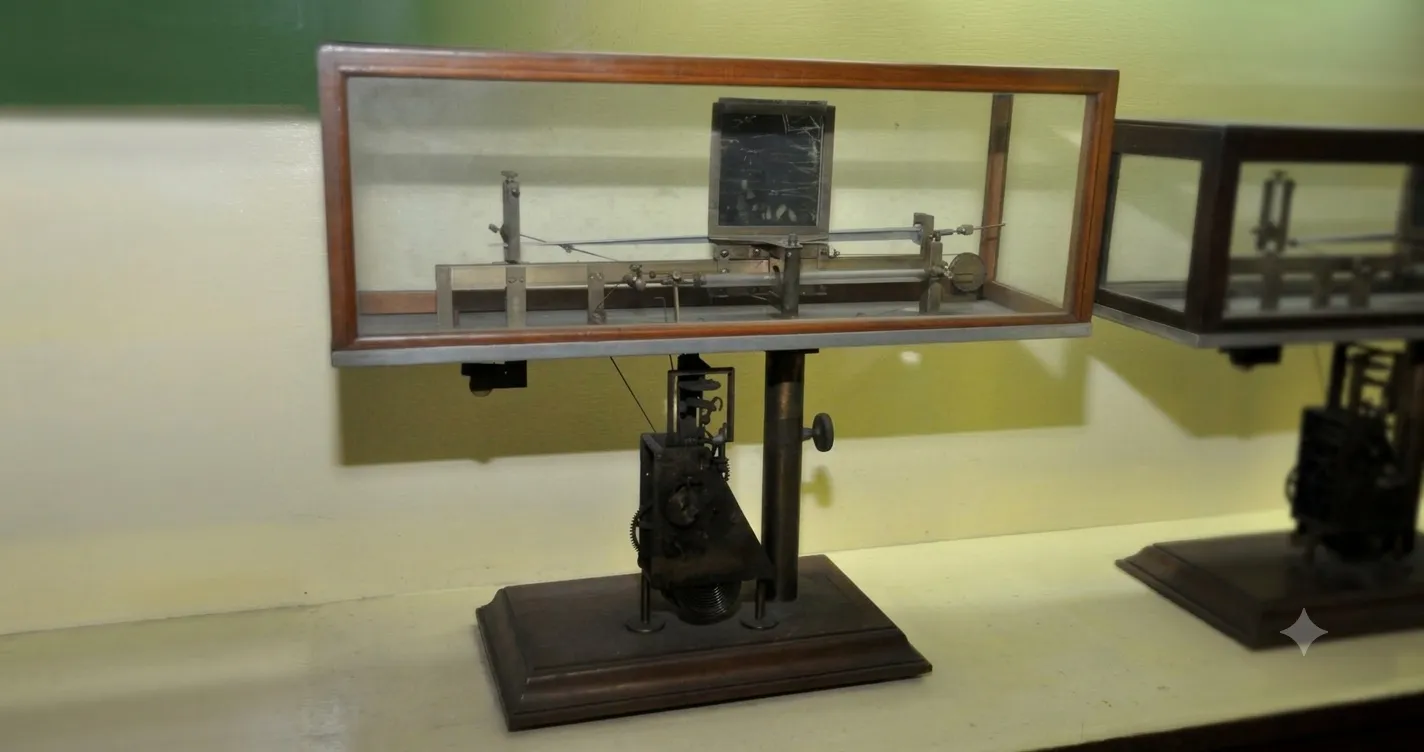
In the early 20th century, Bose developed the crescograph, an ingenious instrument that could magnify the growth of a plant thousands of times and record movements that were otherwise almost impossible to see. His work opened up a new way of studying plants, allowing scientists to investigate how they responded to light, temperature, chemicals and other stimuli.
How do you record a movement this tiny?
Plant growth is deceptively slow. In his later work, Bose noted that the average rate of growth could be as little as about 1/100,000 of an inch per second.
At ordinary magnification, researchers could therefore wait for hours before a measurable change became apparent. But over such long periods, factors such as temperature and light could also change, making experiments harder to control.
Bose wanted a way to shorten this observation period.
His answer was the crescograph, a name derived from crescere, meaning “to grow”. The instrument used delicate mechanical and optical arrangements to amplify tiny movements at the growing tip of a plant.
In his high-magnification version, one lever magnified the movement 100 times, while a second lever magnified it another 100 times. Together, they produced a 10,000-fold magnification. The movement could then be recorded as a series of marks, making the plant’s growth visible as a measurable pattern rather than something that had to be guessed from observation.
What drew a physicist towards plants?
Bose, born in Mymensingh on 30 November 1858, was trained as a physicist and had already earned international recognition for his work on electromagnetic waves before turning much of his attention to plants. He worked at Presidency College in Calcutta and later established the Bose Research Institute.
His interest in plants grew from a larger scientific question: whether living and non-living matter might respond to external stimuli in comparable ways.
/filters:format(webp)/english-betterindia/media/media_files/2026/10/01/jagdish-chandra-bose-2026-10-01-16-09-11.png)
He began developing sensitive instruments to detect responses in plants, studying species such as Mimosa pudica, whose leaves move when touched, and Desmodium gyrans, known for the rhythmic movement of its leaves. His experiments examined electrical and mechanical responses in plants and how those responses changed under different stimuli.
The crescograph became one of his most striking tools because it addressed a basic scientific limitation: how do you measure a movement that you cannot see?
A machine sensitive enough to watch a plant grow
Bose continued refining the instrument, eventually developing a magnetic crescograph that reduced some of the problems caused by friction in mechanical systems.
The principle was remarkably sensitive. A tiny movement in the plant could disturb a carefully balanced magnetic system, producing a much larger movement that could be recorded. Bose reported magnifications reaching millions of times with magnetic amplification, allowing extraordinarily small changes in plant growth to be detected.
By 1917, Bose had submitted his work on the high-magnification crescograph to the Royal Society. The research was published in the Proceedings of the Royal Society B in 1919. A contemporary Royal Society record describes the instrument as part of Bose’s wider investigations into the growth and movement of plants.
Understanding how plants respond
The significance of the crescograph was not simply that it made a plant appear to grow faster.
It gave scientists a new way to ask questions. Instead of observing a plant only through visible changes, researchers could measure tiny changes in growth and compare how those changes responded to different conditions.
/filters:format(webp)/english-betterindia/media/media_files/2026/10/01/jagdish-chandra-bose-2026-10-01-16-12-39.png)
Bose’s work helped establish a more quantitative approach to studying plant physiology, alongside his investigations into electrical responses and plant movements.
More than a century later, the principle behind the invention still feels familiar: when something is too small or too slow for our senses, better instruments can reveal what is happening.
Bose’s crescograph did exactly that for plants. It turned almost invisible growth into something measurable, recorded and open to scientific investigation.
This story is part of “India Invented This?” — The Better India’s weekly trivia series that uncovers the Indian minds, ideas and innovations behind inventions that have shaped the way we live. From ingenious solutions created by scientists and engineers to technologies developed in response to some of India’s biggest challenges, each story goes beyond the invention to explore the problem it solved, the impact it created and why it still matters today.
Sources:
‘Jagadish Chandra Bose’, by Britannica
Disclaimer : This story is auto aggregated by a computer programme and has not been created or edited by DOWNTHENEWS. Publisher: thebetterindia.com