
Tonga’s Prime Minister has joined a chorus of regional leaders condemning China’s testing of a nuclear-capable long-range missile in the Pacific this week as his nation weighs whether to join Fiji and Australia in a new military alliance.
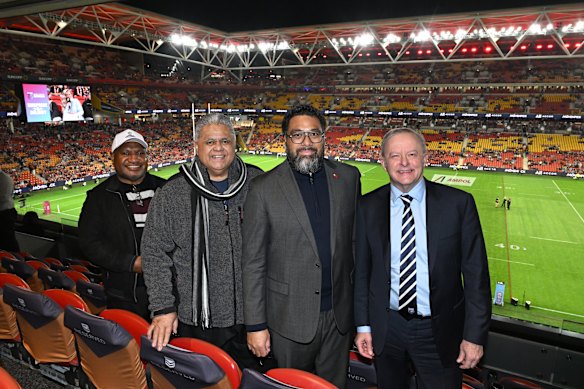
Lord Fatafehi Fakafānua, who attended the State of Origin decider with Prime Minister Anthony Albanese in Brisbane this week, said he was hopeful Australia and Tonga could move quickly strike an ambitious treaty, possibly by the end of the year.
While China gave notice Tonga notice of the missile launch, Fakafānua said that “any escalation to militarise the ocean is something that we join the rest of the Pacific family in not supporting”.
“I think it’s created tension in the Pacific, and some of my colleagues in the Pacific have been quite vocal about that,” he told this masthead in an interview in Sydney.
“So let’s just say it’s caused a bit of a stir.”
Albanese said earlier this week that the Pacific Islands Forum was drafting a “very strong” condemnation of the test firing, which he labelled a “provocative act”.
Solomon Islands Prime Minister Matthew Wale has said China’s test is “not something a friend does” and Tuvalu’s Prime Minister Feleti Teo expressed “grave and serious concern and disappointment” about the missile launch.
Palau’s President Surangel Whipps Jr, who will host next month’s Pacific Island Forum leaders meeting, said he was “shocked and deeply concerned about this kind of behaviour”.
Australia and Tonga are seeking to finalise a comprehensive treaty known as the Kaume’a Ofi (close friends) agreement, which the nations last year said would be “transformational” and “write the next chapter of regional integration”.
It would follow recent pacts Australia has struck with Fiji, Papua New Guinea, Vanuatu, Tuvalu and Nauru.
Fakafānua said he expected the pact would focus on education, health and defence, including maritime awareness, disaster preparedness and climate change adaptation.
“We’re quite ambitious…It could be by the end of the year,” he said when asked about timing, adding officials from both countries would hold negotiations on the details of the pact next month.
Australia and Fiji have flagged they would welcome more Pacific nations with defence forces joining the Ocean of Peace military alliance they signed this week. Tonga would be a logical addition as one of the few Pacific nations – alongside New Zealand and Papua New Guinea – that has a defence force.
While New Zealand has expressed enthusiasm about joining the alliance, Fakafānua said he could see “pros and cons” about signing up. The Australian Defence Force could come to Tonga’s aid in a crisis without the need for a formal alliance, he said.
Asked whether he supports the Australian government’s position that policing and security matters should be handled by Pacific nations themselves rather than outside nations such as China, Fakafānua said: “I think when there’s a fracturing international order…we fall back on our neighbourhood for stability, and more so now regionalism is very important, and it’s good to see the Pacific family coming together.”
He continued: “Australia is a sort of a big brother in the neighbourhood, and we might have points of differences amongst ourselves, but like family, we tend to stick together more than we don’t.”
As a regional bloc, he said the Pacific was “a force to be reckoned with in the international sphere”.
Chinese foreign ministry spokesperson Mao Ning told a press conference in Beijing the test was a “routine arrangement” in China’s annual military training programme.
“It is consistent with international law and customary international practice and is not directed at any specific country or target,” she said.
Lachlan Strahan, a former Australian high commissioner to the Solomon Islands, said Beijing had damaged its reputation in the Pacific with the “tone deaf” missile test, which it fired with only a few hours of warning.
“Beijing can be very skilled at friendly diplomacy. They can flatter and make people feel special; they use a lot of highfaluting language about peace, the equality of states and sovereignty that appeals to the Pacific,” he said. “That all looks pretty hollow now.”
Cut through the noise of federal politics with news, views and expert analysis. Subscribers can sign up to our weekly Inside Politics newsletter.
 Matthew Knott is the foreign affairs and national security correspondent for The Sydney Morning Herald and The Age.Connect via X, Facebook or email.
From our partners
Disclaimer : This story is auto aggregated by a computer programme and has not been created or edited by DOWNTHENEWS. Publisher: www.smh.com.au