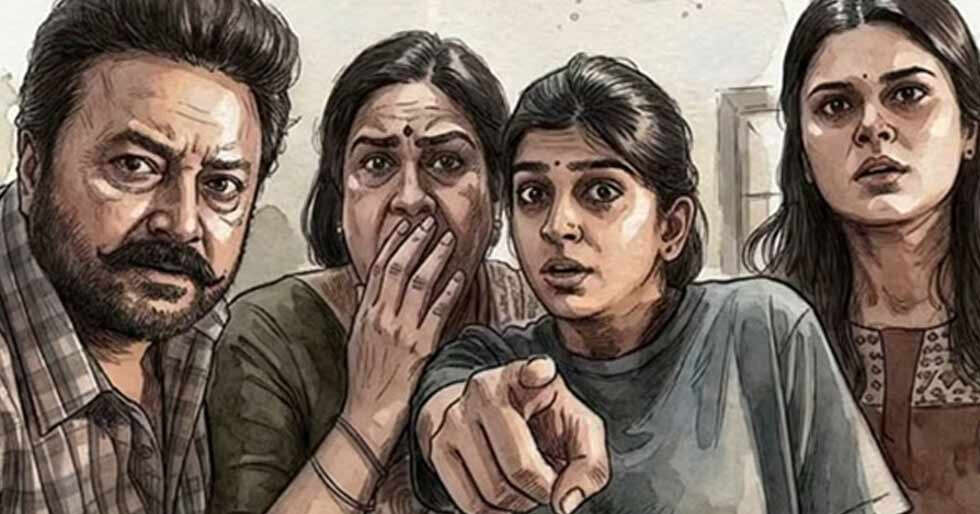
For a filmmaker whose cinema has largely revolved around family bonds, parental anxieties and rural social dynamics, Pandiraaj’s Parimala and Co feels like an attempt to shake things up. On paper, the film has all the ingredients of an entertaining black comedy. There is an ordinary middle-class family, an accidental crime, a growing pile of lies, and a series of increasingly absurd situations. It is a setup that promises equal measures of suspense and humour. Having said that, Parimala and Co never quite finds the consistency needed to fully capitalise on its premise.
The story centres on Parimala (Jayaram), a cautious middle-class man living with his wife Sudhandhiram (Urvashi) and their daughters. When a murder becomes connected to their household, the family finds itself caught in a situation that rapidly spirals beyond its control. Secrets multiply, suspicions grow and every attempt to fix one problem creates two more in its place. The setup has all the ingredients of an effective black comedy, where humour emerges from the desperation of ordinary people dealing with extraordinary circumstances.
What immediately works in the film’s favour is the family itself. Pandiraaj remains one of the more reliable chroniclers of domestic dynamics in Tamil cinema, and the interactions inside this household feel lived-in. The arguments, frustrations and fleeting moments of affection carry a natural rhythm that prevents the characters from becoming mere pieces in a plot machine. Even when the narrative begins to wander, the family remains engaging enough to keep us invested.
A large part of that credit belongs to Jayaram and Urvashi. Jayaram approaches Parimala not as a caricatured everyman but as someone genuinely overwhelmed by circumstances. His performance is built on understatement, allowing the comedy to emerge from reactions rather than exaggerated antics. Urvashi, meanwhile, does what she has done for decades; elevate material through sheer instinct. Whether she is reacting to a crisis or participating in one, she gives the film much of its comic energy. The chemistry between the two actors is effortless, and the film is at its strongest whenever it simply lets them interact.
Sanjana Krishnamoorthy and Ananthika Sanilkumar fit comfortably into the family dynamic, contributing to the film’s lived-in quality. Mysskin, playing the investigating officer, brings an understated gravitas that contrasts nicely with the escalating absurdity around him. Even when the screenplay struggles to sustain tension, his presence lends the procedural portions some much-needed weight. Yogi Babu operates in familiar territory, delivering a few amusing moments in a limited role, while Sandy makes for an effective catalyst for much of the chaos that follows. The cast, collectively, ends up doing far more heavy lifting than the screenplay.
The issue lies in how the film understands black comedy. For the genre to work, tension and humour must feed off each other. Here, they often feel like parallel tracks. There are stretches where the panic of the situation generates genuine laughs, particularly in the first half. But there are equally long stretches where scenes seem to be chasing humour rather than discovering it organically. Several jokes arrive with the force of intention rather than wit.
The screenplay also has a tendency to repeat itself. The first half benefits from the novelty of the central situation and the uncertainty surrounding where things might go next. Once the narrative settles into a pattern of concealment and confusion, however, the film begins to lose momentum. Instead of escalating the stakes in increasingly inventive ways, it circles around. The result is a second half that feels considerably longer than it needs to.
What’s frustrating is that the film occasionally hints at sharper ideas beneath the surface. There are moments where it seems interested in exploring guilt, fear and the moral compromises that ordinary people make when cornered. Yet those ideas remain largely underdeveloped. Whenever the film edges towards something more ambitious, it retreats into safer territory.
George C Williams’ cinematography serves the story efficiently without calling attention to itself, while Foxn’s score supports both the comedic and thriller elements effectively. The craft is rarely the problem here. The film’s limitations stem primarily from the writing.
The climax attempts to bring together the film’s various strands while introducing a broader social message. While the intention is commendable, the payoff feels less impactful than the journey leading up to it. One leaves the film with the sense that the premise deserved a sharper, more confident screenplay.
Parimala and Co works best when it leans into the chaos of an ordinary family navigating extraordinary circumstances. Jayaram and Urvashi bring warmth, humour and credibility to the proceedings, ensuring that the film remains engaging even when the writing loses its way. While Pandiraaj’s attempt at black comedy doesn’t always land with the precision the genre demands, the film’s strong performances and relatable family dynamics give it enough charm to make the journey worthwhile.
Also Read: Karuppu Storms Past Rs 300 Crore Worldwide, Becomes Suriya’s Latest Blockbuster
Disclaimer : This story is auto aggregated by a computer programme and has not been created or edited by DOWNTHENEWS. Publisher: filmfare.com