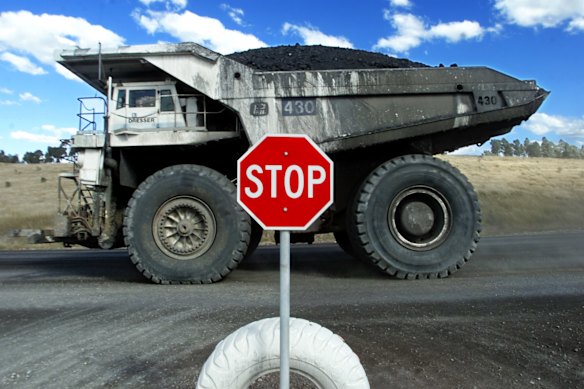
The decision by the High Court to rule as invalid the expansion of a major coal mine is welcomed (“Ruling rocks coal mine cases”, October 8). It is the first time there has been a ruling against the contribution of Australia’s fossil fuel exports to global greenhouse emissions. The two dissenting judges claimed that the NSW Independent Planning Commission had taken exported fossil fuels into account as the importers were signatories to the Paris Agreement. However, none of the nations that receive Australian coal are on track to meet the target of 2 degrees of global warming, let alone the forlorn, and now virtually abandoned, 1.5-degree target. As a consequence, pinning the justification of exports on the obligations of the importers to the Paris Agreement is totally meaningless. Roger Epps, Armidale
The High Court of Australia has just disallowed a 22-year expansion of the massive foreign-owned Mount Pleasant coal mine in the Hunter on climate grounds. The court saw that 98 per cent of the mine’s huge greenhouse gas emissions would occur when the coal is burnt overseas. Now the industry and the parties of the right are screaming for the law to be changed, so these massive emissions won’t need to be considered. They show no concern for the terrible effects of climate change to which this country is already and especially exposed. Nor do they care about climate change driving up the cost of living, or that when these companies can no longer sell their coal, they pull up stumps without any effort to transition the workers. The noise from the right is just that – opportunistic and politically motivated but dangerous noise. And Labor isn’t far behind in that race to the bottom. Rod Anderson, Earlwood
The High Court’s decision on the extension of coal mining in the Upper Hunter is a victory for the little people, not just of that region, but of the world. The mining industry and business will say “But what about jobs?” To which I reply, the land enclosures that occurred towards the end of the 18th century had people crying out about jobs, then along came the Industrial Revolution. As the world turns, jobs will come. Our planet needs protection from business and industry with blinkers on that only see what they want to see. My family is from the Hunter and my grandfather was a coal miner. He died in 1963 of lung cancer, and my family has hated the mines ever since.
Genevieve Milton, Dulwich Hill
The High Court’s excellent, science-based decision requiring NSW coal mines to account for their climate pollution should not be viewed as a shock. Rather, we should be shocked that the Albanese government has continued to approve new coal and gas projects despite their well-known climate costs. Australians expect governments to act in the public interest and safeguard the future. If that duty of care means anything, it must extend to protecting today’s children and future generations from worsening climate harm. Thank you to the brave community group who spoke up for us all. Larni Dibben, Glen Iris (Vic)
Spotlight on solar
While continuing to expand gas and coal production, Albanese wants to be thought of as a good neighbour by Pacific nations. He would be better making the claim for ordinary citizens with rooftop solar. Add home batteries and there’s the added benefit of firming the grid. Jim Allen, Panorama (SA)
If Herald readers are anything to go by, the Albanese government is indeed set to “COP it for Pacific diplomacy” (“PM’s bold statement at odds with record” and “Why Albanese will COP it for Pacific diplomacy”, October 8). The government’s thin veil of pretence of climate action is slowly unravelling as Anthony Albanese’s warnings about the urgency of climate action ring increasingly hollow in the Pacific and across Australia. Because our federal environment laws still fail to properly take climate impacts into account, it’s taken the High Court to place a pause on Labor’s steady stream of coal and gas approvals. Hopefully, this proves a turning point and a moment of clarity. A nation that claims to be part of the Pacific family cannot keep approving the very projects that threaten the region’s future. Australia needs a clear plan to move beyond dangerous and polluting coal and gas.
Amy Hiller, Kew (VIC)

Concrete invasion
A glossy brochure heralds the design for the Cammeray Parklands (“The ‘lush oasis’ being built next to Sydney’s busiest motorway,” September 1) to be restored by Transport for NSW. Overshadowed to the south by a large tunnel facilities building and obscured in the north by a giant cement retaining wall, the parklands are a poor substitute for the grassy slopes destroyed by the Warringah Freeway and tunnel construction. Catherine Turner, Cremorne
Fund the future
Your correspondent calls government-built EV chargers “socialising the costs of private needs” (“Private EV needs”, October 8). What about fuel tax credits, negative gearing, private health rebates and private school funding? John Matheson, Antechamber Bay (SA)
How silly could it get (“Tesla and power giants unite to oppose ‘EV charger tax’ plan,” October 8)? I don’t have a car but I do have solar panels and a battery. The common sense of using sunshine and wind to provide energy, plus the rapid take-up of electric vehicles – one in four new vehicles sold – lays bare the need for EV chargers in every street. Easy for roadside parked vehicles and no danger for pedestrians having to walk across power leads. When outlying areas like Gerringong were added to the metropolitan water supply, it made sense to spread the cost across the whole community. What would have been a huge burden to the small local population was negligible when it became metropolitan-wide. Now we should do the same to help electrify vehicles. Glenda Gartrell, Newtown
Government involvement in building EV chargers is not “socialism” if it is smart enough to make a modest profit by supporting this important, climate-friendly service. Philip Bell, Bronte
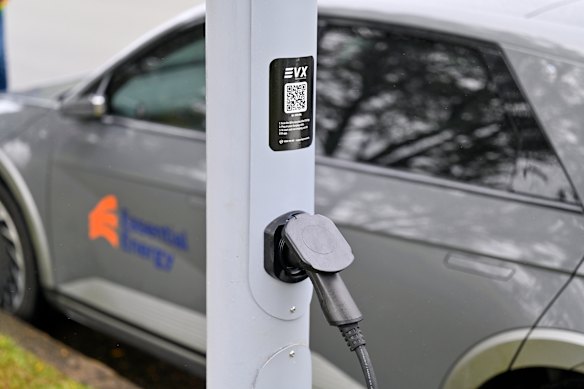
It sounds like a good idea to add a small amount to power bills to fund public EV chargers on power poles. Unfortunately, unless agreement with local councils can be achieved, it is doomed to be a waste of money. In my suburb there are already a number of EV chargers on power poles, all of which are unusable as the council has not marked the parking spaces for EV charging. The spots are therefore taken for most of the day. It also can take many hours to charge at the low 7kW rate most of these sites utilise. Another case of being “seen” to be doing something. Christopher Smith, Epping
Well-read
I am astounded that Vince Rugari (“Mary Fowler’s latest decision tells us something we should already know about her”, October 8) began his piece on Mary by quoting Maya Angelou. I am going to have to rethink my thoughts about sports journalists! It reminds me of the day when I was sitting at a Sheffield Shield game and discovered that a NSW fast bowler, waiting while his teammates batted, was reading a book. I mentioned it to one of the female players who were there too. She told me not to worry. It was probably a comic book. Brian Everingham, Engadine

If only Ivan Cleary hadn’t put Nathan on the field with a broken foot, as if the Panthers didn’t have a chance without him, we would all be spared this anguish. Jenny Stephenson, Wollongong
The great Scottish manager of Liverpool FC, the late Bill Shankly, is reputed to have said “Some people think football is a matter of life and death. I can assure you it’s more important than that.” I don’t think he was joking. My sympathy lies with Mary Fowler who, showing maturity beyond her tender years, clearly believes that there is a life beyond the football pitch. Nick Franklin, Katoomba
Urban destruction
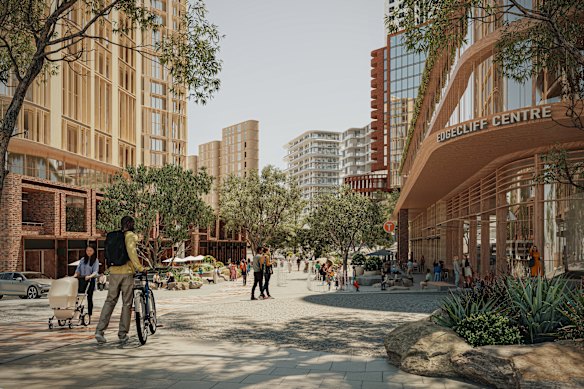
Economist Dominic Behrens and his abacus mentality are off-piste with his sermon over the state government’s misconceived rezoning of Edgecliff and Woollahra (“It’s time to home in on Woollahra as a housing solution”, October 8). Not one new piece of affordable housing will be built unless more housing is demolished. The scheme is urban destruction. Heritage values will be reduced, roads clogged, more overshadowing by 34-storey mega-towers with population bloat all adding to concerns. Behren’s idea for sharing the current local amenity is misconceived. You can’t share something by eroding it. If government wants to make housing more affordable it should consider tax breaks, lower stamp duty and land taxes, and providing a subsidised loan scheme for buyers. Andrew Woodhouse, Potts Point
Thursday’s Herald reported 52,201 dwellings have been started and 47,168 completed in the June quarter (“Home construction is up but still well short of government targets”, October 7). But how many represent an actual increase in dwellings? In my area, all new dwellings have simply replaced one being knocked down. It is time to calculate the true increase in dwellings, or we are never going to solve the shortage. John O’Connell, Old Toongabbie
Immigration hypocrisy
It is fascinating, but there seems to be this race to the bottom by politicians on immigration (“True cost of Taylor’s migration gamble”, October 8). I seem to remember there was a fleet of 11 ships that came to our shores with immigrants when there was no housing policy at all, and they also came with a host of criminals who provided very cheap labour. I’m sure our Indigenous people didn’t invite them, and had the same reaction as some of our politicians are now displaying. At least perhaps now we are starting to understand how our Indigenous people reacted to this early immigration policy. Ken Pares, Forster
We should all applaud Michael Myer’s sincere, intelligent and courageous views on migrants and their contribution to this nation (“Fear of foreigners should not pollute our politics”, October 8). Migrants come to Australia not to sponge on the state, or to undermine democracy, the rule of law or the English language, but to avail themselves and their children of the opportunities afforded by Australian values through hard work and dedication. They have significantly benefited all Australians by injecting the best features of their own cultures, helping to create a more lively and progressive future. Denial of this is both unhelpful and counterproductive.
Gordon Koch, Ashbury
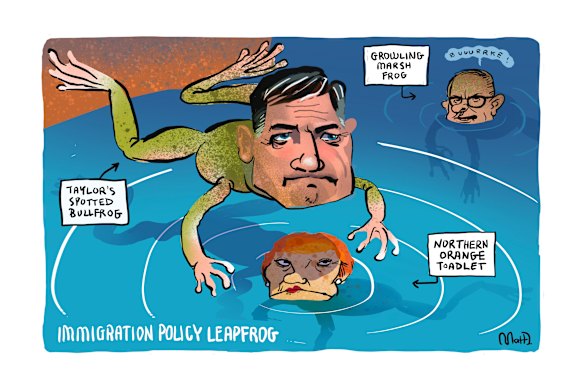
Indeed, “to demonise immigrants is essentially un-Australian”. Fear of immigrants comes from a mix of economic worries, cultural fears, and political messaging. Critically, the vast majority of our diverse immigrants have integrated well, respecting and abiding by the “primacy of Australian values and laws” and fair-go. While a small element of migrants strays from these values, let’s not throw the immigration baby out with the bathwater. It is a reasonable assertion that our diverse migrants have undeniably contributed significantly to help boost our nation’s economic and social progress. Like bees and flowers, both immigrants and Australia benefit from a generally positive interaction. Steve Ngeow, Chatswood
It was only recently that the lack of sufficient housing was blamed on the explosion of short-term holiday rentals in what was formerly residential stock. Now that gets no mention, and the blame is now entirely put on migration. Wonder what will next be found to be the cause of a shortfall in housing? We have short memories of claims made by politicians trying to win votes. Paul Foley, Caringbah South
Michael Sidney Myer’s last sentence is one of the essential truths of Australia – all modern mankind walked from Africa to make unique cultures that fitted the time and place where they stopped. Chris Hornsby, Warriewood
Safety or show?
Police are apparently now going to be seen at major events carrying assault rifles. (“NSW Police unveil armed response command in wake of Bondi terror attack,” October 8) In the context of the Town Hall protests, in particular, why do I feel so much less safe? In what situations will they think it is acceptable to point their cradled big guns at people? Greg McKay, Warrawee
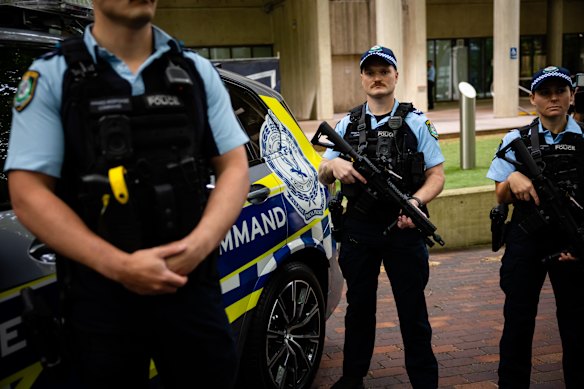
Police armed with assault rifles on our streets; the “welcome mat” pulled from under the feet of migrants; diminishing concern for the ravages of climate change. Somebody should tell Trump he only needs to look to America’s true and trusted ally Down Under to boast about his insidious influence spreading from his own diminished country across the cowering world. Kay Blanch, Kareela
Subsidy strain
John Howard introduced subsidies on private health cover to entice us out of the public system (“Coalition and Greens unite to revolt against Labor’s private health ‘pensioner penalty’”, October 7). Dropping subsidies will increase pressures on public health that is already under strain. Dr Denise Russell, Thirroul
Party secrecy
Linda Reynolds (“Nobody told me they were Brethren”, October 8) raises some important questions, not all addressed in the article. Yes, “campaigns require confidentiality”. Perhaps, but why does the campaign deserve confidentiality but the public, apparently, does not? How is democracy advanced by granting One Nation, the LNP or Labor carte blanche to deal with my information and share it with others to cold call on their behalf – including, allegedly, poorly vetted volunteers and/or religious organisations? Why are our political parties so special and, apparently, so trustworthy? Geoff Davidson, Ourimbah
Congratulations and thanks for one of the most powerful group of opinion pieces assembled in one edition (October 8). Former senator Lynda Reynolds calling on the Liberal Party to come clean about its links with the Exclusive Brethren (“Liberals must reveal Brethren’s influence”); Michael Myer reminding us of the contribution of his migrant grandfather, Sir Sidney Myer, who arrived in Melbourne as a penniless refugee, with little English, from the pogrom in tsarist Russia, and became the prototype of the successful entrepreneurial business migrants who followed, and a man of great compassion for the unemployed during the Great Depression – a powerful rebuke for the newly announced anti-immigration policies of the Coalition (“Fear of foreigners should not pollute our politics”). And Dominic Behrens called on the wealthy NIMBYs and councillors of Woollahra to share one of the most beautiful parts of Sydney with 20,000 new and younger residents whom the NSW government hopes will rejuvenate the suburb when they move into the new high-rise housing around the long-overdue train station (“Time to home in on Woollahra as a housing solution,” October 7). Keep up the high standard. I am now 98 and a daily reader of the printed Herald over breakfast. John Challis, Elizabeth Bay
Clean eating
Thank you for resolving a “discussion” my wife and I have been having for five decades (“Yes, you really need to wash fruit and veg”, October 8). Do you wash vegies immediately after buying them, or just before using them? Fortunately, I was right. Peter Hill, East Ballina
To submit a letter to the Sydney Morning Herald, email letters@smh.com.au. Click here for tips on how to submit letters.
The Opinion newsletter is a weekly wrap of views that will challenge, champion and inform. Sign up here.
Disclaimer : This story is auto aggregated by a computer programme and has not been created or edited by DOWNTHENEWS. Publisher: www.smh.com.au