
Hundreds of leaked documents show how the state government neutered the watchdog and withheld crucial data needed for it to perform its role as set out by a royal commission.
A trove of leaked documents reveal how the state’s mental health watchdog was put on a path to ruin by the state government, with its powers, budget, staff and independence slashed to such an extent it could barely perform its safeguarding and oversight roles.
As Victoria’s new mental health commissioner starts in her job, the records show she will be inheriting a watchdog demanded by the royal commission that has been progressively diluted over the past 18 months.
Internal Mental Health and Wellbeing Commission documents, seen by The Age, detail how it was weakened to the extent it can no longer effectively monitor the sector or track the state government’s promised reforms – the two roles it was mandated to perform.
The hundreds of pages reveal the watchdog’s roles and powers have been so extensively undermined, it cannot investigate systemic issues such as whether there are enough new mental health beds for young people, whether restraints are being illegally used, patients being discharged into homelessness, or whether poor pay is contributing to a mental health workforce crisis.
The commission was also blocked from accessing vital data by the Department of Health and did not act on concerns of excessive emergency department wait times for the mentally ill, or that health service administrators may be siphoning off mental health funds to prop up other areas of their struggling hospitals.
The MHWC’s former commissioners and senior executives drafted a scathing opinion piece, in June 2025, as part of a plan to go public about their diminishing independence and fears the government was turning its back on the royal commission recommendations, but did not follow through.
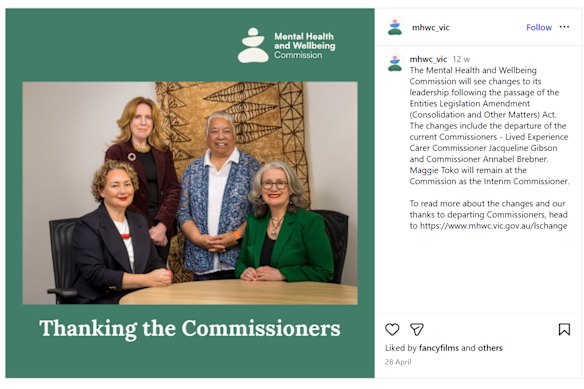
Months later, in December 2025, an act of parliament was introduced to remove the four independent commissioners, sold as a cost-saving measure.
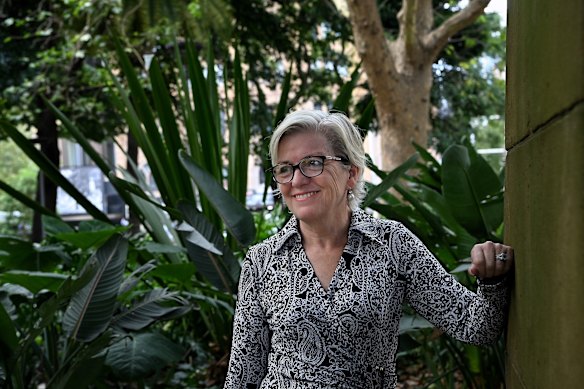
Health Minister Ingrid Stitt appointed a single commissioner in their place. Former NSW mental health commissioner Jennifer Black took up the role from September 29 – but with only half the staff and budget that the watchdog had a year earlier, and with a greatly reduced mandate to hold the government to account.
When contacted by The Age about the reduction of its powers, budget and staff as detailed in its confidential documents, the commission stated it had upheld its independence and was focused on its role as it “navigated a period of significant organisational and governance change”.
The Department of Health said the MHWC remained independent and a critical part of Victoria’s mental health oversight framework.
Death by $5 million cuts
When MHWC executives gathered for a commissioners’ governance meeting on February 20, 2025, there was no hint of the carnage that would soon befall the watchdog, the mental health system and, most importantly, the Victorians who need it.
Official notes from that meeting detail discussions that would be typical for the organisation. A planning day for its lived experience team, a meeting with the Victorian Aboriginal Legal Service, and Victoria Police raising concerns that it did not have funding to train recruits in how to cope with mental health callouts.
There was also a short update to let everyone know the mental health commission had submitted its 2025-26 budget bid, and that it was seeking a copy of the government’s final budget to see what it would receive.
The commission was told “the process was cabinet in confidence and was not given an indication of what was to come”.
There were no obvious alarm bells. The executives were so confident about the budget that the meeting moved on to a discussion about salary modelling in light of a mid-year recruitment drive.
But when the commissioners met on June 12, 2025, everything had changed, and recruitment was now the last thing being discussed.
“The Mental Health and Wellbeing Commission has been advised by the Department of Health that it will receive drastically reduced funding in the next financial year and that plans are afoot to change the Mental Health and Wellbeing Act which will reduce and reshape the role of the commission,” the MHWC executives heard.
As part of this, the organisation’s four commissioners would be pared back to just one.
Although details were limited, the MHWC already believed their role as a watchdog was being limited just 18 months after they had been established. They aired views that, through its mottled changes, the government was shifting power back to the department, which represented “a significant change from the intent of the royal commission”.
“The government appears to have scrapped two elements of this central reform agenda – regional boards and the Mental Health and Wellbeing Commission operating as outlined in the royal commission,” the June meeting heard.
The MHWC had been so blindsided that it noted that the government “did not outline why it was making the changes” and planned to clarify to the public, via the media, that they were not engaged or included in any of these decisions.
By the middle of July, the commission learned its operating budget had been cut in half – from $9.93 million in 2024-25 to $4,761,000.
To stem the bleeding, chief executive Simon McKenzie suggested to the Department of Health that senior leaders could work below full-time to provide savings.
The department told McKenzie that, despite the cuts, they still expected the commission to hold the government to account on progress with the royal commission.
If the chief executive believed them in July, briefing documents show that by the end of 2025, the watchdog’s senior leadership was deeply worried that its key purpose was being wound back.
As of January 2, 2026, there were no staff in the System, Performance and Monitoring Team whose main role entailed tracking big-picture problems and assessing how Victoria was performing against its royal commission targets.
By this time, the MHWC’s total staff had fallen from 43.9 full-time roles to 27.19. Those who remained had been relocated to share an office with the Health Complaints Commission, prompting privacy concerns over the discussion of highly sensitive information.
The hurdle watchdog refused to jump
By law, the MHWC is required to monitor and report on the quality, safety and performance of Victoria’s mental health system.
But month after month, the watchdog’s concerns grew that the department was refusing to hand over the data it needed to see what was happening inside mental health services, or whether the promised reforms were being implemented.
It labelled the department’s obstruction as “hurdles”, though they had huge consequences.
Information the watchdog struggled to access included basic details on the number of mental health patients admitted to beds or attending emergency departments, right up to safety data detailing how many patients were being subjected to bodily restraints, compulsory treatment orders or violent attacks.
While trying to prepare its annual report in June 2025, the MHWC’s governance committee raised the issue of the department withholding vital information.
“We note that the Draft Information Sharing Agreement as provided by the Department omitted critical information that the commission requested within the data-sharing schedule, and which is required to fulfil our functions. The commission is therefore seeking these data outside of the information-sharing agreement to facilitate timely extraction and provision of this information.”
The June meeting resolved to remind the department of its obligation to hand over the data, including spelling out the relevant sections of the law demanding it “provide reasonable assistance to the Commission” and that “the Commission may collect data and information from the Department in order to perform its functions”.
It also reminded the department it was a signatory to the Victorian Public Sector Data Sharing Heads of Agreement, and requested information about mental health patients be provided within 14 days, and details of the royal commission recommendation implementation to be handed over within five days of the end of the financial year.
By August, the governance committee reported its “assertive approach” of referencing the legal obligations had seen an improved turnaround by the department, though there were concerns the resulting data would not present an accurate picture, nor would it allow it to cover the entire 2024-2025 year in its annual report.
In December, the MHWC was denied access to data on the promised mental health system reforms while trying to complete its report into the government’s implementation of the royal commission recommendations.
But there was one massive hurdle the commission refused to jump.
In exchange for access to the data, the department asked the commission to sign a secret data-sharing agreement that included terms that would effectively remove the watchdog’s ability to independently hold the government to account.
The terms, seen by The Age, would have handed the department a right to review the way the mental health commission used its data, as well as the right to review any of its reports before publication.
It also demanded the right to seek advice on any “analytical risks” associated with use of its data.
The commission refused to sign up to the agreement, citing concerns for its independence, prompting the department in December to block its access to the data needed to perform its legislated oversight role.
“Have also been advised that despite words of assurance to protect data, it will not be shared unless there is a data-sharing agreement in place,” the MHWC heard in December.
“The department cited that the decision from the MHWC to pause progression of the data-sharing agreement without acknowledging the various hurdles/difficulties presented by the department, which influenced the decision to put it on hold,” the MHWC’s December meeting heard.
Rather than cede its independence, the MHWC decided to “do the best we can” with whatever information was already publicly available, while calling out the department’s obstruction in its report.
“Agreement that, based on the previous year, if expectations and timelines have not been met, to not let the department off the hook and communicate to the public that the MHWC will endeavour to report on anything that doesn’t meet the annual report submission requirements.”
However, the withholding of information may not even be the most concerning aspect of the department’s handling of mental health data to emerge from the documents.
Confidential information provided by the department’s executive director of governance and accountability reveals it does not even record data on the number of violent incidents occurring in its mental health units, nor the number of patients dying of suicide while being treated.
Warnings not delivered
Commissioners, executives and MHWC staff uncovered a host of serious failings and issues directly harming mental health patients while conducting a series of visits inside the state’s mental health units.
A report outlining those “pressing issues”, detected in 14 visits to mental health services across the state during 2024 and 2025, was presented to the MHWC’s leaders on August 5, 2025.
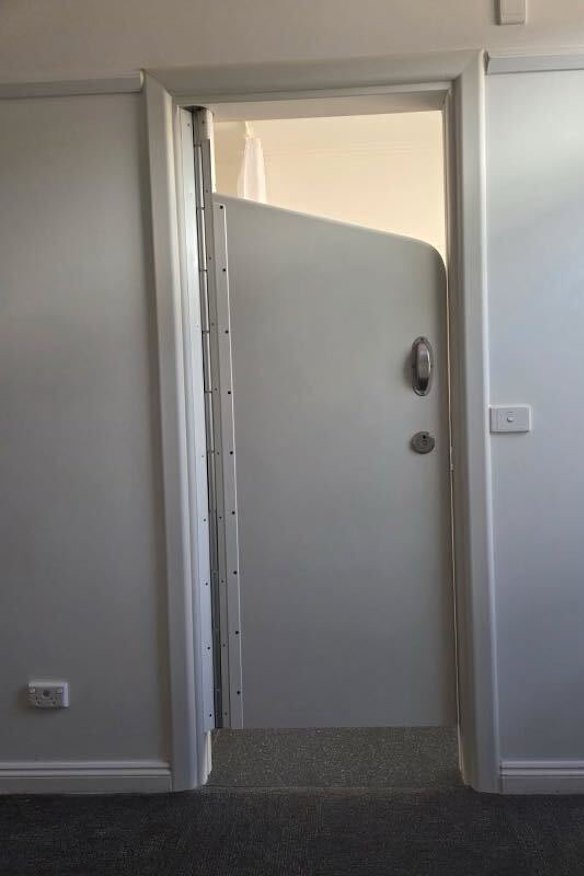
It detailed critical staff shortages in mental health units that were up to five times higher than in other departments at the same hospitals, inconsistent documentation on patients being restrained, discrimination faced by lived experience workers, and challenges for mental health patients in emergency departments.
The report also raised concerns that features, including shared bedrooms and bathrooms, continued to be an issue at some “outdated facilities”, where infrastructure improvements had not been undertaken.
Seven months later, on February 22, 2026 – while the report and the concerns it raised had still not been made public – Michael McKeown was found dead inside his acute room in Geelong’s Swanston Centre, which was joined to the room of Joel Steinbock, who has since been charged with his murder.
The MHWC’s service visit report was eventually published, but not until July 7, 2026 – 11 months after being presented to the executive meeting, and more than four months after McKeown’s death.
While the published report continued to flag concerns over the transparency of funding and the sustainability of the royal commission reforms, additional allegations that mental health dollars were being misappropriated, which were contained in the August version, had been removed.
“Some services reported that mental health funding was being diverted to support sub-acute care, undermining the original intent of the reforms,” the August report had stated.
Later, the watchdog also privately flagged its need to investigate systemic issues harming mental health patients in emergency departments, though there is no evidence it followed through.
The MHWC’s January 29, 2026, governance meeting raised systemic issues stemming from prolonged emergency department stays. The meeting heard its investigators had two reports available, and the attendees detailed the legal provisions that gave the watchdog jurisdiction to launch an own-motion investigation into the issue.
At that time, 20 of the state’s 21 adult mental health units were failing to meet their target for admitting acutely mentally unwell Victorians to a bed within eight hours, and a host of leading medical groups were pushing for action amid grave fears for their patients.
While discussing their need to investigate, members of the MHWC executive suggested they meet with the deputy president of Australian College of Emergency Medicine to gain background and data on the issue.
However, there has since been no evidence of any investigation having been undertaken by the MHWC despite its January discussion. When asked by The Age, the College of Emergency Medicine said it had never been contacted by the mental health commission, and that it did not even have a position of deputy president.
Backed by more than five leading medical groups and unions, The Age this month revealed the extent of issues for mental health patients in emergency departments. When asked this month whether it was investigating the emergency department issues, the MHWC initially stated it did not have relevant information to discuss, and later confirmed it had received complaints – but pointed to an ongoing examination by the Victorian Auditor General’s Office, rather than any work it was undertaking.
Blowing the whistle
After learning it was set to lose its budget and remit, the MHWC in June 2025 developed a communications plan to blow the whistle on the government “walking away” from its royal commission commitments.
It planned a stinging rebuke that would inform the public of the government’s intent to centralise power back with the Department of Health in contravention of the royal commission’s findings.

Presented at the commission’s June 12, 2025, governance meeting, a communication plan was hatched outlining the importance of getting on the front foot with public and stakeholder messaging before the changes were imposed.
One of the main objectives was the need to make it clear the MHWC was not involved in, or even consulted about, the decisions that would water down its functions and composition.
Its proposed key messages were blunt:
“These changes represent a significant change from the intent of the royal commission – to shift power away from a central government department to involve lived experience voices in decision-making.
“As the oversight authority – highlight the government is walking away from the RC [royal commission] to decentralise control of the system and operate a new system of governance.”
The commissioners and executives discussed plans to let the public know the MHWC’s funding had been “drastically reduced”, but that the government had not outlined why.
Its resolve even saw the MHWC draft an opinion piece, penned in the name of then-chief commissioner Treasure Jennings, which informed Victorians the government was stripping the watchdog of the powers it needed to hold them to account.
“Now it appears the government has decided to refocus the Mental Health and Wellbeing Commission away from system oversight and more toward service oversight and complaint-handling,” Jennings’ unpublished op-ed said.
“If government is stepping away from the central mechanisms for enabling reform, however, there needs to be openness and transparency regarding the Mental Health levy and how it is used. We encourage the government to provide details.”
Two days after discussing its plan to speak out, a June 14 front page article in The Age revealed the watchdog’s “drastic” budget cuts and Jennings’ warning that the MHWC may be rendered unable to hold the government to account for the performance of the health system.
Jennings’ comments, however, did not extend to warning the public that the government was walking away from the wider mental health reforms it had promised.
The state government provided The Age information for that article stating the commission would get $5.97 million in funding for 2025-26 – a 40 per cent cut.
But when the MHWC met again for a “Budget Reprioritisation Meeting” on June 24, it had received confidential news that was even worse than the government had led it and the public to believe.
“DH shared that a letter (‘the Letter’) from the minister is expected to be shared shortly [with] the commissioners which will provide the MHWC’s Budget and Ministerial Directions. The budget reported in The Age is not what the figure that will be communicated in ‘the Letter’. It is less than the reported figure,” the June 24 meeting was told.
After digesting the full scale of the cuts, the MHWC’s governance team in August debated another communications strategy. Its goal was how “best to illustrate the lack of support received from the department to perform our role/functions”.

As well as highlighting that its modest funding would not meet the expectations of the royal commission, the MHWC wanted to highlight the government’s retreat from the lived-experience commitments at the heart of the reforms.
“It is likely that if we ask ‘why’ the department will provide a standard response. The philosophy should be ‘what is next?’ If the government is stepping away from the RC recommendations, there should be transparency about this and ‘what is next’.”
It’s a question the new commissioner, Jennifer Black, will now have to turn her mind to alone.
Start the day with a summary of the day’s most important and interesting stories, analysis and insights. Sign up for our Morning Edition newsletter.
Disclaimer : This story is auto aggregated by a computer programme and has not been created or edited by DOWNTHENEWS. Publisher: www.smh.com.au