
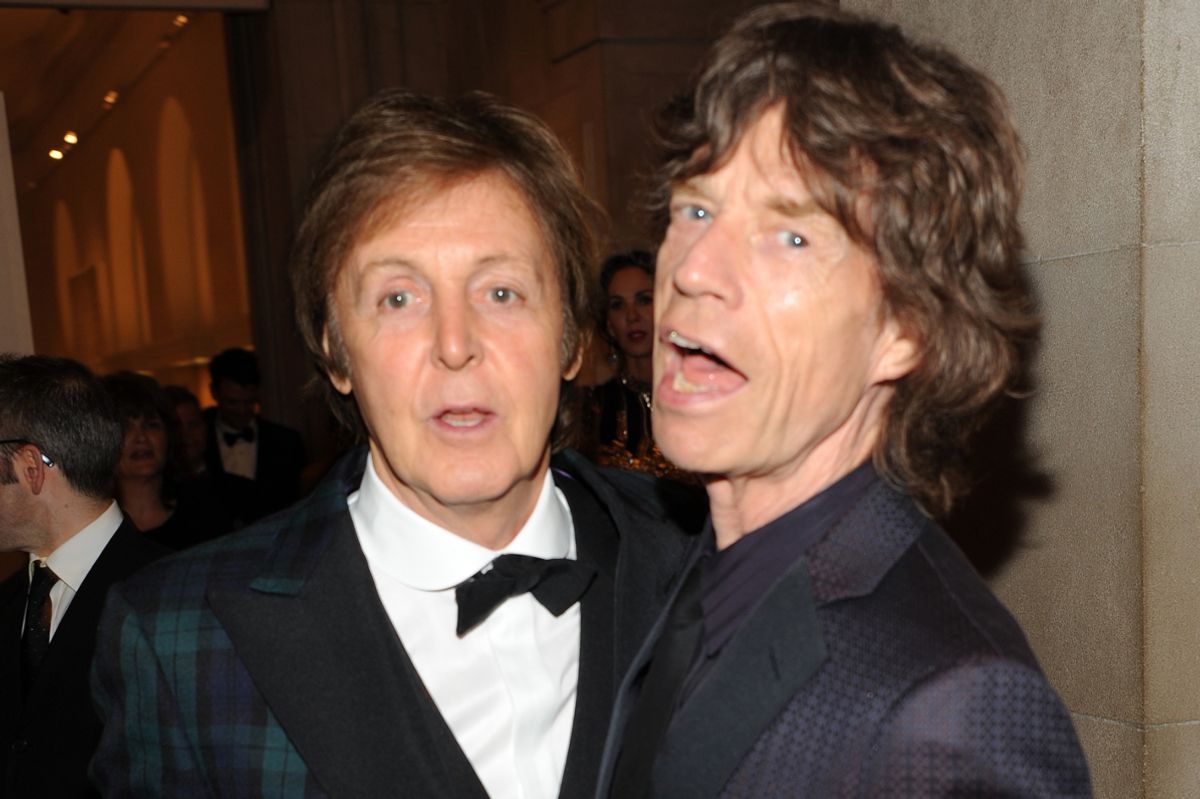
The Rolling Stones and The Beatles were rivals, but a new book, The World’s Greatest Rock n Roll Band reveals there was another partnership brewing between Jagger and McCartney
Music legend portrays The Rolling Stones and The Beatles as arch rivals. Beatlemania came first, but Lennon and McCartney’s songwriting genius inspired Jagger and Richards to follow suit – penning their first global smash, (I Can’t Get No) Satisfaction in 1965, which topped the charts in the UK and the US. Now a new book, The World’s Greatest Rock n Roll Band, by music journalist Bob Spitz, reveals there was another partnership brewing between Jagger and McCartney.
The original ‘frenemies,’ the canny businessmen came close to forming a ‘Rolling Beatles’-style supergroup, with plans to dominate the British music industry. Spitz says: “Mick and Paul wanted to start their own studios and record label. They were very close to doing that. Paul and Mick were the business minds of their bands.”
READ MORE: Cheryl Baker still has ‘bits of road buried in leg’ after crash that nearly killed Bucks Fizz
After manager Andrew Oldham resigned in 1967, The Stones never had another manager – effectively leaving it to Mick, says Spitz. He continues: “Mick and Paul had got together and sensed they had a stranglehold on the scene, so why not have a business stranglehold? They wanted headquarters, one company, one label, but John [Lennon] and George [Harrison] were not going for it.”
McCartney even devised a plan to create a joint Beatles/Stones HQ at a disused brewery in Camden, north London. Spitz says: “Mick went to see it and thought it was great. They had investment money put aside. Paul even wanted a heliport, so they could fly bands in and out. I think Paul was fantasising quite a bit and whatever Mick is, he is not a fantasist. He is a straight head cold blooded businessman. That just did not make sense to him. If the Beatles and Stones had got together, who knows what would have happened.”
The plans never came to fruition. But Jagger and RIchards’ songwriting prowess helped The Stones sell more than 250 million albums worldwide and gross $2.9billion at the box office from touring. Sadly, their perfect harmonies did not play-out off stage. Jagger lost tolerance with Richards’ ongoing drug abuse. He, in turn, gave short thrift to Jagger’s solo ambitions. Spitz says: “Mick and Keith have renewed their vows so many times it is ridiculous.”
Saved by never being in competition, he explains: “Mick was the peacock and Keith was the master of riffs. They were just able to not get in each other’s face except in the mid 90s when they almost teetered on divorce. It was a love story from the very beginning.”
Richards’ drug use spiralled out of control on the road after releasing their 1976 Black and Blue album. Kicking off the tour in Frankfurt, West Germany, Spitz recalls a strung out Keith winding up on his bottom on stage and continuing to play. He adds: “In Münster, in the midst of Fool to Cry, he was so wasted that he fell asleep on stage. He nursed an appetite for heroin and cocaine. In restaurants, he’d snort cocaine right off a dinner plate while openmouthed maître d’s and waiters stood by.”
But when he fell asleep at the wheel of his Bentley, driving back to London from the Midlands in a storm in 1976, he and his passengers were lucky to escape alive. Spitz says: “Hitting 100 mph, he nodded off and sent his Bentley careening off the M1 motorway and through a barrier, coming to rest in a farmer’s field.
“The passengers – his son, Marlon, Freddie Sessler (brother of London restaurateur Siegi Sessler) and two women – miraculously escaped unhurt. Keith ditched his stash under a bush. But three policemen were on the scene in no time, one of whom noticed a coke spoon attached to a silver necklace on the floor of the battered car. That precipitated a strip search at the police station, where a blotter of LSD was found in the pocket of Keith’s jacket. His explanation was feeble, ‘it could belong to anyone’. He was promptly arrested.”
The crash resulted in drugs charges and a £750. Spitz says: “Keith was seriously f*cked up, taking industrial quantities of drugs. Physically, he was wasted; his frame was emaciated, his eyes sunken, his teeth blackened and rotting. Sure, some of this came with the territory for a rock’n roller, but he was courting disaster.”
Likewise, Ronnie Wood’s drug battles over the years are legendary. He joined The Stones in 1975, replacing Mick Taylor, who could no longer hack the lifestyle.Former Rolling Stones Records president Marshall Chess, 84, recalls: “In my apartment in New York, I had a cocaine-sniffing Art Deco table with a black glass top. Freddie Sessler [late restaurateur] would come by with one of his brown-glass bottles, dump out a massive amount of cocaine, and Ronnie and I hit that table like Peter Rabbit running.”
But at the dawn of the Eighties, Jagger lost patience and threatened to let Wood go. Spitz says: “When the Stones decided to go back on the road in the fall of 1981, they floated the idea that it might be better if Woody didn’t accompany them. Keith, of course, went to bat for him. Keith knew the importance of the band as a safety net when you were in the grip of drugs. Woody assured him he’d be cool, he’d stay off the pipe.”
Spitz recalls things reaching a head on a US tour, when Richards caught Wood taking drugs on the sly. It was at a gig where they were supported by then unknown artist Prince. Spitz continues: “Woody, who held his own under the lights, was hitting the pipe on the sly. Keith took it personally. He decked Ronnie before a San Francisco gig.”
When the European leg of the tour started in May 1982, Mick wanted to sack Wood. He says: “He’d even made advances to George Thorogood, who played a wicked blues guitar, about taking over for Woody. When it was clear Ronnie would accompany the band to Europe, Mick insisted he stay elsewhere, apart from the band, and put him on a weekly allowance to curb his access to drugs.”
Today, all three surviving Stones are squeaky clean, with Wood, now 78, celebrating 16 years sober as well as Richards, who stopped drinking in 2018 and ditched fags in 2020. Meanwhile, Mick – who had heart valve replacement surgery in 2019 following a scare – trains five to six days a week, focusing on stamina, cardio and flexibility, often supplemented by ballet and yoga. And they are preparing to release their 25th studio album, Foreign Tongues – which features Paul McCartney.
Of his book, Spitz says: “At its heart, the story is about two boys, Mick and Keith, and their unique, fraught, alchemical bond, often tested, never sundered. The Glimmer Twins and the bandmates, like Charlie Watts, who found their groove in relation to this double star, made the trip intact, while those who struggled, like Brian Jones and Mick Taylor, were chewed up and spit out.
“This is a story with many dark corners. But whether Jagger and Richards sold their souls to the devil at the crossroads for blues greatness, or just squeezed their heroes for every drop of inspiration, in the end their connection to their music and to each other put them in a category of one, where they very much remain.”
*The Rolling Stones:The Biography, by Bob Spitz, is released May 28 in the UK. The new Rolling Stones album Foreign Tongues is out July 10.
READ MORE: BGT’s Jonathan Antoine reveals suicide hell, breakdown and horror health battle
Disclaimer : This story is auto aggregated by a computer programme and has not been created or edited by DOWNTHENEWS. Publisher: mirror.co.uk



