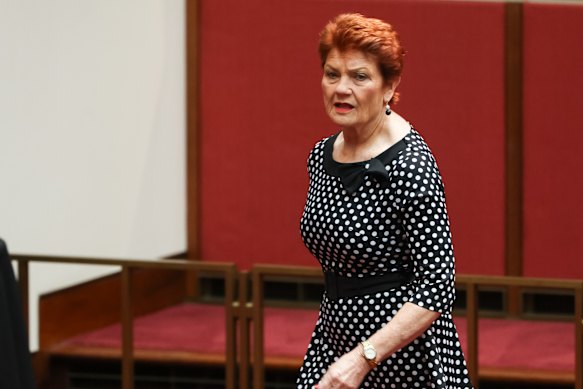

Migrants would be barred from bringing parents to Australia and the refugee intake slashed by 90 per cent under One Nation’s latest hardline immigration plan, as Home Affairs Minister Tony Burke retreats from backpacker rules that regional businesses warned would trigger labour shortages.
Populist-right leader Pauline Hanson has pledged to cut from 20,000 to 2000 the yearly refugee intake at a time when the US and nations across Europe have also clamped down on migration. It would end Australia’s status as one of the most generous developed countries outside Canada, where Prime Minister Mark Carney has also begun winding back parent and refugee visas.
Hanson has shifted focus to the permanent intake after promising in September to cut the temporary program by 750,000 in an uncosted plan for negative migration, which economists said would smash the economy. The policy launch followed a series of reversals and mixed messages from the anti-immigration party about the level of their cuts.
Aiming to bring national attention back to her core issue of migration as the Coalition works to gain momentum by focusing on inflation, Hanson said: “Migrants have helped build Australia, and we remain a generous country, but we must look after Australians first.”
The senator’s move to reignite the migration debate by announcing more cuts comes as One Nation MP Barnaby Joyce talks down the party’s chances at the Victorian election and after this masthead revealed claims of chaos and financial impropriety inside the party.
Hanson’s national media profile has dipped slightly before the Victorian poll, though she has made numerous trips to campaign in the state.
One Nation argues Australia would still be above the OECD average for per capita refugee intake if the numbers were capped at 2000 a year, but the big cut is likely to attract criticism from progressives for being hard-hearted as the UN estimates global conflicts from Sudan to Ukraine displace around 118 million people.
Labor was also considering cutting the humanitarian program from 20,000 to the long-run base figure of 13,750 but reversed course after a backlash from its own MPs, costing the budget $1 billion. Opposition Leader Angus Taylor, who, like Labor, was pressured by One Nation to make deep cuts, has pledged to halve the 20,000 intake.
The roughly 7000 parent and grandparent visas granted each year would be axed entirely. Under One Nation’s plan, parents and grandparents would still be able to visit children on three, six, or 12-month visitor visas.
The One Nation policy, which also bans the common practice of applying for asylum onshore, relies on Treasury estimates that parent and refugee arrivals cost federal and state taxpayers more than $500,000 over their lifetimes due to lower workforce participation. This contrasts with skilled migrants, who contribute a net $260,000 and are the focus of the Coalition’s rival plan.
One Nation’s calculations suggest taxpayers would save $140 billion dollars in today’s dollars over the lifetimes of the parents and refugees who would otherwise have come to Australia under Labor’s settings.
Like its first tranche of migration proposals, One Nation’s policy was not costed by the Parliamentary Budget Office, but instead underpinned by Treasury estimates on visa classes. Taylor’s plan was informed by analysis from the budget office but not officially costed.
The migration fight will run to the next election amid persistent inflation, as Labor, the Coalition and One Nation all concede the post-pandemic migration surge that started under the Morrison government and was reined in too slowly by Labor has hurt housing affordability.
On Tuesday, Burke was obliged to announce his second reversal on Labor’s migration overhaul. The home affairs minister was forced to go back to the drawing board a few months ago when cabinet ministers baulked at his proposals, forcing him to cancel a press club speech.
When he eventually announced the details, Labor’s policy was aimed in large part at reducing working backpackers, whose numbers have soared recently. Burke also barred international students from bringing spouses.
After a well-organised backlash from regional businesses, Burke said the government’s previous plan to cut the number of third-year working holidaymakers to 5000 had been adjusted to 25,000. Backpackers will need to complete an extra month of regional work to qualify for their second-year visa.
Burke said any upward pressure on net overseas migration – a key metric the government is trying to rein in amid voter frustration – would be offset by bureaucrats slowing down visa processing.
Despite the policy shift, he said the outcome was “so much better than where we thought we’d be able to be”.
The backlash highlights the tough trade-offs in the migration debate, where cutting historically high arrivals risks harming key sectors such as universities, health and construction depending on the visa class.
Hanson’s policy calls for net negative migration, meaning more people would leave Australia than arrive, but does not specify by how much. As this masthead has previously reported, Joyce initially rebadged the party’s proposed cap of 130,000 permanent visas as a net migration target, after realising that issuing 130,000 permanent visas would lead to economic damage.
But after copping fury from hard-right influencers while new party MP David Farley made contradictory statements about targets, the party abandoned that 130,000 pledge in favour of three years of net negative migration.
Meanwhile, assistant minister to the prime minister Patrick Gorman used a speech at the Sydney Institute on Tuesday to suggest that Hanson wanted to create a “discriminatory migration system like the old one based on race or religion”.
Gorman took a veiled swipe at Hanson’s employment until April of convicted rapist Sean Black, saying “self-enrichment must never be the purpose of political parties”.
Gorman displayed Labor’s newfound embrace of national symbols, arguing he was proud to embrace Australia Day against “progressives [who] say it is uncool to be proud of our country”.
But he argued: “We don’t seek to exclude citizens from the Australian project, we include people. We don’t talk Australia down at home, or with disgraced podcasters abroad.”
Cut through the noise of federal politics with news, views and expert analysis. Subscribers can sign up to our weekly Inside Politics newsletter.
 Paul Sakkal is Chief Political Correspondent. He previously covered Victorian politics and won a Walkley award and the 2025 Press Gallery Journalist of the Year. Contact him securely on Signal @paulsakkal.14.Connect via X or email.
From our partners
Disclaimer : This story is auto aggregated by a computer programme and has not been created or edited by DOWNTHENEWS. Publisher: www.smh.com.au