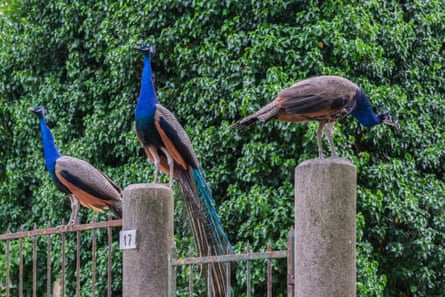
Federico Bruni was sitting on a bench, eating a piadina romagnola (flatbread sandwich) and minding his own business, when a peacock strutted up in the hope of a few crumbs. High-pitched squeals emanated from the direction of a disused military barracks across the road. “That would be the call to love,” Bruni said. “The male peacocks are courting the female ones – we’re in peak mating season.”
As another couple of peacocks wandered by, their iridescent trains sweeping the pavement behind them, this could be mistaken for a wildlife park. But the scene is Punta Marina, a seaside town on the Adriatic coast of Italy’s Emilia-Romagna region that has been colonised by the birds, to the delight – or despair – of its approximately 1,000 residents.
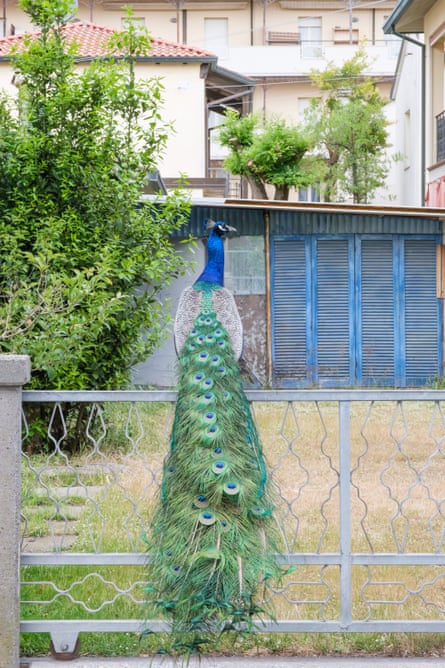
The birds have made their home in the gardens of abandoned properties and perch on rooftops and fences, or peak out from trees. They carefully navigate the traffic, sometimes tapping their beaks on the windows of parked cars after catching their reflection. The Guardian saw one shamelessly leaping over the gate of a block of flats and doing a poo on the entrance steps.
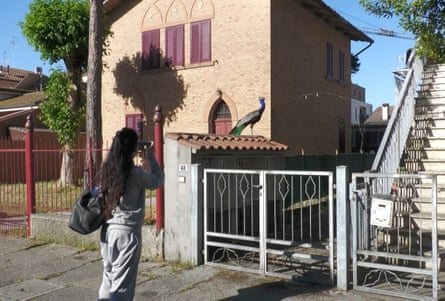
They don’t bother Bruni, who frequently comes to his holiday home in Punta Marina. “It’s no different to seeing a cat, really, they’re part of the fabric of the town,” he said.
Others are less welcoming. “There are too many of them,” said Francesco, who preferred not to give his surname. “They jump over the wall and on to my balcony, leaving excrement. But the main issue is the mating – the screams are keeping people awake.”
His relative Marco said: “Each time I come to Francesco’s home, I tread on peacock poo outside. It’s unhygienic; the peacocks need to be contained.”
Some say the peacock, a bird of Indian origin, was introduced to the European continent by Alexander the Great, or even before. Their populations are well established in parts of Europe, especially in England and Spain, and although some have been reported in Italy, their presence in Punta Marina is especially notable.
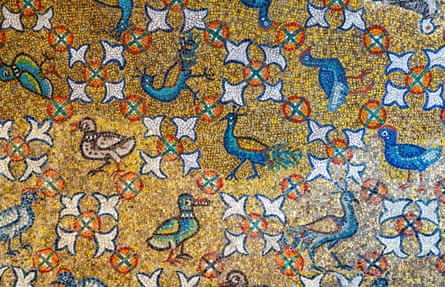
Historically a symbol of immortality, peacocks feature in many of nearby Ravenna’s prized Byzantine mosaics, and over the centuries they became status symbols, once adding colour to the resplendent gardens of Emilia-Romagna’s wealthy residents.
How they settled in Punta Marina is a mystery – although there are reports they were brought in as pets by a resident more than 20 years ago.
“I heard that a male peacock, left to his own devices after the woman died, crossed paths with a female one in the old military barracks – they mated and it all began from there,” said Ilaria Sansavini, who owns a shop selling fresh pasta. She said she was strongly in favour of the birds. “This is their season of love and they should be left alone.”
For a long time, the peacocks lived in the sprawling pine forest behind the town. But then came Covid in 2020, and for months the peacocks roamed free while people were in lockdown. The occasional human they came across gave them food, enticing them to return.
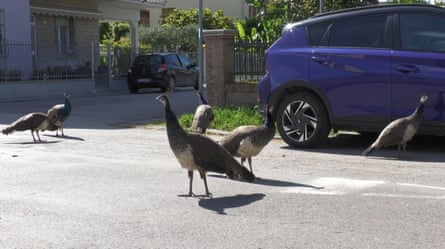
There is no official data on their numbers in Punta Marina, but the population was estimated at 10 in 2018, 40 in 2023 and about 120 today.
Rosario Balestrieri, an ornithologist at the Naples-based Anton Dohrn zoological station, said: “The pine forest serves as a preferred habitat and nesting refuge … but supplementary feeding actively provided by the local population has encouraged steady population growth.”
While people were used to the birds’ more prominent presence at this time of year, the mating period, a recent social media post from a disgruntled female resident imitating the mating scream has gone viral, creating a media frenzy.
A local police officer said some resulting reports – depicting an “invasion” of peacocks forcing people away from the town because of a possible threat to public health – were wildly exaggerated.

Still, the high profile tensions have left Ravenna city council, which in recent years has been grappling with how to manage Punta Marina’s peacock population, with a dilemma. An attempt to move them in 2022 was opposed, and after that, Clama, a voluntary animal rights association, was enlisted to protect the peacocks and encourage harmony.
Clama has produced leaflets and put up signs to teach residents and tourists about the birds, saying they absolutely must not be fed.
“If they know it’s easier to come and snack on a sandwich in the town rather than having to forage for their own food in the pine forest, then of course they will keep coming back,” said Cristina Franzoni, a volunteer with Clama, adding that people who fed the peacocks could be fined. “They feed them because they love peacocks, but unfortunately in doing so they upset the neighbours who don’t.”
“Peacock rangers”, who can be called on to clean up poo from the streets, homes or the wheels of cars have been recruited to defuse tensions, while the council is planning the first official peacock census.
Other Italian regions have offered to “adopt” the birds, but Franzoni said removing them was not the solution and would cause “trauma”. She said: “We need to try to live with the animals instead of making them victims of our choices – they didn’t choose to come here, we brought them here and so must respect them.”
Disclaimer : This story is auto aggregated by a computer programme and has not been created or edited by DOWNTHENEWS. Publisher: theguardian.com