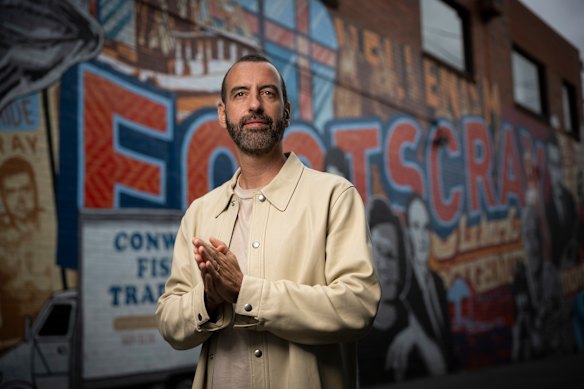

In a city of cobbled streets, cafe culture and cyclists, Mirik Milan had a radical idea. Critics hated it.
“People are going to die here,” they told him. Blood will be spilled on the streets of Amsterdam, they said, of this plan for a 24-hour city (and liquor licences). But the city’s night mayor pushed on.
“The night has been demonised [since the year] 2000, or maybe even longer, for some folks’ advantage – to either stay in power, to not let certain ideas surface,” Milan told the Cities After Dark summit in Melbourne’s west.
“It’s also a cultural battle in terms of, if we let all these ideas and things flow out, they’re losing control over the narrative.”
People argue that “nothing good ever happens after midnight”, Milan said. He says they’re wrong.
The nighttime economy is cyclical. Every few years, a new group of young people ages into it. Some ultimately bow out. Others stick with it.
Milan – a charismatic and stylish forty-something – is a lifer.
Where bureaucrats are clueless, jaded by their last experiences in nightlife from their university days (and thinking it synonymous with alcohol abuse), the former club promoter recognised nighttime culture’s untapped potential when he was elected as Amsterdam’s inaugural night mayor in 2012.
“Many people that make decisions for our cities, or also at a national level, they might not have experienced nightlife or nighttime culture the way I’ve been doing in recent years,” Milan said.
“We are still a very niche part of society.”
Milan saw people staying out later and going to more shows, people dancing at festivals well into their 50s, and communities forming in warehouses pulsing with electronic music.
He also saw problems. Among them, the tide of people pouring onto the city’s narrow streets at 3am and 4am when most venues closed.
If venues had capacity for, say, 1000 people, neighbourhoods would be overrun with crowds the equivalent of “a demonstration” in the early morning. “You can’t even control those in public space, let alone late at night,” Milan told this masthead.
People were moving off into illegal venues after the house lights came on, and businesses closed. And, at a macro level, Amsterdam was losing artists, musicians and designers to creative capital Berlin.
A way to retain them, Milan decided, would be through 24-hour licences in up-and-coming neighbourhoods on the city’s outskirts (within a 20-minute bike ride). In a first, the local government would offer the licences through a tender process.
“When you’re developing your nighttime economy, you need to really start changing the rules of the game, and that sometimes means that maybe it’s not a level playing field,” Milan said.
“Of course, we also got a lot of pushback from entrepreneurs or from venue owners [in the inner city] because we had looked at designated areas … only on the outskirts.
“But we really developed a vision.”
Each of the venues have to be “multidisciplinary” – with mixed functionality from nightclubs to bars, galleries and co-working spaces. Some of the venues even have daycare facilities (not for people partying, but as an added benefit for the community, Milan stressed).
Venues don’t have to be open 24/7, but they have the freedom to open and close whenever they like. The licence is attached to the venue operator, rather than the building, and can be revoked at any time.
“There are now 15 of these venues in the outskirts of the city, [which] really [helps] to develop those areas into cultural hotspots,” Milan said.
The process allowed for a kind of cultural audit or “programming” of Amsterdam, whereby officials fielding proposals could see whether a neighbourhood could expect gaps in small, mid-tier or large venues, Milan said.
It also has economic benefits, with every euro invested in nocturnal creative industries yielding up to €11 in return, according to Milan’s research and advocacy agency Vibelab.
More than 4.1 million Australians – or almost 30 per cent of the workforce – regularly work at night, according to University of Melbourne urban studies researcher Anna Edwards, who also spoke at the summit.
Australians are going out an average of 80 nights a year in 2026, or 15 per cent more often than last year, according to Visa research. The payment company ranks Melbourne as the country’s top nighttime economy when factoring in spending, governance, safety, vibrancy and accessibility.
Melbourne doesn’t have dedicated 24-hour liquor licences, and the state government has no intention of bringing them in. Venues have to apply for late-night liquor licences if they want to serve alcohol beyond 1am – and few venues (including the CBD’s Colonial Hotel and Captain Melville) have bumped this out to be around the clock on most days.
Should Labor be re-elected next month, licensing for pubs would automatically be extended to 3am, a state government spokesman said.
“We back venues to do what they do best to create the shared experiences that connect us, support local jobs, and keep Victoria’s live music scene Australia’s number one,” the government spokesman said.
The commitment is among a package of reforms and grants Labor announced last month, while the Victorian opposition has also promised “a new dedicated focus on the nighttime economy”.
“We’ll cut red tape, fast-track permits, and standardise council laws so businesses can operate reliably across different areas,” Deputy Opposition Leader David Southwick said.
“We’re building an economy that works around the clock.”
A separate safety initiative in the central nightlife district of Rembrandtplein in Amsterdam had reduced alcohol-related violence by 20 per cent, and public nuisance by 30 per cent, Milan said.
As part of the initiative, a team of people dressed in bright red jackets (called “square hosts”) patrol the square on Friday and Saturday nights, acting as intermediaries between patrons, police and venues, helping people get around, and de-escalating situations when required.
Maribyrnong City Council is deploying a similar model in Footscray, with a trained two-person “welcome crew” working business hours (and between 11am and 7pm from Thursday to Saturday) to listen to feedback, support traders and locals, and better co-ordinate council services.
The council’s Cities After Dark summit made the case for its Creative West precinct – which Maribyrnong mayor Mohamed Semra described as “the solution” for the west.
The project – comprising a park, library and 500-seat theatre – would be a source of pride for the entire region, Semra said. His council is seeking $50 million each from both the Victorian and federal governments to help fund the $148 million project, with a view to beginning construction in early 2027.
“Our creatives have hustled, making extraordinary things happen with whatever resources they had, but creativity alone cannot compensate for a lack of cultural infrastructure,” Semra told the summit.
Milan draws parallels between government approaches in Footscray and Amsterdam. “There’s this huge development going into Footscray – 100 per cent, it will be successful,” he said.
However, a bigger question remains.
“How are we protecting, in the long run, small businesses that will be here, through rent control or through also these creative spaces?” Milan said.
In European cities including Berlin and Amsterdam, nightclubs are gaining status as cultural institutions, he said. The government is recognising their contributions with tax cuts and legacy policy to protect venues and, ultimately, to make them a “fundamental part” of civil infrastructure.
Summits like the one in Footscray were an important step forward, Milan said.
However, he said: “We still need to pull the nighttime culture out of the space of mischief and mayhem, because it’s so much more.”
Start the day with a summary of the day’s most important and interesting stories, analysis and insights. Sign up for our Morning Edition newsletter.
From our partners
Disclaimer : This story is auto aggregated by a computer programme and has not been created or edited by DOWNTHENEWS. Publisher: www.smh.com.au