in Madrid
Spain’s prime minister, Pedro Sánchez, has admitted “trust in high-speed rail has been broken” after Wednesday’s deadly train collision that killed at least 69 people, injured more than 100 and prompted a national debate on the safety of the country’s rail network.
Sánchez said the Spanish state was “working tirelessly” to provide information as quickly as possible to the families of the victims – who include people from at least 23 different foreign countries – adding that his government was committed to finding what had caused Spain’s second deadly train collision this year.
Two trains, one from Spain’s state-owned Renfe and the other from the private rail company Iryo, were travelling from Madrid towards the southern region of Andalucía on Wednesday when they collided just before 9am. After the Iryo train came to a halt, the other slammed into its rear, knocking several carriages off the track near Urda in the central region of Castilla-La Mancha.
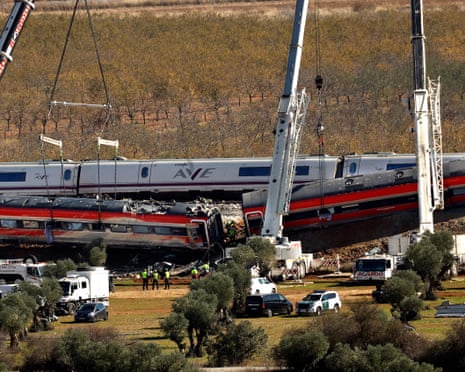
The crash came nine months after 46 people were killed and dozens injured when two trains – one from Renfe and one from Iryo – collided on the same line near the town of Adamuz in Andalucía.
“It’s unacceptable for a country like Spain – which has such a powerful high-speed rail system – to experience two accidents of this nature and magnitude within a single year,” the prime minister said on Friday.
“Therefore, our task isn’t merely to investigate the causes of what occurred, but also to provide solutions to further strengthen our nation’s high-speed rail system.
Public trust in the high-speed system has been broken; the government’s responsibility goes beyond diagnosing the causes – it must also offer solutions to ensure that a tragedy of this scale doesn’t happen again.”
Shortly after Sánchez spoke, Spain’s transport minister, Óscar Puente – who is under growing pressure to resign – gave a press conference in which he dismissed calls to step down, promising instead to focus on “providing the Spanish people with solutions” to restore trust.

“My duty now isn’t to talk about whether or not I carry on with my job; it’s to solve the problems, clarify what happened and offer clear explanations,” he said. “The most important thing I can do is offer solutions as best I can. If the investigation shows there were failures of organisation or control, we will act accordingly. And if individuals are found to be responsible, action will be taken.”
Puente once again suggested that responsibility for Wednesday’s crash appeared to lie within the Madrid control centre of Spain’s state infrastructure operator, Adif. He said that in the run-up to the crash, the LZB signalling system – which automatically halts a train if the line ahead is occupied – had gone down, but stressed that such incidents were not at all uncommon. Once the system was down, he said, control and decision-making powers ultimately reverted to humans, as was the case in other transport sectors.
And, on that note, we will be closing the blog for today.
-
Spain’s prime minister, Pedro Sánchez, has admitted “trust in high-speed rail has been broken” after Wednesday’s deadly train collision that killed at least 69 people (11:04).
-
At least 51 foreign nationals from 23 countries are believed to be affected by the crash (11:09), with Sánchez suggesting the number could be even higher.
-
Spain’s transport minister, Óscar Puente dismissed calls to step down (12:08, 12:46, 13:09, 13:32, 13:44, 14:08), promising instead to focus on “providing the Spanish people with solutions” to restore trust.
-
He offered detailed explanations on the causes of the incident based on early inquiries (12:17, 12:26, 12:36, 12:40, 12:43, 12:55, 13:20, 13:42) as the investigation continues.
In other news,
-
Evacuations of civilians from Russian-occupied Ukrainian city of Oleshky are believed to be underway, as part of a US-brokered localised ceasefire to provide humanitarian aid to the city’s residents (10:34).
-
Street protests sweeping Europe are expected to spread to Germany and reignite in France on Saturday, with police mobilised to stop potential looting and rioting on the fringes of what organisers hope will be peaceful rallies (15:55).
-
The Russian independent newspaper Novaya Gazeta has announced it is closing, citing pressure from authorities who recently searched the home of its senior editor and earlier this year detained one of its journalists (16:31).
-
Bulgaria’s next president will be elected in a runoff vote on Sunday, after a close race between the two main contenders ended inconclusively in the first round (16:39).
If you have any tips, comments or suggestions, email me at jakub.krupa@theguardian.com.
I am also on Bluesky at @jakubkrupa.bsky.social and on X at @jakubkrupa.
Bulgaria’s next president will be elected in a runoff vote on Sunday, after a close race between the two main contenders ended inconclusively in the first round.
The incumbent Iliana Yotova, former vice-president to Bulgaria’s former president and current prime minister Rumen Radev, faces pro-European opposition candidate, Andrey Gyurov.
The two candidates will pit contrasting political visions against each other in a highly polarised contest on Sunday, AP noted.
Contrary to pre-election expectations by observers for a double-digit difference in favour of Yotova, her opponent showed a surprisingly strong performance coming just 2.8 percentage points behind her and leaving all options open for the runoff.
AP noted that Bulgarians vote against a backdrop of growing economic hardship and drone attacks on Black Sea shipping, which have left several sailors dead or missing.
Polls will open 7am local time and close 8pm local time.
The Russian independent newspaper Novaya Gazeta has announced it is closing, citing pressure from authorities who recently searched the home of its senior editor and earlier this year detained one of its journalists.
“Novaya Gazeta is ceasing to exist,” the editor-in-chief, Sergei Sokolov, said in a video statement published on YouTube on Friday. “The Russian authorities – the Russian special services – have forced the editorial team to end its work.”
Russia has introduced near-Soviet levels of censorship since sending troops to Ukraine, pushing the vast majority of independent journalists into exile. Novaya Gazeta, a bastion of independent journalism in Russia, is classed by Moscow as a “foreign agent”, a label used to stifle dissent.
Sokolov said: “Novaya Gazeta has been killed … On 9 November we will turn off the lights in our home, where we have lived for 30 years. We will shut down the servers and leave.”
This month Sokolov was taken in for questioning and Russian authorities searched his home over a criminal case involving one of his colleagues, Oleg Roldugin, who was arrested in April.
Russia has intensified its crackdown on independent news outlets since its offensive on Ukraine in February 2022. Novaya Gazeta cut down production inside Russia after the offensive began. Authorities revoked its media licence the same year.
The paper’s then editor-in-chief, Dmitry Muratov, jointly won the Nobel peace prize in 2021 for his “efforts to safeguard freedom of expression” at the helm of the paper.
Guy de Launey
in Belgrade
In Belgrade’s Pioneers Park, just across from the national assembly, a small crowd craned their necks to listen. One woman held aloft a placard reading “Love prevailed for the people and Serbia”.
With a bouquet of media microphones in front of them, members of the Student List, the direct democracy movement that won an improbable but decisive victory in Sunday’s election, gathered under the trees.
Student List candidate Svetlana Stanarević was applauded when she accused the officials of violating the law. She also called for the director of Serbia’s internal intelligence agency to resign, accusing him of running the organisation as “a party security service, not a state security service”.
There was approval, too, for the “reopening or expediting of cases” related to the disaster that sparked the student protest movement. Sunday will mark the second anniversary of the canopy collapse that killed 16 people at a renovated railway station in Serbia’s second city, Novi Sad. There have yet to be any convictions.
The announcements on Thursday were the Student List’s way of stressing they intended to put anti-corruption efforts at the heart of government.
“For years, for decades, people have been really frustrated,” said Iva Marković, a Student List candidate and political ecologist who founded the Right to Water initiative.
“We see this as a time where everyone who was honestly and credibly working within [public] institutions can do their jobs. They are no longer under political pressure, and we ask them to do their jobs, which also means for prosecutors to prosecute, and police to investigate.”
Having spent days bathing in the euphoria of their unexpected triumph, the candidates’ focus was now clear: the cleaning up of the rotten institutions that had increasingly blighted the lives of Serbs over the 14 years of government by the populist leader Aleksandar Vučić and his Serbian Progressive party (SNS). They called for the dismissal of many senior law enforcement officials, among them the chiefs of the criminal police, the paramilitary gendarmerie and an anti-terrorism unit.
Reinforcing the student movement’s key principles is also a way, perhaps, to allay concerns that the Student List might not know how to handle its stunning victory over Vučić and the SNS.
The movement is not a traditional party. It does not have a hierarchy or leader – and although the students selected the list of candidates, they will not have any direct control over the people who have been elected, once they have been sworn in as MPs.
Marković said the common commitment the students and their parliamentary candidates had made should not be underestimated.
“The process didn’t start with the elections,” she noted, adding that preventing “individualism” from undermining core goals had been key to the student movement’s success.
“When you dream together with some people, it’s very hard to forget this dream, even if you are in parliament.”
Deborah Cole in Berlin and Jon Henley in Paris
Street protests sweeping Europe are expected to spread to Germany and reignite in France on Saturday, with police mobilised to stop potential looting and rioting on the fringes of what organisers hope will be peaceful rallies.
Weeks of, at times violent, student demonstrations have rocked Italy, Spain, Portugal, Albania and France, where activists on Halloween have again called for people to make their anger over the cost of living and deficient public services felt across the country.
In Germany, a loose alliance of groups called Gen Z regelt (Gen Z is sorting it) has called for supporters to turn out in more than 30 cities demanding more spending on schools, climate protection and housing, and against any plans to return to mandatory military service.
Alexander Throm, of the ruling conservative Christian Democratic Union (CDU) parliamentary group, wrote in the Handelsblatt business newspaper: “Scenes like those in France must be prevented at all costs.”
But Felix Banaszak, the co-leader of the opposition Green party, cautioned against attempts to place the youth protests under general suspicion in advance.
“The [CDU’s] rhetoric, which seeks to criminalise these protests pre-emptively and paint them as the work of marauding gangs, may even drive people towards radicalisation,” he told the RND media group.
Berlin’s police chief, Barbara Slowik Meisel, said she would deploy an additional 1,500 officers in the capital, though she had little reason to fear that people or property would come under attack.
“We have no concrete evidence of any coordinated looting operations being planned,” she said.
About 10,000 protesters, mainly pupils, students and their parents, are expected at the Brandenburg Gate on Saturday afternoon, with another smaller gathering planned in the early evening in the Mitte district.
Large rallies have also been called in Cologne, Munich, Frankfurt and Hamburg.
The team behind Gen Z regelt has used social media and its website to call on participants to exercise restraint:
“Our protest is peaceful, without exception. Violence goes against everything we stand for. Only through peaceful means can we achieve something together.”
By Friday, more than 160,000 people had registered on the website saying they planned to attend the protests.
Let’s take a quick look at other news in Europe today.
in Madrid
Spain’s prime minister, Pedro Sánchez, has admitted “trust in high-speed rail has been broken” after Wednesday’s deadly train collision that killed at least 69 people, injured more than 100 and prompted a national debate on the safety of the country’s rail network.
Sánchez said the Spanish state was “working tirelessly” to provide information as quickly as possible to the families of the victims – who include people from at least 23 different foreign countries – adding that his government was committed to finding what had caused Spain’s second deadly train collision this year.
Two trains, one from Spain’s state-owned Renfe and the other from the private rail company Iryo, were travelling from Madrid towards the southern region of Andalucía on Wednesday when they collided just before 9am. After the Iryo train came to a halt, the other slammed into its rear, knocking several carriages off the track near Urda in the central region of Castilla-La Mancha.
The crash came nine months after 46 people were killed and dozens injured when two trains – one from Renfe and one from Iryo – collided on the same line near the town of Adamuz in Andalucía.
“It’s unacceptable for a country like Spain – which has such a powerful high-speed rail system – to experience two accidents of this nature and magnitude within a single year,” the prime minister said on Friday.
“Therefore, our task isn’t merely to investigate the causes of what occurred, but also to provide solutions to further strengthen our nation’s high-speed rail system.
Public trust in the high-speed system has been broken; the government’s responsibility goes beyond diagnosing the causes – it must also offer solutions to ensure that a tragedy of this scale doesn’t happen again.”
Shortly after Sánchez spoke, Spain’s transport minister, Óscar Puente – who is under growing pressure to resign – gave a press conference in which he dismissed calls to step down, promising instead to focus on “providing the Spanish people with solutions” to restore trust.
“My duty now isn’t to talk about whether or not I carry on with my job; it’s to solve the problems, clarify what happened and offer clear explanations,” he said. “The most important thing I can do is offer solutions as best I can. If the investigation shows there were failures of organisation or control, we will act accordingly. And if individuals are found to be responsible, action will be taken.”
Puente once again suggested that responsibility for Wednesday’s crash appeared to lie within the Madrid control centre of Spain’s state infrastructure operator, Adif. He said that in the run-up to the crash, the LZB signalling system – which automatically halts a train if the line ahead is occupied – had gone down, but stressed that such incidents were not at all uncommon. Once the system was down, he said, control and decision-making powers ultimately reverted to humans, as was the case in other transport sectors.
If you are only joining us now and want a recap of today’s event, here it is…
Here are a couple of the latest images from the crash site, as investigators and rescue workers continue operations.
Another effect of the crash may be to change the way that Spanish railway authorities handle upgrades and engineering works in the future.
In his press conference, transport minister Óscar Puente noted that he was considering closing the Madrid-Barcelona line while it is upgraded. In Spain the usual practice has been to remodel and upgrade lines while they still have traffic moving on them, unlike in other nations where the approach is typically to completely close lines for engineering.
He said:
It is currently one of the things we are evaluating, not only for safety reasons, but for multiple reasons. I don’t know if, under these circumstances, the most prudent course of action is to suspend service and significantly shorten the construction time. It’s something we have to consider.
in Madrid
Ada Colau, the former Barcelona mayor who now leads the leftwing Frente Amplio coalition that is running in the election, also said Puente needed to go.
“We’re not going to engage in the triviality of debating whether that resignation should take place today, tomorrow, or the day after,” she said. “It must happen as soon as possible.”
Despite all these detailed answers, it does not look like the opposition is convinced by Puente’s explanations at all.
El Mundo reported that the opposition People’s Party’s leader, Alberto Núñez Feijóo, took aim at Puente this morning, demanding political responsibility for the crash.
He accused the government of abandoning the focus on safety in their management.
“Whoever has failed in their duty to run the transport ministry properly must bear the consequences, he said.
“And the person who appointed them – and kept them in their post – even more so. If they do not resign, we will remove them at the ballot box.”
His comments came in response to Puente’s insistence that he will not resign from the post (12:08, 13:09).
Puente also points out that in all modes of transport, the ultimate responsibility – despite supporting systems – falls on humans running them.
“In the maritime sector, if a ship loses its onboard equipment or the plotter used to chart its course, who takes control? Do we just leave the vessel adrift? No: a person takes control.
If three aircraft are waiting to land and their control and approach systems fail, who takes charge? A person does. In fact, in aviation, there have been instance, even with redundant, ‘double-check’ systems, where human controllers have made errors; this is because the final recourse … is always a human being.
In its standard, day-to-day operation, the system does not rely on human intervention; it relies on automated systems. However, these are always subject to human supervision, and in exceptional cases – when the automated systems fail – humans step in to take control.”
Disclaimer : This story is auto aggregated by a computer programme and has not been created or edited by DOWNTHENEWS. Publisher: theguardian.com