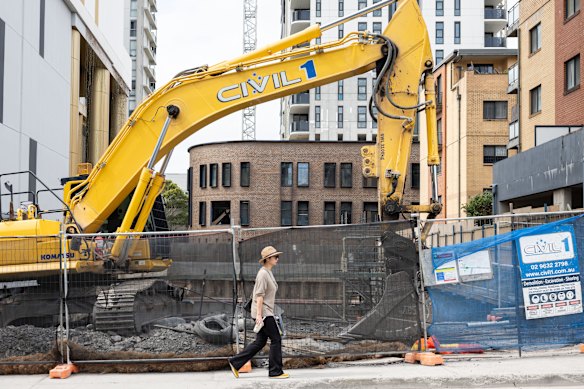

New housing supply is at risk of stalling just when the government has been focused on improving housing affordability, with analysts warning developers face historically tough conditions due to tumbling house prices, rising construction costs and the retreat of a key funding source.
Morgan Stanley property analyst Lauren Berry told journalists in a briefing in Sydney last week that the current economic and policy conditions were generating a “perfect storm” for lower supply.
“Specifically for residential developers, we think we’re seeing some of the most challenging conditions to build and sell housing that we have seen ever,” she said. “Really, it’s heading into a bit of a perfect storm for lower supply.”
Developers have long warned on rising costs, and the industry was rocked by the August collapse of Sydney development company Bathla Group, which owed more than $3 billion.
Berry pointed to cooling property prices, tax settings which she said, “obviously disincentivise property investment in the established market,” and inflation, especially in fuel prices.
“This is driving up construction costs, and then on top of all of that, we’ve got the pullback in private credit as well, and that’s been underpinning a lot of apartment development,” she said. “And if that pulls back, then you know you’re going to see a downturn in supply on the back of it.”
The federal government’s Housing Australia Future Fund, which is aiming to finance the construction of 40,000 social and affordable homes over five years from mid-2024, has, as of September 2026, completed 1600 homes with 7850 more under construction.
Treasurer Jim Chalmers has maintained the government’s tax and housing policies aim to make homes more accessible, but has said it is “not yet clear” how the Reserve Bank’s five interest rate rises this year will affect the economy and that “the risks are substantial” for the housing market and economy more broadly.
Data from the Australian Bureau of Statistics’ consumer price index showed new dwelling prices rose 5.1 per cent in the 12 months to October 2026, up from a 4.7 per cent rise in the 12 months to September 2026, driven by project home builders raising base prices to pass through higher labour and material costs.
Berry said one of the most important factors playing into tougher conditions for developers was likely the loss of buyer confidence.
“We’re just not seeing pre-sales coming through,” she said, noting pre-sales tend to move in line with house prices. “House prices going up, pre-sales go up, house prices go down, pre-sales go down. New buildings just won’t get off the ground, and we are definitely seeing these launches being delayed, particularly for apartments.”
Peter Icklow, chief executive of Sydney-based developer Monarch Investments Group, who has worked in the industry for 60 years, said he has spent the year looking at projects, none of which ended up being viable.
“There’s no development industry left,” he said. “I’ve seen interest rates at 21 per cent, recessions every 10 years, and it’s never been as bad as it is now.”
Icklow was highly critical of the federal Labor government, including its changes to negative gearing which he said has led to investors leaving the market. He said the “real fallout” for the industry is yet to come.
“People aren’t building houses any more, they don’t want to sell their properties, and there’s no market for investors,” he said. “The government has killed any hope of young people owning a home.”
AMP deputy chief economist Diana Mousina said it has become a tougher market for developers for several reasons.
“There’s uncertainty in the housing market and a lack of transactions because there are expectations that prices will fall a bit further,” she said. “The development environment has also been made difficult by high costs of material and labour, rising interest rates – although they look to have peaked – and tax changes which have pulled some investors out of the market.”
While completion rates for residential housing have remained steady, many of these projects were given the green light before house prices started falling. Mousina said the full impact of the market slowdown on housing supply may be yet to flow through.
“The effect [of the current situation] on housing supply has been mixed,” she said. “We’re still seeing a high level of construction being finished, but new home sales data, which can also come in with a lag, is a bit weak.”
Property Council NSW executive director Katie Stevenson said the peak body was seeing tough conditions hit developers.
“Our members are telling us it’s getting harder to make the numbers stack up,” she said. “Construction and financing costs remain high, and taxes, infrastructure charges and delays are pushing too many viable projects out of reach.”
Stevenson pointed to NSW Premier Chris Minns’ warning on falling stamp duty last week when he walked back new regulations banning property agents from underquoting prices amid a property market where prices were dropping.
“When property activity slows, NSW gets fewer homes, fewer jobs and less revenue,” she said. “Government can’t control every economic headwind, but it can pull the levers within its control to make it easier to invest and build.”
The Business Briefing newsletter delivers major stories, exclusive coverage and expert opinion. Sign up to get it every weekday morning.
 Millie Muroi is the economics writer at The Sydney Morning Herald and The Age covering workplace and economics. She was formerly an economics correspondent based in Canberra’s Press Gallery and the banking writer based in Sydney. Instagram/TikTok: @millie.muroiConnect via X or email.
From our partners
Disclaimer : This story is auto aggregated by a computer programme and has not been created or edited by DOWNTHENEWS. Publisher: www.smh.com.au