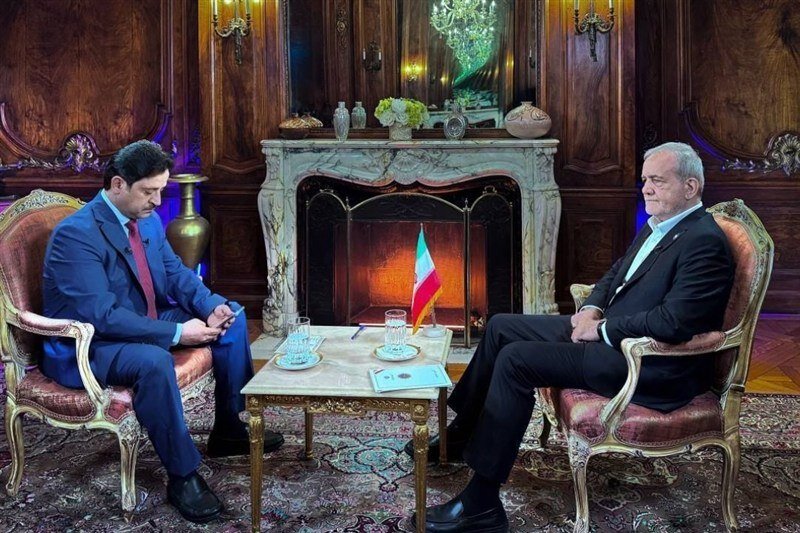
TEHRAN— Iranian President Masoud Pezeshkian has said that differences surrounding the Strait of Hormuz can be resolved through dialogue and regional cooperation, stressing that Iran will not submit to pressure or threats while remaining committed to peaceful engagement with neighboring countries.
Speaking to Al Jazeera during his visit to New York for the United Nations General Assembly, Pezeshkian said Iran remained open to negotiations with the United States but added that Tehran’s confidence in Washington had been seriously undermined by previous violations of agreements and military action following diplomatic engagements.
The president said indirect contacts between Iran and the United States were continuing through mediators, including Qatar and Pakistan, and that the two sides had reached an understanding on a framework for possible negotiations.
He called on Washington to make clear whether it was prepared to engage within that framework and stressed that meaningful negotiations required assurances that any agreement reached would be respected.
Addressing the Strait of Hormuz, Pezeshkian said Iran had not initiated restrictions on the strait and maintained that the waterway could remain open to commercial and free trade provided disputes were addressed through dialogue.
He nevertheless stressed that strait should not be used as a conduit for transporting weapons and military equipment for regional conflicts.
Pezeshkian’s remarks came amid heightened international attention to the security of the Persian Gulf and the Strait of Hormuz. Iran has repeatedly maintained that the security of the waterway should primarily be addressed by the countries of the region and that the presence or intervention of extra-regional powers can complicate rather than resolve regional security challenges.
The president rejected the idea that an external guarantor was necessary to ensure security in the Persian Gulf, arguing that the Arab and Muslim countries bordering the waterway could establish mechanisms for collective security themselves.
He described Iran’s relations with Muslim countries as brotherly and said Tehran was prepared to help resolve disputes among regional states through dialogue, including differences between Saudi Arabia and Yemen.
No surrender under sanctions
Turning to Iran’s economic situation, Pezeshkian acknowledged the severe difficulties created by sanctions but said economic pressure would not force Tehran to surrender its national interests.
He said Iran would overcome the challenges posed by sanctions and would seek or establish alternative economic and commercial routes whenever existing channels were obstructed.
The president also pointed to Iran’s relations with China and Russia, saying the two countries had provided political support to Tehran and that Iran maintained economic ties with both.
Iran’s position on Yemen
Pezeshkian rejected the characterization of Iran as a party to the fighting in Yemen alongside the Houthi movement, saying Tehran’s position was based on sympathy for people facing injustice rather than direct participation in the conflict.
He said Iran was ready to contribute to efforts to resolve differences between Saudi Arabia and Yemen through dialogue.
The president also called for greater unity among Muslim countries, arguing that stronger regional cooperation could prevent outside powers from exploiting divisions among states in West Asia.
He suggested that Saudi Arabia and Mecca, as places of particular significance to the Muslim world, could play a role as a center and symbol of Muslim unity.
Iran says it did not seek war
Pezeshkian said Iran had not sought war but would respond to attacks against it.
At the same time, he stressed that Tehran wanted countries across the region to live in peace, develop their economies and cooperate on security rather than becoming trapped in cycles of confrontation.
On Syria, the president said Iran currently maintained limited relations with the country’s new government, while expressing hope that Damascus would act in accordance with principles of Islam, justice and fairness.
Terrorism and the use of regional airspace
Pezeshkian also described Iran as a victim of terrorism, referring to attacks that have targeted Iranian officials, military commanders, scientists and civilians.
He criticized double standards in international relations and argued that states should not allow their territory or airspace to be used as a platform for attacks against other countries.
The president reiterated that Iran did not seek confrontation with its neighbors and urged Muslim countries to address their differences through regional mechanisms rather than allowing external powers to deepen divisions.
Palestine and Gaza
On Palestine and the Gaza Strip, Pezeshkian said Iran’s position was rooted in support for people facing oppression and opposition to attacks against civilians.
He stressed that Iran’s broader regional approach was based on solidarity with oppressed populations and called for greater unity among Muslim countries in addressing regional crises.
Disclaimer : This story is auto aggregated by a computer programme and has not been created or edited by DOWNTHENEWS. Publisher: tehrantimes.com