
TOKYO –
Japanese technology company MW is developing a home equipped with artificial intelligence and ceiling-mounted robots designed to automate household chores, with the goal of freeing people from the roughly four hours a day that can be spent on domestic work.
The project is led by MW Chief Executive Shuzo Narita, who is seeking to combine physical AI, robotics and residential design so that tasks such as carrying groceries, folding laundry and clearing dishes after meals can eventually be performed automatically.
Physical AI refers to systems in which artificial intelligence not only processes information but also controls machines that interact directly with the physical world. Development is accelerating globally, with companies competing to improve the speed and accuracy of AI-powered robots.
MW is taking a different approach by focusing on everyday household life rather than industrial applications. Narita said the company’s immediate goal is not to create a system that performs every task perfectly, but to build a home in which robots are already useful and gradually improve their capabilities.
“We want to reinvent the home,” Narita said. “We are trying to create a future in which physical AI robots are brought into the house and household chores are fully automated.”
The company’s prototype is built inside a trailer-like structure containing many of the functions of a conventional home, including air conditioning, running water, a washing machine and a kitchen.
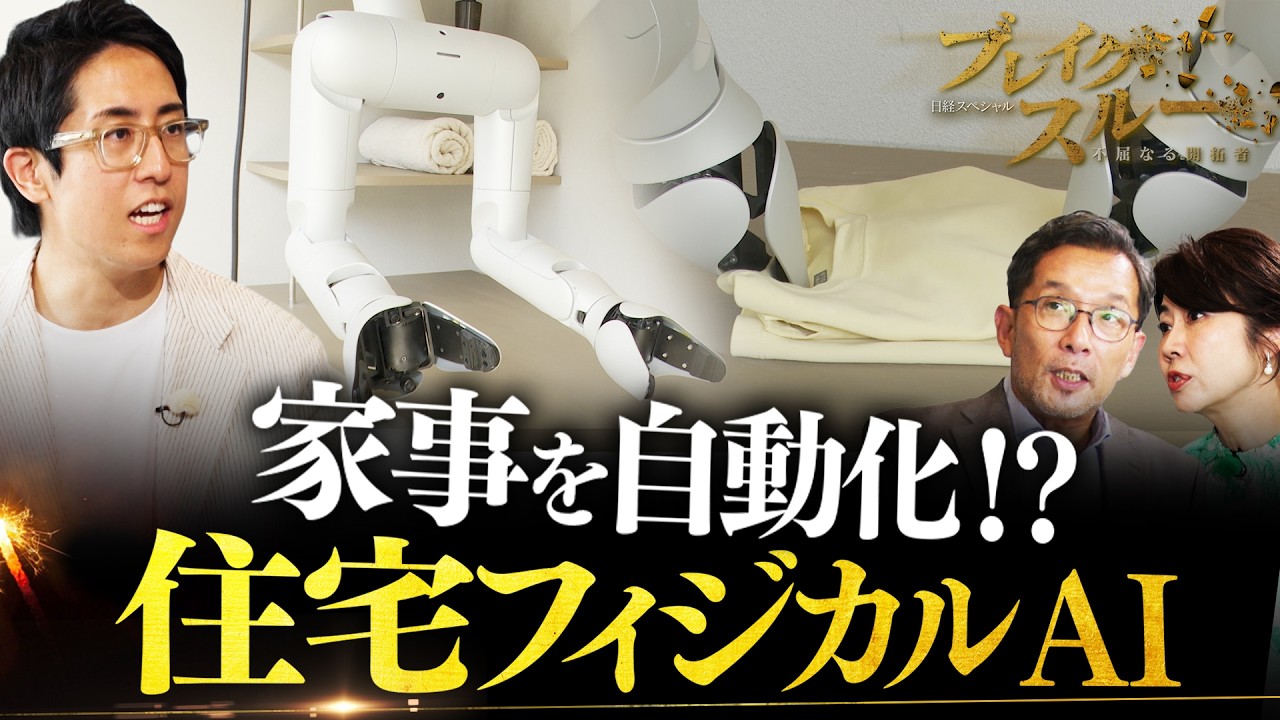
At the center of the system is a robot known as the Moobot, which travels along rails installed near the ceiling. The robot can transport objects through the house and work together with other robotic units positioned in different areas.
In one demonstration, a shopping bag containing groceries is placed in a designated container. Sensors developed by MW detect that the bag has arrived, prompting the transport robot to begin moving automatically along the ceiling rail toward the kitchen.
Once the groceries reach the kitchen area, another ceiling-mounted robot equipped with two articulated arms can take over tasks requiring more detailed manipulation.
MW is also installing sensors throughout the home so the system can understand what is happening in individual rooms and react without requiring residents to operate the robots manually each time.
Tablets are placed in each room as part of the home’s control system, while the company is developing its own AI to coordinate the equipment and household functions.
Narita said the objective is broader than simply creating a highly functional or convenient house.
“We don’t just want to make a convenient home or one with a lot of functions,” he said. “We want to make a home where people can feel that their lives are richer and where they can use their time in a more fulfilling way.”
Automating housework could allow residents to redirect time toward their jobs, hobbies or families, Narita said. The company ultimately hopes to reduce the amount of time people must personally spend on household chores to as close to zero as possible.
The idea is rooted partly in Narita’s own experience. While he was a student, he spent considerable time caring for his mother and handling other responsibilities, making it difficult to secure time for himself. That experience contributed to his decision to pursue technologies capable of automating domestic work.
MW’s longer-term goal is to integrate its robots with a smart-home system in which AI learns residents’ routines and lifestyle patterns. Rather than waiting for instructions, the system would eventually be able to anticipate household needs and carry out chores automatically.
Such a home could, for example, recognize when residents return with shopping, move groceries to the kitchen, manage household equipment and perform routine cleaning or tidying tasks through a network of sensors and robots.
While the technology remains under development and some movements are still slow or imperfect, Narita said the company intends to begin with systems that are practical even before they become fully autonomous.
The company’s broader vision is to use physical AI not simply to replace human labor but to give people back time, allowing them to spend more of their lives on work, family, leisure and other activities they value.
Source: テレ東BIZ
Disclaimer : This story is auto aggregated by a computer programme and has not been created or edited by DOWNTHENEWS. Publisher: newsonjapan.com




