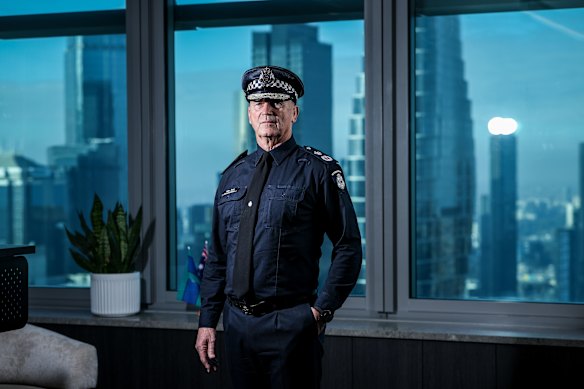

Chief Commissioner Mike Bush is calling for the introduction of graduated mandatory sentencing for serious crime to send a stronger message to criminals, particularly younger offenders, that their actions would have serious consequences.
Under Bush’s proposal, a mandatory minimum would be set for a first offence, with additional punishment for a second and then a third for juvenile and adult offenders to give greater certainty for “victims, offenders and the community”.
“Offenders will know that if they commit serious offences they will be going to jail,” Bush said, in an interview marking his first year in the job, during which youth crime has been a high-profile and politically contentious issue.
After four years of spiralling crime that has prompted an increasingly hardline approach from the state government, the latest figures show a levelling off of the state’s overall crime rate (down 1.9 per cent) and youth offending (down 6 per cent) in the year to March, but both are still well above pre-pandemic levels.
Bush said that many young offenders were “focused on impressing their mates and have no idea of the consequences of their offending on the victims, themselves, their families and the community”.
“We need clarity so that everyone knows what it will look like.”
However, the state’s mandatory minimum sentencing policies have long been contentious. Court of Appeal judges Chris Maxwell and Terry Forrest previously called the practice “wrong in principle”, saying they “require judges to be instruments of injustice”.
In December, new laws were introduced to allow children who commit violent crime – including home invasion, aggravated burglary and carjacking – to be tried and sentenced as adults, despite Attorney-General Sonya Kilkenny conceding they were incompatible with human rights.
In a wide-ranging interview with The Age, Bush outlined a number of major reforms he hoped to see through during his tenure, including to the justice system, reducing violent crime rates, improving technology to introduce instant notifications for offenders breaching ankle bracelet monitoring, and getting more officers back on the street.
Bush said streamlining and simplifying the court process would allow young offenders to be processed before they reoffended on bail. He also pointed to complex disclosure laws that force police to spend hundreds of hours gathering material that might not be needed in court cases.
“It is overly bureaucratic,” he said. “A speedy justice system is an effective justice system.”
Victoria Police was having discussions with the attorney-general over a raft of potential reforms, he said.
The former New Zealand commissioner revealed that he was headhunted and asked to apply for the job, but initially had reservations about what the force was looking for in its next leader.
“I wasn’t interested if I was there to just make up the numbers,” he said. “I felt a local candidate would be better, but if there was a need to drive change, then it might benefit from a fresh set of eyes.
“When I was told there was an appetite for change, I applied.”
Despite an eventful first year that has including overseeing the largest manhunt in Australia and now tackling a crime spree across Melbourne’s nightlife venues, Bush said he intended to complete his five-year term. “The first two or three to make the changes needed, and then two to embed them,” he said.
He said that when he arrived, he was impressed with the quality of police but saw how inefficient paperwork was slowing core duties. “Staff have to do some things three times that should take one. It is the source of constant frustration.”
Bush said that when he took over, he was surprised that “there were almost as many police behind desks and watchhouse counters as on the street. That’s madness.”
As part of his revamp, Bush drastically cut the size of the command team and the leadership public service support group.
He has also ordered a technology review – including the use of AI to provide transcriptions to replace officers sitting behind computers writing reports – and 3000 mobile devices have been rolled out to specialist police that will allow them to look up suspects and upload body-worn camera footage.
A mobile app allowing police to charge and bail street offenders at the point of arrest rather than return to a police station is set to start.
A key part of this strategy will be a $5 million upgrade of the 24-hour State Command and Coordination Centre connecting crime analysts, youth justice officers and Corrections Victoria to monitor crimes and offenders in real time.
Corrections Victoria officers working in the centre would instantly notify police of any breach of ankle bracelet restrictions, allowing patrols to move in before crimes were committed.
Bush called for an expanded bracelet program for prolific youth offender, along with instant breach notification.
He said that with a combination of more police on the streets and a revamped intelligence centre, the aim was to “catch crooks quicker, prevent crimes from being committed and keep our staff safer.”
He also wants to see the centre linked to thousands of cameras across the city via councils and shopping centres. Private and corporate cameras could be kept on a database and allow police to ask for access to gather evidence if required.
Police also wanted access to automatic number plate recognition cameras used in police traffic cars, sheriff vehicles and toll roads to track offenders immediately, “to get in front of the problem”, Bush said.
Though numbers on the force have been declining for years, Bush’s plans to recruit 200 ex-police as reservists to complete non-operational duties, allowing more police back on the road are on track, and he flagged extending the program. By the end of the year, he wants to announce which police stations will have a 24-hour watchhouse service “to provide the community with clarity. Our priority will be to keep our staff on the road.”
As part of the police’s Safe Victoria strategy last year, Bush announced the aim to reduce violent crime by 5 per cent a year and increase the community confidence in the police force to 80 per cent from the present high 50s.
“What the system is doing is starting to work,” Bush said. “It is a good start.”
The chief commissioner has also set a deadline of late 2028 to recruit an extra 1550 police to fill all the present vacancies.
Bush said reaching and keeping numbers relied on recruitment, but also retaining officers through an attractive workplace and encouraging members who had resigned to return to the ranks.
“We are lighting a fire under recruiting and will have double squads going through the academy [increasing graduates from 650 to 1300 a year],” he said. “There will also be a regional academy in Mildura and a second proposed for the Latrobe Valley.”
Asked if the community fears over crime were justified, he said: “In law enforcement, perception is reality. Victorians need to be safe and feel safe. We want to assure the public that we are here for them.”
Start the day with a summary of the day’s most important and interesting stories, analysis and insights. Sign up for our Morning Edition newsletter.
From our partners
Disclaimer : This story is auto aggregated by a computer programme and has not been created or edited by DOWNTHENEWS. Publisher: www.smh.com.au