
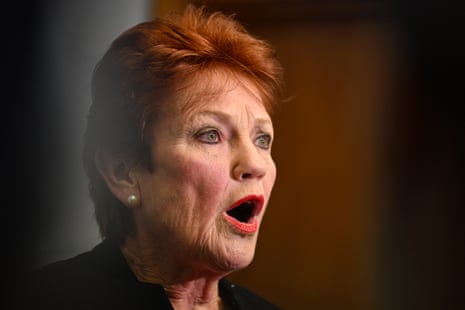
Pauline Hanson decries ‘hypocrites’ in push for early access to super
The One Nation leader, Pauline Hanson, has held a press conference as part of the party’s push to allow Australians early access to super to pay rent or make mortgage payments
She told reporters:
People are struggling to keep roofs over their heads. Have we got an obligation for people in this nation to do what we can to assist them now. It is their money.
I’ll raise another point what a bunch of hypocrites – [treasurer Jim] Chalmers and his staff – when members of parliament can access 3% of their super.
But the Super Members Council has estimated a typical 30-year-old worker on that income would end up $25,000 poorer by retirement if they opted in to the One Nation plan.
Poorer retirees would force the government to spend more on the age pension. The SMC estimated the Covid-era withdrawals, where 3 million Australians took out nearly $38bn, would cost taxpayers up to $85bn by the end of the century.
Jim Chalmers blames Middle East conflict for high inflation
Jim Chalmers has blamed higher global oil prices for intensifying cost of living pressures at home, after inflation jumped to 4.3% in the year to September.
The treasurer in a statement said inflation was “too high”, but that prices were rising faster across a range of countries, not just here.
Fuel prices were up more than 9% last month, and were 24% higher than a year earlier, he said.
We’ve seen higher oil prices driving higher inflation around the world and today’s figures confirm we are not immune from that. From an economic point of view, the [Middle East] conflict can’t end soon enough.
We know this doesn’t make it any easier for families who are under pressure.
The treasurer’s comments come after a sometimes heated debate earlier in the day between the Treasury secretary, Jenny Wilkinson, and Liberal senator Jane Hume around the extent to which government spending was to blame for high inflation.
Sarah Hunter, the RBA’s chief economist, says none of the bank’s real-time economic indicators “are suggesting that the economy is in, or heading into, a recession”.
Speaking at Senate estimates, Hunter’s assessment followed comments by her boss, Michele Bullock, that the Reserve Bank expects unemployment to “gradually move up”, but that “we’re not worried about the pace of increase in the unemployment rate at this stage”.
The key jobless measure has climbed to 4.7%, its highest in five years. But it’s still below the 5%-plus pre-Covid level, and the RBA officials’ comments confirm the central bank’s primary worry is high inflation rather than weak growth.
Woolworths CEO says she expects to see ‘modest inflation’ in grocery prices
The Woolworths group chief executive officer, Amanda Bardwell, says she expects “modest inflation” in grocery prices in the near future.
Speaking to journalists after the company released its results for the first quarter of the 2026-2027 financial year, Bardwell said:
Overall, what we’d expect as we go forward is to see some modest inflation in food, similar to what we will have seen in previous years.
There’s no doubt that as fuel continues stay at elevated levels and input costs continue to rise, that will cause some suppliers to need to ask for price increases.
Bardwell said there had been a surge in requests from the supermarket’s product suppliers to raise prices earlier in the year, immediately after the war on Iran began, but this reduced “fairly quickly” to a “normalised” number of requests.
Inflation in the food and non-alcoholic beverage sector rose again last month according to the latest official data released this morning by the Australian Bureau of Statistics (ABS).
The ABS’s consumer price index showed annual inflation in the sector was 3.2% in the 12 months to September 2026, up from 3% in August 2026.
Aged care algorithm leading to unfair outcomes for older Australians seeking at-home care, estimates hears
More from health estimates: Greens senator Penny Allman-Payne has challenged health and ageing officials at estimates over the aged care algorithm.
Referring to expert testimony and report findings, she argued it pushes critical health issues for older Australians such as dementia, frailty and medication management so far down the decision tree that they barely impact a person’s funding package.
The commonwealth ombudsman’s report examined the integrated assessment tool and found it is leading to unreasonable and unfair outcomes for older Australians when it assesses what level of home support older Australians need.
Allman-Payne questioned why complex cognitive and personal health needs are treated as secondary factors by the algorithm.
We’ve heard from functional assessment experts that these are critical domains, and yet, in the way the algorithm is designed … they come in so late in the decision-making tree that at best they move people up one or two levels.
Functional assessment experts are saying … they should be at the front of the algorithm, so that the questions people are being asked at the start.
Department deputy secretary Sonja Stewart pointed to the government’s recently announced independent review into the classification and prioritisation algorithms.
The government will consider and finalise terms of reference for the review that it has announced, in terms of the classification algorithm and the priority algorithm, and the points that you go to are particularly relevant to the classification algorithm and the involvement of experts in that review.
Inflation is ‘too high’, says RBA deputy governor
Andrew Hauser, the RBA’s deputy governor, said this morning’s inflation numbers were “too high”, but also “broadly in line” with what central bank officials and private sector economists were expecting.
Reserve Bank officials are appearing at Senate estimates this morning, and Hauser said the “nightmare” was that longer-term inflation expectations pick up, which would make it harder to get inflation out of the system.
Hauser said:
We don’t think it is necessarily crystallising yet, but it is a particular risk.
More on inflation data:
The consumer price index shows that costs for everyday goods and services are rising at the same time as unemployment lifts, making life uncomfortable for many households.
Transport costs have risen 8.7% over the past 12 months, due in large part to escalating fuel prices stemming from the US and Israel conflict with Iran.
Food prices have also jumped another 3.2% in a year, and housing costs are up 5.2%.
These are all big components of a typical household budget and are largely unavoidable.
The dynamic feeds into the growing political unease in Australia and elsewhere, as voters express their discontent over reigniting cost-of-living pressures.
Continuing from the previous post, Rothville was also asked about her husband driving off without paying for petrol last week. What was her reaction?
Oh look, it was you know the emoji with the hand on the forehead moment. But look, it happens.
She says she was “just upset” she didn’t return her daughter’s friend’s pencil case herself.
Ben Carroll’s wife joins him on campaign trail
Ben Carroll has a special guest on the campaign bus with him today – his wife, Fiona Rothville. He told reporters he’s lucky she’ll be joining him during the campaign as she’s a “great moral support”.
Rothville adds:
I’m very happy to be involved in the campaign. Not every day … It’ll be you know a couple of times of the campaign here and there again, just to support Ben and support my family and balance my responsibilities.
But her appearance comes amid tension at 1 Treasury Place over her involvement in the running of his office. The Herald Sun at the weekend reported Rothville attended briefings and guided policy.
She denied this:
We’re a family that discusses the news, and so you know it’s the standard conversations.
Reporter: “But is he getting your advice on policy?
Rothville: “No. I mean, I’ll have a view on certain things, and we’ll have a chat just like anybody does. “
RBA governor says more pain needed to bring inflation under control
Michele Bullock, the Reserve Bank governor, says “a further period of subdued growth” is needed to bring inflation back under control, ahead of next Tuesday’s decision on whether to deliver a fifth interest rate hike for the year.
Just minutes before the release of the latest inflation figures, Bullock in her opening statement to Senate estimates pointed to a re-escalating Middle East conflict and its impact on fuel prices. She said the AI investment boom was also playing a part in renewed cost-of-living pressures.
She said:
Importantly though, it is not just these global pressures that are driving inflation in Australia.
While they are certainly compounding the inflation problem, we still see inflation arising from domestic capacity pressures.
The labour market might be “a little bit tighter” than thought despite rising unemployment, and weak productivity is a “fundamental challenge” for the Australian economy, she said.
Against this backdrop, and despite growth in domestic demand slowing, a further period of subdued growth of aggregate demand is needed to reduce capacity pressures and bring inflation down sustainably.
Australia’s headline inflation rate has accelerated to 4.3%, sharpening expectations of another interest rate rise next week.
The Reserve Bank of Australia’s preferred gauge of consumer prices that strips out volatile items, called underlying inflation, was also elevated at an annual 3.6% to the end of September.
The consumer price index release comes shortly ahead of the central bank’s next monetary policy decision on 3 November, when most economists are tipping another increase to borrowing rates.
The cash rate, which informs lending rates including mortgages, already stands at 4.6%, its highest level in 15 years, after four increases this year.
Pauline Hanson decries ‘hypocrites’ in push for early access to super
The One Nation leader, Pauline Hanson, has held a press conference as part of the party’s push to allow Australians early access to super to pay rent or make mortgage payments
She told reporters:
People are struggling to keep roofs over their heads. Have we got an obligation for people in this nation to do what we can to assist them now. It is their money.
I’ll raise another point what a bunch of hypocrites – [treasurer Jim] Chalmers and his staff – when members of parliament can access 3% of their super.
But the Super Members Council has estimated a typical 30-year-old worker on that income would end up $25,000 poorer by retirement if they opted in to the One Nation plan.
Poorer retirees would force the government to spend more on the age pension. The SMC estimated the Covid-era withdrawals, where 3 million Australians took out nearly $38bn, would cost taxpayers up to $85bn by the end of the century.
Disclaimer : This story is auto aggregated by a computer programme and has not been created or edited by DOWNTHENEWS. Publisher: theguardian.com









