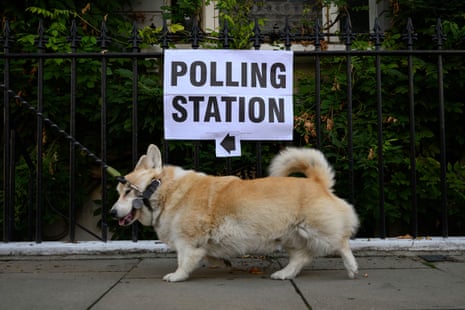
Good morning and welcome to our UK politics live blog.
Polls have opened in Keir Starmer’s old seat in Holborn and St Pancras, where the Green party leader, Zack Polanski, is hoping to break Labour’s longstanding grip in the north London constituency.
He might have his work cut out for him. Labour’s Sagal Abdi-Wali is projected to retain the seat in today’s byelection, but the party shouldn’t take victory for granted. As the Guardian’s senior political correspondent, Peter Walker, reports, Polanski has mounted an intensive campaign, but the scale of the challenge is clear from the numbers. Starmer won the seat by 11,500 votes in 2024, after Labour majorities of nearly 28,000 in 2019 and more than 30,500 in 2017.
You can read Peter’s report from this morning here:
In other news:
-
Andy Burnham is in Berlin today where he will hold meetings with German chancellor Friedrich Merz. On the agenda is a new joint security partnership to counter sabotage, cyber-attacks and other hybrid threats, as well as support for Ukraine, instability in the Middle East, and disruption to global trade routes. We’re expecting to hear from the prime minister this afternoon.
-
The diplomatic row between Britain and Israel is escalating over the UK’s consular presence in East Jerusalem. Israel said the British consulate has “ceased to function” with 20 diplomats due to leave, but the foreign secretary, Ed Miliband, said the building will remain open and renamed the “UK Mission”.
Back to Berlin, Germany’s Merz and UK’s Burnham have issued statements after their talks.
Burnham talked about rebuilding the UK’s relationship with the EU after Brexit. Their meeting in Berlin came ahead of the UK-EU summit later this year – expected in late November – as he said he is “very committed to securing deeper cooperation” with the EU at the summit.
He wanted to see “if we can bring the UK closer to Europe, particularly in the interest of economic growth and collaboration on irregular migration,” he said.
You can read more of his statement, and that of Merz, over on the Europe live blog:
We have some comments (via the Common Wealth thinktank) from Labour MP Alex Sobel and the general secretary of the University and College Union (UCU), Jo Grady, in response to the Transition Security Project report on the government’s military strategy.
As Peter Walker reports, the study warns the UK’s military is too focused on global commitments at the expense of domestic defence, meaning the government’s planned increase in defence spending is likely to result in even greater waste
Sobel said: “At this time of global instability, it is critical that we spend every pound carefully ensuring our troops are well looked after and that procurement supports UK industry and provides best value.”
Grady added: “Working people are repeatedly told there is no money to properly fund our colleges, universities and public services, whilst billions of pounds are poured into maintaining the capacity to fight wars around the world.
“This report exposes the enormous costs to taxpayers and the huge amounts of waste involved. Real security means decent jobs, strong public services and social security, not ever-increasing spending on weapons and war.”
The UK’s military is too focused on global commitments at the expense of domestic defence, meaning the government’s planned increase in defence spending is likely to result in even greater waste, a thinktank report has warned.
According to an analysis by researchers at the Transition Security Project, Britain has the most overseas-oriented military among European nations, with almost a quarter of the defence budget spent on commitments across five continents.
Calling this a symptom of a “destructive, outdated foreign policy” centred on overseas missions that have often made the world less safe, the report says ministers should prioritise changing their approach rather than immediately increasing spending, with resources shifted from overseas commitments to domestic defence.
The government is committed to spending 3.5% of GDP on defence by 2035 and a defence investment plan (Dip) was unveiled in July at the tail end of Keir Starmer’s premiership.
Starmer’s then defence secretary John Healey resigned over a refusal to commit to reaching 3% by 2030, but now that Healey is chancellor that target has been shelved for now.
It would involve a doubling of the defence budget in nominal terms from £70bn in 2026 to £151bn in 2035, according to the Transition Security Project, a research centre that was spun out of Common Wealth, a thinktank with close links to Andy Burnham.
Read more:
Prime minister Andy Burnham has arrived in Berlin, where he was welcomed by German chancellor Friedrich Merz.
Their meetings today will focus on tackling cyber-attacks and hybrid threats in the form of a new security partnership. My colleague Jakub Krupa will have more over on the Europe live blog here.
A serving member of the Royal Navy has been charged with spying, police have said.
Teddy Young, 24, will appear today at Westminster magistrates’ court after he was charged with obtaining protected information that could benefit a unnamed foreign power.
He was arrested at his home in Bedfordshire on 6 October after an investigation by Counter Terrorism Policing London (CTPL). He had now been charged with a number of offences under the National Security Act, the Metropolitan police said on Thursday.
Cmdr Helen Flanagan, the head of CTPL, said: “These are very serious charges against a serving member of the armed forces. We have worked extremely closely with relevant operational colleagues within the Ministry of Defence as our investigation has progressed to ensure appropriate measures could be taken to mitigate any potential risks linked to this matter.”
Read more:
Ed Miliband is in Kyiv this morning. There’s scant information about what he’s actually doing there, other than “make clear the UK’s unwavering support for Ukraine”, as the Foreign Office says. We shall, as ever, bring you more when we get it.
Away from the byelection, research has found Brexit, Liz Truss’s mini-budget and other “shocks” over the last 10 years have led to a serious and lasting deterioration in the UK population’s mental health.
The findings come as Prof Peter Fonagy prepares to publish the report of his long-waited government-commissioned inquiry into the dramatic increases in recent years in diagnoses of mental illness, ADHD and autism. It will be published on Friday amid concern that those conditions help explain why a record 2.8 million Britons are too sick to work and almost 1 million young people aged 16 to 24 have become “Neets” – not in education, employment or training.
Researchers led by Dr Annie Jeffery of University College London used data from the UK Household Longitudinal Study of 87,857 people aged 16 and older, which was collected every year between 2009 and 2024, to estimate the mental health impact of those five “systemic shocks”.
Jeffery said:
The past decade or so has been tumultuous, shaped by multiple overlapping shocks and ongoing uncertainty and instability that have impacted mental health in Britain,” said Jeffery.
We have shown that major government decisions and current global events can have substantial impacts on people’s mental health.
Here are some of the latest images from the Holborn and St Pancras constituency, which the Guardian’s head office is just on the boundary of:
Labour’s flagship changes to special education in England are at risk of unravelling because parents are rushing to secure support for their children before the system changes, new analysis has found.
The Institute for Government (IfG) thinktank says the government’s plans to largely replace education, health and care plans (EHCPs) in England with more widespread support in mainstream schools may be too optimistic and take longer to complete than its 2030 timeline.
The thinktank’s report calls on the government to review the timetable for the changes. And it suggests that if ministers do not act they “risk basing both their reforms and spending plans on assumptions that the system cannot deliver”.
The news will be seen as a sign that the government’s ambitious plans to overhaul the special education system did not reckon with the scale of worry among parents, many of whom appear to have acted to ensure support and avoid uncertainty in the future.
The Guardian recently reported that councils and schools have reported a surge in applications for EHCPs, with one school describing the level as “unreal” compared with previous years. Several councils are now projecting that at the current rates of increase, nearly one in 10 pupils will have an EHCP by 2029.
Amber Dellar, the author of the IfG report out this week, said the long rollout of the changes created a “moral hazard” that encouraged parents to apply for EHCPs now rather than wait for the new system.
Read more:
The foreign secretary, Ed Miliband, has said Britain’s consulate general building in East Jerusalem will not be closing but will be known as a UK mission, remaining independent, operational and serving Palestinian people.
Israel had ordered the British consulate in East Jerusalem to close on Thursday over the UK’s plans to impose sanctions on settlements in the West Bank.
Miliband said that having withdrawn a number of staff and families in recent weeks, it would now work to build up its presence.
He said Britain would not take any reciprocal action against Israel while the two sides engaged in talks, following speculation it could expel some Israeli diplomats from Britain.
Diplomats from other western countries had been worried about any closure setting a precedent, and suggested Britain had to respond strongly to the Israeli move because it had implications beyond the immediate dispute.
The consulate is separate from the UK embassy, based in Tel Aviv, and has a distinct diplomatic role, covering East Jerusalem, the rest of the West Bank and Gaza, where it provides consular services to Palestinians.
Israel had threatened to close it in protest at the UK’s decision to ban trade in goods from illegal Israeli settlements in the occupied West Bank. Israel’s foreign minister, Gideon Sa’ar, said Britain’s decision to impose sanctions was “morally distorted” and accused the governing Labour party of being hostile towards his country.
Read more:
The French finance minister, Roland Lescure, said the UK could rejoin the EU “anytime” after Andy Burnham indicated a major review ofBritain’s relationship with the bloc.
Lescure said it was up to the British public whether to return to the EU, telling the BBC that “if they’re willing to come back, they will have to decide”.
“But what I can tell them is: come back, anytime,” he added. Ben Quinn has the full report here.
As our political correspondent Aletha Adu reported last week, the prime minister opened the door to the UK rejoining the EU, saying Britain could “go all the way” as he prepares to reconsider Labour’s post-Brexit red lines.
Read more:
Good morning and welcome to our UK politics live blog.
Polls have opened in Keir Starmer’s old seat in Holborn and St Pancras, where the Green party leader, Zack Polanski, is hoping to break Labour’s longstanding grip in the north London constituency.
He might have his work cut out for him. Labour’s Sagal Abdi-Wali is projected to retain the seat in today’s byelection, but the party shouldn’t take victory for granted. As the Guardian’s senior political correspondent, Peter Walker, reports, Polanski has mounted an intensive campaign, but the scale of the challenge is clear from the numbers. Starmer won the seat by 11,500 votes in 2024, after Labour majorities of nearly 28,000 in 2019 and more than 30,500 in 2017.
You can read Peter’s report from this morning here:
In other news:
-
Andy Burnham is in Berlin today where he will hold meetings with German chancellor Friedrich Merz. On the agenda is a new joint security partnership to counter sabotage, cyber-attacks and other hybrid threats, as well as support for Ukraine, instability in the Middle East, and disruption to global trade routes. We’re expecting to hear from the prime minister this afternoon.
-
The diplomatic row between Britain and Israel is escalating over the UK’s consular presence in East Jerusalem. Israel said the British consulate has “ceased to function” with 20 diplomats due to leave, but the foreign secretary, Ed Miliband, said the building will remain open and renamed the “UK Mission”.
Disclaimer : This story is auto aggregated by a computer programme and has not been created or edited by DOWNTHENEWS. Publisher: theguardian.com