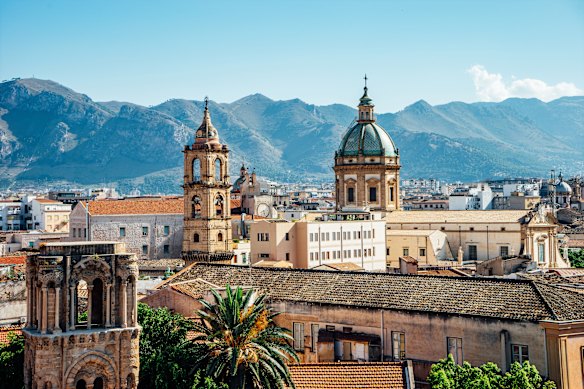

The capital of Sicily was once avoided thanks to its grime and Mafia connections but has cleaned up its act and become Italy’s latest tourist hotspot.
Who goes there
Thanks to several superb monuments and art museums, very lively street life, great food and the world’s best gelato, tourism in Palermo is booming and more cruise ships are visiting than ever before, with the season extending into winter. All the big cruise lines sail there, so do many smaller ones, usually on Italian or western Mediterranean itineraries, but sometimes on longer voyages from starting points such as Southampton.
Sail on in
Don’t get too excited. The backing of mountains is nice, but Palermo itself is mostly flat and doesn’t reveal much by way of charm on the approach. To starboard looms Monte Pellegrino, a lumpy peninsula inhabited since Palaeolithic times. Its Sanctuary of Saint Rosalia is a pilgrim site.
Sign up for the Traveller Deals newsletter
Get exclusive travel deals delivered straight to your inbox. Sign up now.
Berth rites
No surprises at the Stazione Marittima: a white cruise terminal recently renovated, berths for several ships, a tourist information office and other basic facilities. You’re well-positioned for visiting the city, but head inland rather than be tempted by the waterfront, which is flanked by a busy road. Beware taxi drivers unless you want to be fleeced.
Going ashore
If you’re a hearty walker, you could see almost everything on foot but otherwise use the hop-on hop-off bus. Top sights are the Palazzo dei Normanni and especially its staggering chapel covered in glittering Byzantine-style mosaic work, La Martorana church, the cathedral, and the Galleria Regionale for medieval artworks. However, this city of crumbling, blackened baroque buildings provides interesting architecture at every turn, as well as street markets, lively back alleys and hidden chapels bursting with baroque encrustations.
Don’t miss
Although it isn’t in Palermo but 10 kilometres outside it, Monreale Cathedral is one of Sicily’s top sights. A 12th-century Byzantine-Arab-Norman architectural fusion created one of medieval Europe’s great buildings. Floors are inlaid with coloured jasper and porphyry, wooden ceilings are patterned in green and gold, and walls and ceilings covered with dazzling Byzantine mosaics showing biblical scenes, from Noah clambering off his ark to Lazarus being unwrapped by amazed onlookers. The cloister is distinctly Islamic in style, with formal gardens, columned arcades and a fountain strikingly like those in Spain’s Alhambra Palace.
Get active
The alternatively traffic-choked or narrow pedestrianised streets of Palermo aren’t conducive to running or cycling and, while the nearby Madonie mountains are good for hiking and mountain biking, they aren’t easy to get to in a cruise day. Use the ship’s gym instead.
Best bites
Lay off the four-course meals on the ship and save stomach space for snacking in Palermo because Sicilian food is a splendid explosion of flavours that draws on its amazing cultural heritage from Asia Minor, North Africa, Greece, Spain and Italy. You’ll want to try arancini, sfinciuni (the local pizza), pannelle (chickpea fritters) and cannoli for a start. Pani ca meusa (spleen sandwich, a street-market speciality) is better than it sounds. For something more substantial, tuck into pasta con le sarde, pasta with sardines, saffron, pine nuts and raisins.
Further afield
You have several very fine options that will set you dithering, including Monreale cathedral, Segesta for its superb Greek temple in a country setting, Cefalu for its old town and beaches, and cliff-clinging Erice for medieval streets and fabulous views. Agrigento, which has several Greek temples, is another option but the drive is two hours each way, and the site will be hot and crowded by the time you get there, so best reconsider unless you’re a ruin fanatic.
 Brian Johnston seemed destined to become a travel writer: he is an Irishman born in Nigeria and raised in Switzerland, who has lived in Britain and China and now calls Australia home.
From our partners
Disclaimer : This story is auto aggregated by a computer programme and has not been created or edited by DOWNTHENEWS. Publisher: www.smh.com.au