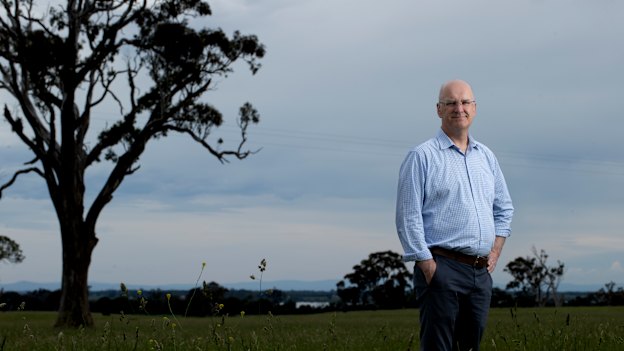
Amid the expected electoral carnage of Saturday night, when anywhere between 25 and 40 seats in the Victorian parliament could change hands, one of the more remarkable stories may be that of the party that, against all odds and without much fuss, quietly protected its own.
Nationals leader Danny O’Brien, while prefacing all his remarks with the normal caveats about taking nothing for granted and having to fight for every vote, says there is a real possibility his party will emerge from this election without losing a seat and perhaps with one or two extra in its column.
If this happens, and the Jess Wilson-led Coalition forms the next government with a comfortable parliamentary majority, it will have been the Nats Wot Won It – the party which stopped an orange wave from swamping northern Victoria.
According to O’Brien, such a result would reinforce two truisms in politics. The first is that, as a political outfit which for as long as anyone can remember has been declared at death’s door, the Nats are very hard to kill. The second is that, for voters who live outside our major cities, elections are principally local affairs.
“We’re counting no chickens,” O’Brien tells The Age during a break in campaigning from his home outside Sale. “We’ve got a long way to go yet until all the votes are counted. But we’ve been through this before. In fact, for 110 years, we’ve had people writing off the National Party, saying we won’t exist after the next election or we will be reduced to a rump.
“We have always prevailed. We’ve lost seats, we’ve won them back and we’re still here because I fundamentally believe that people want a party that stands up for rural and regional Victoria.
“All politics is local. We have local champions as MPs who really work their electorates hard, and we pick candidates who are local champions and passionate about their electorates.
“I’ve seen it, time and time again, where pundits will look at the mood across the board or the polling across the state, and extrapolate that to individual seats and say the Nats will be in trouble. It won’t be the case because we’ve got a fantastic local member or a great candidate who’s really picked up on a local issue.”
The Age reported dire statewide seat projections five months ago, showing the Nats could be swept aside by Pauline Hanson’s One Nation in Murray Plains, Shepparton, Gippsland East and Morwell. Not for the first time, the analysis put insufficient weight on the capacity of the National Party to understand its constituents and the issues that matter.
With only days remaining in the Victorian campaign, the Nationals remain in a perilously close contest in Gippsland East and Morwell. But with both Bendigo seats now considered possible pick-ups, the Nats have a good chance of breaking even and perhaps doing better than their 2022 result.
O’Brien says he was worried when early voting opened last week in Sale and a long line of voters pushed past him to grab a One Nation how-to-vote card. The longer the week went on, the more Nationals voters came his way. A similar pattern was reported at other polling places around country Victoria. “We know we’re under stress in a number of areas so we’ll wait until the votes are counted before we get excited. But there’s no doubt that we’re fighting hard and in with a good chance of doing quite well.”
If O’Brien can hold his own seat of Gippsland West and the Coalition wins the election, as all major polls are predicting, two significant jobs await. The first is serving as deputy premier to Wilson. The second is serving as roads minister in a state where potholes, especially on major regional roads, have become a rim-busting emblem of Victoria’s decline.
O’Brien says his greatest frustration from listening to ministers and senior bureaucrats in public accounts and estimates committee hearings, is the emphasis placed on how much money is spent on a problem, rather than whether it is fixed. The Coalition has committed a whopping $5 billion to road maintenance over the next four years, but O’Brien says the challenge is to spend money smarter, rather than more of it.
He says one episode that stuck in his craw was when the departmental secretary previously responsible for roads, Jeroen Weimar, commissioned consulting giant EY to conduct a study into why 40 per cent of the roads budget wasn’t being spent on roads.
“That just astounds me. Firstly, that the secretary of the department can’t find that out himself and secondly, where is it going? I think we can do a hell of a lot better with the money that we’ve got, and that is not just me. I’ve heard that from contractors, from VicRoads people, and people involved in the sector for a long time.”
O’Brien, like any MP who represents a regional constituency, has become something of an expert on roads. Perhaps the only member of the Coalition who knows more is the Liberal candidate for Benambra, Steve Martin, a project manager with a master’s degree in pavement engineering. O’Brien says you don’t need a postgraduate degree to understand the problem with Victoria’s roads.
“It’s really about basic maintenance,” he says. “We haven’t been doing that preventative maintenance properly. I’ve asked engineers and road builders whether I have missed something, whether a change in technology means we shouldn’t be grading the roadside or cleaning table drains. They say no, that is exactly what we should be doing, we have just stopped doing it because the government hasn’t put any money into it.”
A report by the Victorian Auditor-General’s Office published in September found that, as of 2024, about half of Victoria’s road network was in a poor or very poor condition and a “substantial and growing road maintenance backlog” had been created by a shortage of funding. Shortly before the report was published, the government announced $352 million would be spent fixing potholes this financial year in addition to the $1 billion already allocated to road maintenance.
O’Brien warns the fix, now that our roads have got to this point, will be slow and cost far more than the maintenance the government chose not to do. Whereas resealing an asphalt road to stop water getting in costs about $10 a square metre, rebuilding costs 10 times that amount.
“It’s not dissimilar to the message that Jess [Wilson] and I have been giving on the budget. It’s going to take a long period of time to fix the roads. The roads are likely to get worse before they get better, simply because there hasn’t been that preventative maintenance. I am asking people to be patient. The roads are our single biggest state asset. As an asset manager, we have treated them appallingly.”
O’Brien says that if the Nationals survive this election with all their seats intact, it won’t mean that the threat from One Nation wasn’t real – only that the Nationals, through the hard work of their MPS and candidates, were able to convince enough voters to stick with them.
He says that, irrespective of the result of this election, the anger that drove people to One Nation will not have disappeared.
“People are angry at the way things are. Broadly, that is because of Labor governments, state and federal, but that has reflected on us. People are saying “we want change”, even though they know it isn’t our fault that we are in this position.
“We need to get into government and turn things around. We need to rebuild trust in politics and in our institutions as well. That’s an important job that we’ve got to do if we do get there and even if we don’t. We need to rebuild that trust for people around this state.”
Start the day with a summary of the day’s most important and interesting stories, analysis and insights. Sign up for our Morning Edition newsletter.
Read more on the Victorian election:
Disclaimer : This story is auto aggregated by a computer programme and has not been created or edited by DOWNTHENEWS. Publisher: www.smh.com.au