Homes and businesses will start feeling immediate relief from rising electricity bills within weeks after regulators locked in price cuts for consumers across the eastern seaboard.
The Australian Energy Regulator on Tuesday said it would reduce the maximum rates that retailers can charge customers on standard electricity plans, known as default market offers, from July 1.
The default price cuts – up to 5 per cent ($137) in parts of NSW and 7 per cent ($155) in south-east Queensland – mark the steepest cuts since 2022, when Russia’s invasion of Ukraine pushed up the cost of energy and triggered double-digit power bill rises. Prices will rise 1.5 per cent in South Australia.
The biggest cuts will be for small businesses, whose rates in NSW will fall up to 11 per cent ($705) and 10.5 per cent ($445), the regulator said.
In Victoria, where the state’s Essential Services Commission sets its own default offer, prices will fall by 5 per cent ($84) a year, while small businesses would save 6 per cent ($241) a year.
However, the default offer is not a fixed price, it is a cap on rates. The price listed represents an average amount of energy use, and if a customer’s consumption matches it, that is the most a retailer can charge those who selected the default plan.
Those on the default plan who use less electricity pay less and those who use more, pay more.
The default offer on the Ausgrid network, for Sydney and the Central Coast, is $1899. On the Endeavour network in western Sydney, Blue Mountains and South Coast it is $2328. On the Essential Energy network in regional NSW it is $2604. In South East Queensland the default offer on the Energex network is $1988 and $2334 in South Australia.
The average default offer in Victoria is $1591.
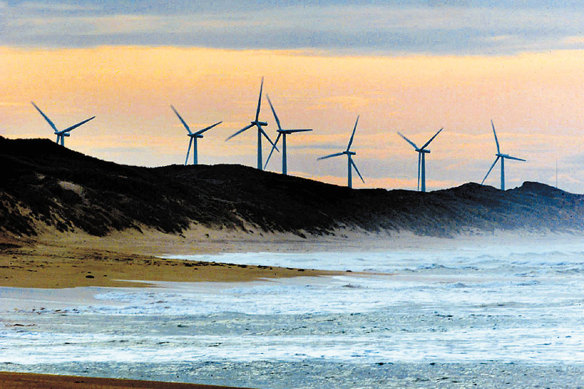
Clare Savage, chair of the Australian Energy Regulator, attributed the cuts mostly to falling wholesale electricity costs – what retailers pay generators for power before supplying customers – following a period of record-breaking contributions from renewable energy, which lowered the need to call on expensive gas-burning power stations to plug supply gaps.
“Despite uncertainty created by conflict in the Middle East, wholesale energy costs have not increased.”
Energy Minister Chris Bowen hailed the falling prices and said it was evidence the government’s plan to replace ageing coal plants with renewables was working.
“Our plan has two parts: more cheaper, cleaner energy and a better deal for households – and that’s what we’re delivering with the latest regulator’s benchmark for energy bills showing declines across households and businesses,” Bowen said.
“We’ve got the best sun and wind in the world, and we’re using our sovereign renewables to shield our grid from global energy volatility and to bring down your energy bills.”
Renewables and giant batteries have powered more than 50 per cent of the grid over the past six months for the first time in history, squeezing coal and gas to record lows, official figures show. Strong output from renewables, combined with a lack of major coal-fired power plant outages, had helped deliver cuts to in electricity prices over that time.
This year’s default market offers – which directly apply to consumers who do not take up special deals but also act as a reference point for retailers such as AGL and Origin Energy – have added significance for household budgets after the Albanese government announced and end to its $75-a-quarter energy bill rebates.
 Nick Toscano is a business reporter for The Age and Sydney Morning Herald.Connect via X or email.
 Mike Foley is the climate and energy correspondent for The Age and The Sydney Morning Herald.Connect via email.
From our partners
Disclaimer : This story is auto aggregated by a computer programme and has not been created or edited by DOWNTHENEWS. Publisher: www.smh.com.au