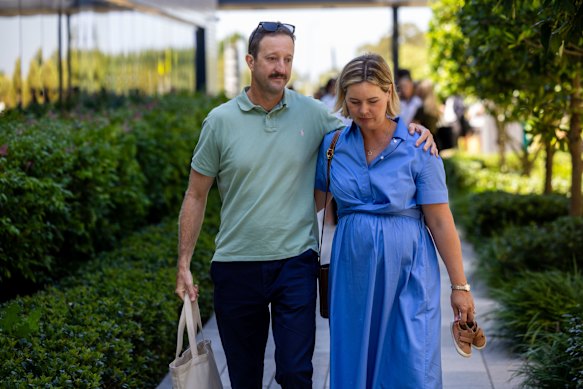
Since the death of her two-year-old, Joe, after serious failures of care at the Northern Beaches Hospital in 2024, several doctors have told Elouise Massa it was “only a matter of time” before a tragedy of that scale occurred at the scandal-plagued institution.
“The writing was on the wall”, they’ve said. It’s always made her and husband Danny “recoil”, she told The Sydney Morning Herald this week. “Why did it have to be our family which was the catalyst for change? But it is and was.”
On Wednesday, the NSW government officially took control of the hospital after a $190 million deal with its former private operator, Healthscope. It brought to a close one of the most significant public policy failures in the state’s recent history. It began in 2013 when the former Coalition government struck a public-private partnership deal to build and run the hospital.
The hospital has been beset by one failure after another. Within weeks of its opening in 2018, the Herald was reporting on shortages of vital drugs including insulin, adrenaline and antibiotics.
The hospital’s then-medical director, Louise Messara, missed the official launch because she had phoned into a meeting with the Australian Salaried Medical Officers Federation – the doctor’s union – which was threatening to support exhausted junior doctors who were withholding treatment from private patients due to “grave concerns” over understaffing. She and two other senior executives at the hospital had moved on within a few weeks.
The then premier, Gladys Berejiklian, dismissed those concerns as “teething problems”. But even the Coalition eventually had second thoughts about the wisdom of paying a private operator $2.14 billion to build and run a hospital, including a public emergency department. Brad Hazzard took over the health portfolio and quietly dumped four more planned public-private hospital partnerships in Shellharbour, Maitland, Wyong and Goulburn.
But the problems at Northern Beaches were not temporary. Reports continued to dog the hospital: a cancer patient having the wrong side of his bowel removed, and allegations that Healthscope offered staff a $500 incentive to convince public emergency room patients to use their private health coverage. And repeated inquiries have found, as the NSW auditor-general put it last year, the model of having a private operator running a public hospital “creates tension between commercial imperatives and clinical outcomes”.
Still, unpicking such a complex – and expensive – contract was never on this government’s agenda. It took a tragedy, and the quiet determination of Elouise and Danny Massa, to make it happen. In February last year, they met Premier Chris Minns and Health Minister Ryan Park, and later Treasurer Daniel Mookhey. All three have spoken of the emotional impact, and they keep a picture of Joe on their desks.
After the boy had spent a night vomiting violently at his North Balgowlah home, his parents took him to the hospital at 7am on September 14, 2024. Suffering significant hypovolemia, his small body was losing too much fluid. A nurse, about to finish her shift, wrongly thought it was gastro, but she said his condition was life-threatening and that he needed treatment within 30 minutes. It was 2½ hours before Joe was given a bed. He went into cardiac arrest at 10.47am. Two days later, his life support was turned off.
On Wednesday, Minns said the Massas were “among the most formidable, intelligent, passionate people” he’d met. As he pointed out, their campaign, launched amid unimaginable grief, was underpinned by an “enormous act of public-spiritedness”.
After those first meetings, senior figures inside the government, including Park and Mookhey, wanted to act to bring the hospital back into public hands, but they realised it may not be possible. The deal struck with Healthscope in 2013 had required the government to pay out all future profits on the hospital until the end of the public portion of the deal in 2038, at a cost of about $900 million to taxpayers.
That was the sum they were working with when news broke in April last year that Healthscope had offered the government the opportunity to buy back the hospital twice in 2023. This prompted criticism of Labor for failing to act sooner. But that astronomical sum, and the risk of creating an unhelpful precedent in dealing with private operators, was why senior government figures resisted earlier calls to trigger a takeover.
This government has had similar negotiations with private operators over, for example, the Eraring power station and the Star Casino. But those did not involve the potential for people to die. Park and Mookhey, for their part, were aware that if they didn’t come up with a deal, the next tragedy would be on them. They initially explored the option of taking back only the public portion of the hospital, but health officials advised that this would be unworkable because, unlike other hospitals, the private and public components at NBH were so closely integrated.
Then Healthscope went into administration in May last year, and the government gave itself the whip hand in negotiations by passing new laws essentially making receivership a breach of contract. It forced Healthscope – and the overseas hedge funds which controlled its debt – to come to the table.
As far as it goes, the $190 million the state is paying for this new(ish) public hospital isn’t too bad. The government is spending $2 billion, for example, to build one in Bankstown, and $910 million for another hospital in Rouse Hill.
If there was one thing the public knew about Labor under Chris Minns, it was that it was anti-privatisation. This hospital takeover will help focus attention on why that position was popular in the first place. Labor may not have intended it to happen, but it will easily rank among its most significant first-term achievements. It also raises an uncomfortable question for Labor and the Coalition, though: how will they fund these projects in the future?
From our partners
Disclaimer : This story is auto aggregated by a computer programme and has not been created or edited by DOWNTHENEWS. Publisher: www.smh.com.au