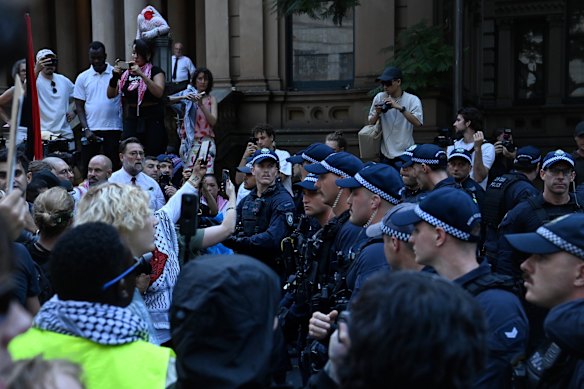

NSW Premier Chris Minns and senior ministers may be forced to testify in court just days before the March state election as part of the criminal case against demonstrators at the now-infamous Town Hall protest.
The defence case says it has subpoenaed Minns, Police Minister Yasmin Catley and Tourism Minister Steve Kamper to answer questions about their role in decision-making in the lead-up to and on February 9, which resulted in confrontations between protesters and police.
More than a dozen protesters are facing charges connected to the demonstration against visiting Israeli President Isaac Herzog, including assaulting police. The rally is also the subject of a Law Enforcement Conduct Commission investigation into police conduct.
A subpoena is a legal order from the court, but one that can be challenged with a valid objection in a motion to the court. That can include relevancy, or if the terms of the subpoena are oppressive, and a judge can decide to set the subpoena aside on those grounds.
A government spokesperson said it would be inappropriate to comment given the matter was before the courts.
Lawyer Nick Hanna, who is representing the protesters, said: “At the hearing we will argue that the police operation was unlawful and that the unlawful nature of it stemmed right from the top of the government.”
Hanna said the date given on the subpoena, March 8, is the first day of hearings in the legal argument as to the lawfulness of police conduct at the protest. Hanna argued there were “cogent and compelling reasons” requiring Minns and the senior ministers to attend court. The election is set for March 13.
The defence will highlight comments Minns gave about the police watchdog inquiry into police actions on the night of the protest, Hanna said.
Minns said in February: “We can’t blame the police for doing what we asked them to do, and that is to keep the people of NSW safe, protect mourners who were down at the ICC on that evening.”
Police officers were operating with powers under multiple pieces of state legislation on the night of the protest, including a Public Assembly Restriction Declaration (PARD), which was part of now-struck-out legislation passed after the Bondi terror attack.
The PARD prohibited protest marches within parts of Sydney designated by the police commissioner, but was later ruled invalid by the NSW Court of Appeal for burdening the implied right to freedom of political communication.
The PARD was invoked by officers on the night and cited in fact sheets used in court cases against protesters, according to court documents seen by this masthead.
Police were also given powers under the Major Events Act, a law which is still valid and one rally organisers failed to overturn in a court challenge in the hours before the protest.
Start the day with a summary of the day’s most important and interesting stories, analysis and insights. Sign up for our Morning Edition newsletter.
 Jessica McSweeney is a reporter at The Sydney Morning Herald covering state politics and urban affairs.Connect via email.
From our partners
Disclaimer : This story is auto aggregated by a computer programme and has not been created or edited by DOWNTHENEWS. Publisher: www.smh.com.au