Prince William says UK faces terrifying risk of more wildfires due to climate change
-
Published
There is a “terrifying prospect” of more UK wildfires in future due to climate change and preparation will be “crucial”, the Prince of Wales has said.
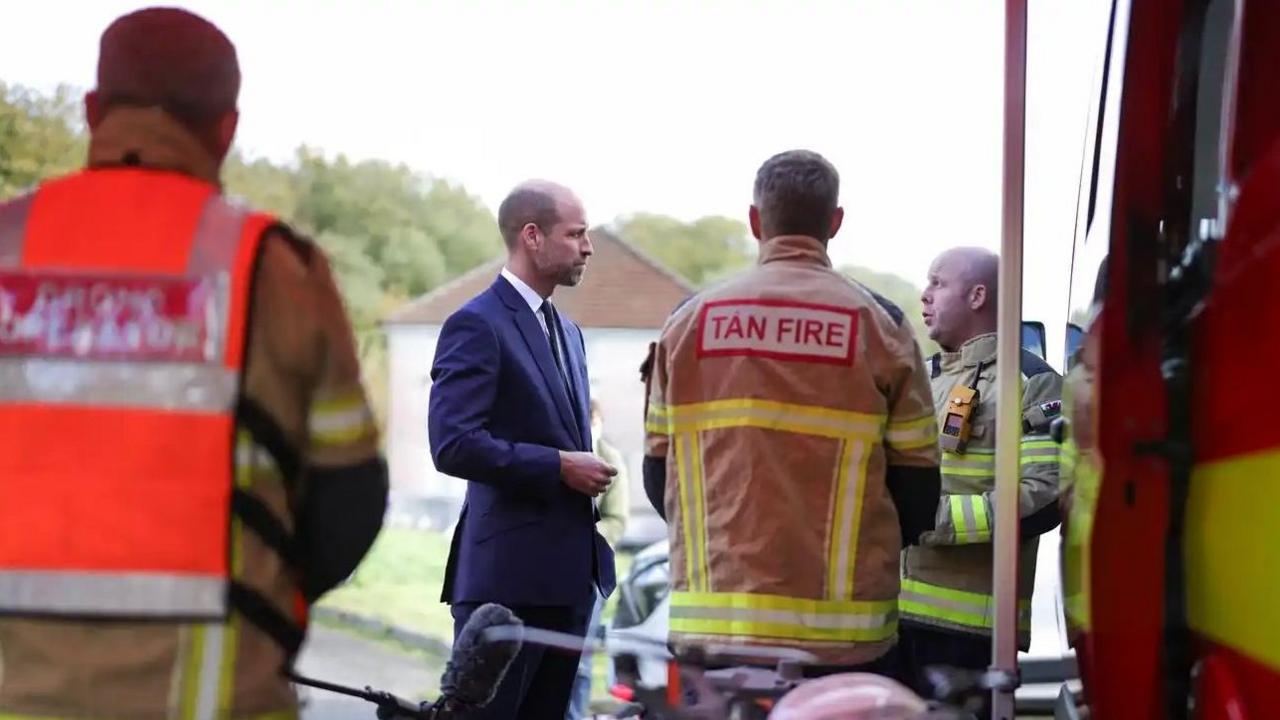
Visiting Treherbert in Rhondda Cynon Taf, which was threatened by a huge mountain fire in August, Prince William praised a “gargantuan” effort to save homes, land and lives.
“We need to start taking wildfires as seriously as the continent has done,” he said, raising issues such as a lack of firefighting aircraft.
He also suggested the community’s response to the incident was an example for others to follow, after locals rallied around to support those fighting the flames.
The hillside, just metres away from the community centre where Prince William met fire crews, military personnel and local volunteers is burnt black.
“You looked up [and] the mountain was alight – it was like lava,” explained Kath Edwards, managing director of charity Valleys Kids, which runs the building.
“I genuinely thought we were going to lose the centre – but more importantly people were going to lose their homes.
“You never think this is going to come literally to your door and that’s what it was – it was just crazy.”
 Image source, Katie Edwards
South Wales Fire and Rescue Service (SWFRS) declared a major incident as it was forced to respond to 14 wildfires at the same time in August, including the one above Treherbert.
Support was drafted in from 22 other UK fire services while soldiers were deployed to dig fire breaks and help supply 2.1 million litres of water to douse the flames, including 200 members of the Queen’s Own Gurkha Logistic Regiment.
Aled Bound, who is crew manager at Maesteg fire station and a retained – on-call – firefighter at Treorchy told Prince William it was “the hardest wildfire season” he and his colleagues had ever dealt with.
 Image source, Katie Edwards
Months of record-breaking heat and dry conditions sparked a wave of wildfires across the UK through spring and summer.
He described it was “mentally and physically draining”.
“I’ve never had to take so much water up a mountain to put on a fire and still come back the next day because that fire has relit, because it’s so deep-seated,” Bound said.
With climate change, he warned it “could well be a sign of what’s to come”.
Figures from the National Fire Chiefs Council show a new all-time high for recorded significant wildfires – 1,350 across England and Wales, up by more than 300 on 2025 and more than 1,000 on 2024.

Prince William told firefighters that 2026 was the first summer “where I’ve felt generally worried about the scale of the wildfires in the country”.
He added: “We might go again next season… it’s quite a terrifying prospect if we’re not… on the ball.”
He asked about availability of firefighting aircraft, noting that “the need for aerial assets has been hoisted quite high up in government” as an area “we’re lacking”.
The prince served a three-year tour flying Sea King helicopters with the Search and Rescue team at RAF Valley on Anglesey between 2010 and 2013, qualifying as a captain.
He recalled flying water bowsers in the Falklands “putting out range fires… and once the Sea King went, we don’t have the assets any more”.
“I think it’s front and centre of many people’s minds now, how do we recreate that.”
 Image source, Katie Edwards
Conversation turned to the kit available to fire crews working in unbearable heat, proactive land management practices and whether social media firms could do more to discourage people from setting fires.
Recently, the UK government announced that the RAF’s Chinook helicopters and A400M aircraft, external would be equipped to fight fires in future.
A separate Welsh government wildfire summit also led to promises of action to improve preparedness, external.
“It feels like this is something we’re going to have to live with as a country or as a world now every summer,” Prince William said.
 Image source, Kensington Palace
“It’s fair to say that we’ve learnt a lot from this season… and there’s lots that we’ll be putting into place, particularly following the wildfire summits,” said Adam Openshaw, deputy chief fire officer for SWFRS.
He described the response of people in Treherbert as “the best demonstration of the community coming together to support the wildfire response”.
He said it really helped as fire crews worked “tirelessly” in “challenging circumstances”.
 Image source, Katie Edwards
Edwards explained that volunteers kept the community centre open 24 hours a day from the Saturday evening of the fire until the following Thursday “to provide whatever service we could”.
Due to the unprecedented nature of the fire, the centre became a control hub for the firefighting operation, a place to rest and regroup and a focal point for people wanting to show their support.
Businesses donated food – “40 pizzas arrived within the first 20 minutes” – and there were regular visits from an ice cream van.
Prince William asked whether volunteers should be used more in future and was told the community’s efforts, hand in hand with military support, enabled the fire service to focus on bringing the incident under control.
 Image source, Kensington Palace
“From something really quite horrific, the valleys did what the valleys do very, very well – we pulled together to make a difference,” Edwards said.
Communities in the south Wales valleys were already experiencing the effects of climate change, she warned.
“We’ve had floods, fires… we’ve got [coal] tips that move as well.
“I think the message I was keen to get across is… we are motivated as a community to ask how do we solve this?
“How can we work together as a community and voluntary sector to support agencies [like the fire service]?”
More top stories
-
-
Published17 hours ago

-
-
-
Published4 hours ago

-
-
-
Published11 hours ago

-
Disclaimer : This story is auto aggregated by a computer programme and has not been created or edited by DOWNTHENEWS. Publisher: newsrss.bbc.co.uk