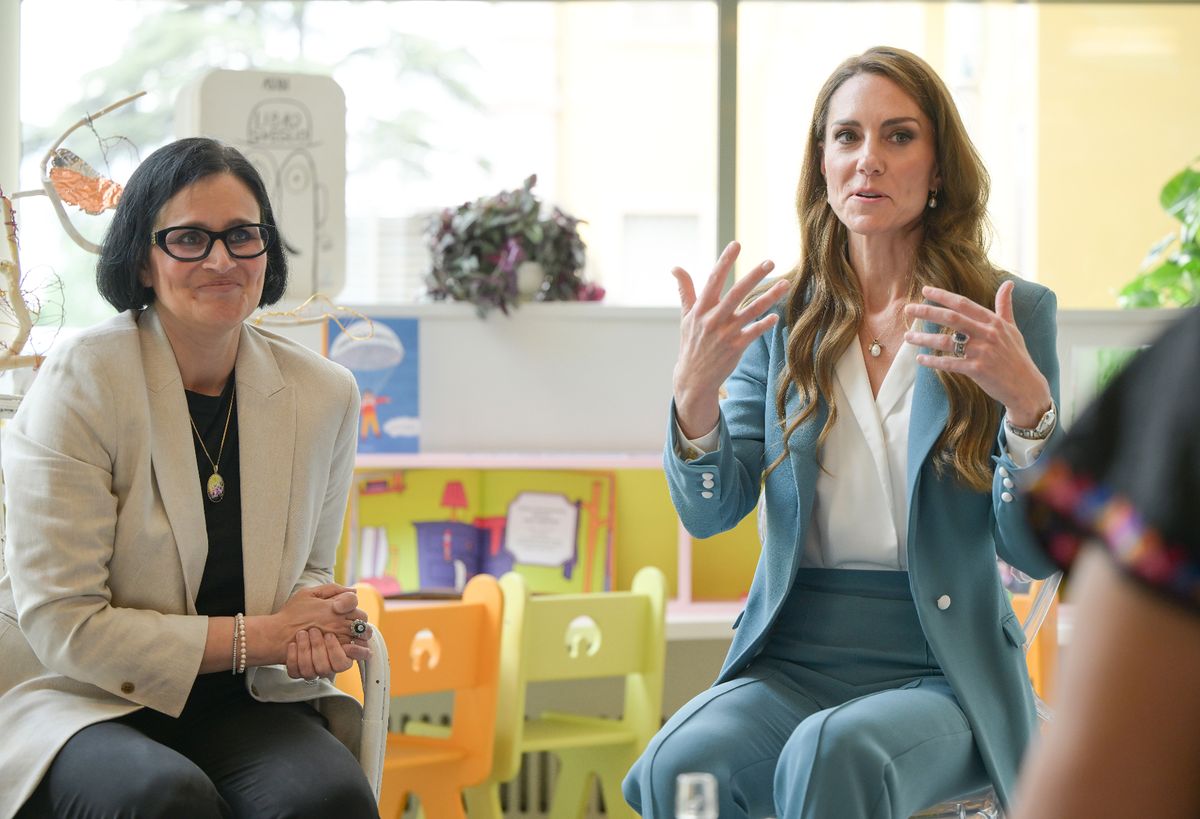
The Princess of Wales has visited the world-renowned Loris Malaguzzi International Centre in Emilio Reggio today after being welcome to the city, where she talked to educators and early years practitioners
The Princess of Wales has spoken of the need to “encourage children to slow down” in their “fast-paced world ”, during her visit to Italy championing work on the early years.
On her second stop in Reggio Emilia today, Kate visited the world-renowned Loris Malaguzzi International Centre, where she met educators and practitioners leading work in the “Reggio Emilia approach”, hearing how it supports social and emotional development.
While walking through the centre’s “light atelier”, a room filled with hanging plastic waves and ornaments on the walls, the centre’s president, Maddalena Tedeschi, explained how it encourages children to interact and play.
READ MORE: Princess of Wales greeted by thousands of noisy fans as she kicks off milestone tripREAD MORE: Kate Middleton taking ‘important step’ in cancer recovery with ‘huge moment’
Kate replied: “And also, it’s encouraging children these days to slow down because their world is so fast-paced now – it’s getting them to notice things, in their sensory environment as well.”
When shown a table covered with multi-coloured plastic objects for children to play with, she said: “I did this in lockdown with the children, we tried to find as many objects in the house as we could with as many colours in the rainbow as possible.”
The princess was hosted on her visit by Miss Tedeschi, and the centre’s international relations lead, Emanuela Vercalli, with Paola Ricco, the education area coordinator. Arriving at the centre, she greeted them with “Bongiorno!” and said was “looking forward to learning more,” adding: “I’ve been meaning to come here for quite some time, so to be here now is very exciting.”
Opened in 2006, the Loris Malaguzzi International Centre serves as a meeting place for international researchers, teachers, and families, focusing on creativity, research, and the documentation of children’s learning.
Each year, it is visited by over 130,000 people who want to learn more about the Reggio Emilia philosophy and embed this learning into their practice, and families who attend one of the specialist “ateliers”.
It is named after Loris Malaguzzi – an Italian psychologist and educator who founded the Reggio Emilia municipal network of infant-toddler centres and preschools after World War II.
After a 15-minute private briefing with the centre’s team to hear more about their work, Kate was shown a pillar featuring the “100 languages poem”, written by Malaguzzi. The poem’s theme is that children have infinite ways to express, explore, and connect their thoughts, feelings and creativity.
After seeing several “light sensory” spaces that children engage with, Kate rolled up her suit sleeves and got stuck into the centre’s clay atelier workshop, led by atelierista, Marco Spaggiari, where she heard how an atelier works in practice, and how children benefit. Shaking hands with some of the other atlieristsas, she laughed as they apologised for smearing her with clay: “Don’t worry! I have children – I’m used to it.”
Sitting down at the table covered with lumps of clay, Kate spoke of how beneficial it is for a child to “actually be able to stop and use your hands and pay attention…these simple things that are all around us.” Slicing herself a lump of clay with wire which she rolled into a long, thin shape, she joked about making clay pasta.
Kate also recalled the video used to promote the launch of her Shaping Us campaign: “We used clay to tell the story of early childhood,” and sounded delighted when the team said they had seen it: “Oh, you’ve seen it? It’s really interesting, this model is embedding connection and expression from the very beginning. Children can learn to draw on these throughout their lives.”
At the end of her tour of the centre, Kate sipped an espresso as she met a small group of delegates from a Latin American study group who travelled from Mexico, Brazil and Colombia to learn more about the Reggio Emilia approach.
She said: “It’s really interesting having a philosophy rather than just ‘a framework’. I really love the therapy approach, it’s not just projecting ‘this is who I am, this is what we do, this is how we tell people how to go through life’.”
As she left the centre, Ms Vercalli presented her with a bunch of flowers, thanking her for the visit and saying she wishes she could stay for longer. Kate told her: “I wish I could stay longer too, thank you so much, I’ve learned a huge amount.”
Disclaimer : This story is auto aggregated by a computer programme and has not been created or edited by DOWNTHENEWS. Publisher: mirror.co.uk