
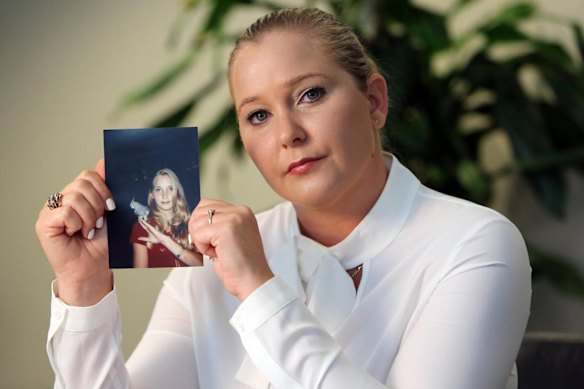
Some of Australia’s most prominent domestic violence experts have thrown their weight behind Virginia Giuffre’s family’s plea for a public coronial inquest, warning that the circumstances surrounding her death raise broader questions about family violence, coercive control and expose systemic failures.
In a rare intervention, 16 researchers and practitioners from some of the nation’s most influential universities and domestic violence organisations have written a letter to West Australian Coroner Ros Fogliani.
The signatories include WA Centre for Women’s Safety and Wellbeing chief executive officer Alison Evans, University of Melbourne professors Heather Douglas and Cathy Humphreys, Monash University professor Kate Fitz-Gibbon, University of Western Australia professor Melanie O’Brien, Curtin University professor Donna Chung and University of Technology Sydney associate professor Jane Wangmann, who is also on the state’s domestic violence death review committee.
It comes after this masthead revealed Giuffre’s US-based brothers, Sky Roberts and Danny Wilson formally requested a coronial inquest in May.
Giuffre died by suicide on April 25, 2025, at her property in Neergabby, an hour’s drive north of Perth, in WA’s Wheatbelt region.
The family does not dispute their sister took her own life. But they believe police failed in their responsibility to thoroughly investigate domestic violence reports, to provide adequate support and to properly investigate an alleged assault on January 9 and early morning on January 10, 2025.
In their letter to the coroner, Giuffre’s family claimed she repeatedly sought police assistance from police.
Giuffre was involved in divorce proceedings with her husband Robert Giuffre, who she shared three children with.
He was granted a family violence restraining order (FVRO) on January 14 against Giuffre in Perth Magistrates Court, shortly after a 72-hour police order against him was lifted.
The FVRO order included two of her children, who were younger than 18.
The experts’ letter says misidentification of victim-survivors as perpetrators is a “well-documented and dangerous failure. One that can result in loss of access to children, exclusion from the family home, criminalisation, and significantly elevated suicide risk”.
WA CWSW chief executive officer Alison Evans said a victim’s distress and suicidal thoughts should not be treated as individual disorders.
“(Suicidality) must be understood as responses to ongoing violence, coercive control and entrapment and systemic failures,” she said.
“When the impacts of abuse are routinely misclassified as a mental health issue, the danger posed by violent partners or family members disappears from view.”
Evans said victims beings mistakenly identified as the predominant aggressor can contribute to suicidality.
“In some cases, women’s defensive actions, such as fighting back, are misinterpreted as aggressive behaviour, leading to their identification as the predominant aggressor rather than the person most in need of protection,” she said.
In the experts’ letter, they argued it would be a “profound injustice” if the events leading up to Giuffre’s death were not examined.
“Virginia Giuffre spent much of her adult life in a courageous pursuit of accountability for the abuse she suffered, taking significant personal risk to expose a network of exploitation and in doing so, helping to protect other women,” the letter states.
“It would be a profound injustice if the question of whether systems failed her in her final months were not examined with equivalent rigour.
“We owe her that, and we owe it to the many women whose experiences mirror hers but whose deaths will never receive this level of attention.”
One of the signatories, University of Melbourne professor Heather Douglas, said Giuffre’s death could be the catalyst to help others.
“Most importantly, an inquest could look into how responses to violence and trauma can be improved to ensure that victims like Virginia are not let down by the very systems designed to protect them,” she said.
An inquest would have the ability to scrutinise the actions of police, support services, the courts and other relevant agencies in the lead up to her death and provide recommendations.
The Coroner’s Court of Western Australia said the matter was under active investigation and a decision about an inquest will be made after the police investigation is completed and next of kin consulted.
WA Police and Robert Giuffre have been contacted for comment.
 Carla Hildebrandt is a journalist with WAtoday. She previously worked on ABC’s Four Corners and as a court reporter at The Daily Telegraph in Sydney. For secure contact: carlahildebrandt@proton.me.Connect via email.
From our partners
Disclaimer : This story is auto aggregated by a computer programme and has not been created or edited by DOWNTHENEWS. Publisher: www.smh.com.au





