
Prosecutors in England and Wales have been told to “fast-track” hate crime prosecutions after a spate of antisemitic attacks that the prime minister on Tuesday called a “crisis for all of us”.
Stephen Parkinson, the director of public prosecutions, issued guidance to his staff on Tuesday telling them to bring forward prosecutions against any sort of hate crime as quickly as they could, rather than waiting until they had gathered all possible evidence.
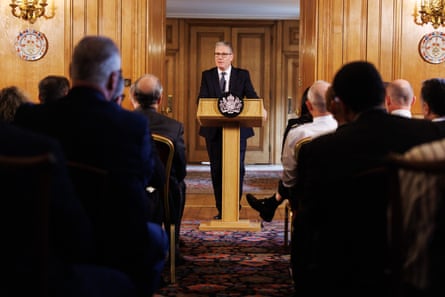
Keir Starmer urged groups including universities, arts groups and charities to do more to tackle antisemitism during a summit in Downing Street.
As well as imposing new reporting requirements on universities and the Arts Council, the prime minister threatened “consequences” against Iran if it was found to have been behind last week’s stabbing in Golders Green, north London.
Parkinson said in a statement on Tuesday: “The acts of extreme violence and criminal damage that we have seen against the Jewish community in recent months have been deplorable. People have been arrested and charged and those cases will be dealt with as quickly as possible.
“But it is also clear that there are daily threats or abuse which are designed to harass and distress Jewish people. These, too, are criminal offences and they are contributing to a climate of fear felt by the Jewish community.”
Under the changes he announced, prosecutors will be encouraged to bring hate crime prosecutions as quickly as possible “even if some supporting evidence can be obtained later”. This contrasts with other offences, where prosecutors are urged to compile a full file of evidence before making a charging decision.
They will also be told that in some cases, such as public order offences, they will be able to recommend charges based on a reliable victim’s account, without any supporting evidence. If dealing with an assault case, they will be asked to take into account photographs of injuries or medical notes as well.
The new guidance is one of a number of actions organisations are taking as part of Starmer’s push to combat antisemitism after last week’s attack on two Jewish men in Golders Green. Police are treating that attack as terrorism.
Starmer said universities would now be expected to publish audits on the scale of antisemitism on their campuses, while Arts Council England would be expected to withdraw funding and claw it back from anyone found to promote antisemitism.
The prime minister told those at the summit: “I am calling on you to act with urgency – to look clearly at where you are succeeding – and just as clearly at where there is still work to be done. And to commit to the tangible action that Jewish people in this country need to feel safe again. Because stopping antisemitism is not someone else’s responsibility: it is all of ours. That is the test before us, and only by working together will we meet it.”
Vivienne Stern, the chief executive of Universities UK, said: “Antisemitism continues at universities and in wider society, despite the diligent efforts of many, including in higher education … Tackling this growing societal evil will take all of us, working together, to make any difference.”
The prime minister also warned Iran he would take further action if it emerged the country was behind the recent spate of antisemitic attacks, including last week’s stabbings and recent arson attacks.
“We are investigating, of course, all the possibilities,” Starmer said after the meeting. “And we are clear that these actions will have consequences if that proves to be the case. Our message to Iran or to any other country that might seek to foment violence, hatred or division in society is that it will not be tolerated.”
The government has promised to introduce a law making it easier to place sanctions on state-backed groups such as Iran’s Islamic Revolutionary Guard Corps, but is under pressure to move more quickly.
A spokesperson for the Campaign Against Antisemitism, which was not invited to the summit, said: “We all know that Iran is a malign influence in this country, so why hasn’t the IRGC been proscribed and its ambassador expelled?”
The Board of Deputies of British Jews, which did attend, has made the same call.
Disclaimer : This story is auto aggregated by a computer programme and has not been created or edited by DOWNTHENEWS. Publisher: theguardian.com



