Somewhere between a pub, a dive bar and a communiuty living room, the mighty Kneipe is a ubiquitous cultural cornerstone in Germany. Here’s a pint-sized guide of it’s history.
If you’ve spent any amount of time in Germany, from the biggest cities to the smallest villages, you will have encountered one – the lace-curtained windows, the faded gold lettering and the cast of characters murmuring Prost (cheers) around their Stammtisch (regulars’ table) – the German Kneipe is an institution.
But as the skylines of our cities shift under the weight of glass-fronted developments and the younger generation swaps pilsner for matcha, Kneipenkultur could well be entering its most challenging phase yet.
A tight squeeze
Sitting somewhere between a traditional pub and a dive bar, the term Kneipe emerged in the 18th century as a shorthand for Kneipschenke.
The name is rooted in the verb kneipen; literally “to press together”. These were premises so cramped that guests had no choice but to sit shoulder-to-shoulder.
At this time, beer was primarily the drink of the lower classes, consumed in modest local taverns. But the Kneipe was never just about alcohol alone. In the 19th century, these premises were vital refuges for the labour movement.
During the era of the Anti-Socialist Laws, they became central political spaces where the resistance could meet under the guise of a quiet pint.
READ ALSO: ‘Beer is cheap and everywhere’ – How Germany’s drinking culture surprises foreigners
While you might hear more formal terms like Schankwirtschaft, Taverne or Spunten across Germany, Kneipe remains the definitive term.
But a word to the wise. While you may hear a Kneipe be referred to as a Lokal, the general term for a place to eat and drink, a Lokal is rarely a Kneipe. One serves simple drinks; the other serves three-course meals.
Germans, particularly those of a certain generation, take this distinction very seriously.
A shelter during tough times
In the early 20th century, Germany’s drinking culture formed the foundation for numerous livelihoods. Many people worked in the hospitality industry, and positions as innkeepers, waiters, beer drivers and brewers were common.
During the hyperinflation of the 1920s, Kneipen kept a roof over people’s heads in an even more immediate way.
“Bum pubs” or vagrant bars provided an alternative to police-monitored shelters. In unlit back rooms, the unemployed and “shady characters” would doze in armchairs, while early-morning trade in bread, potatoes and liquor took place before the city fully woke up.
Following the devastation of the Second World War, the Kneipe took on a new role as a symbol of Germany’s reconstruction. By the 1950s, you could find a pub on literally every corner on some city intersections.
They became vital community pillars in a country still lying in ruin and with a limited number of social spaces outside the home or workplace. Despite their increasing number and proximity to one another, patrons tended to stay loyal to their local pub.
READ ALSO: 10 fascinating facts you never knew about German beer
Gentrification and changing tastes
Today, statistics paint a sobering picture for the Kneipe. Between 2009 and 2015, the number of pubs and restaurants across Germany plummeted from nearly 36,700 to around 31,100.
Hamburg was at one time the leader in closures, losing 48.1 percent of its establishments in a decade, closely followed by Lower Saxony.
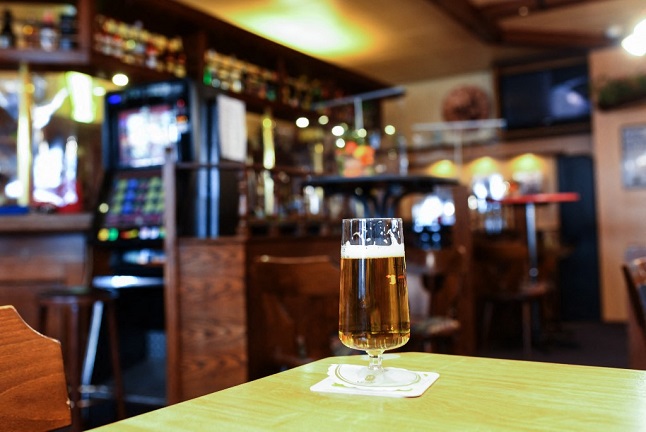
A glass of beer stands on a table in a Kneipe in the city in Oberhausen, western Germany. (Photo by Ina FASSBENDER / AFP)
The reasons for the downturn are many and varied. People have been steadily drinking less beer since the 1970s, and younger generations are opting for different leisure activities over the smoke-filled corners of a traditional pub.
Rising rents, higher living costs and changing demographics are also dealing a heavy blow to the humble “corner pub” in favour of more profitable, high-end ventures.
READ ALSO: Everything you need know about Germany’s sacred ‘Biergarten’ culture
A space for community (and conflict)
Despite the decline, the Kneipe remains a central pillar of community identity for many. They are often the headquarters for local clubs, sports associations and neighbourhood groups, proudly displaying club flags and trophies.
Traditional features such as pool tables, dartboards and the ubiquitous “savings box” for local members still hold firm in many establishments.
In some corners of the country, new life is being breathed into these old bones. For example, in Düsseldorf’s Altstadt, friends Tim and Anthony have brought things full circle by taking over a legendary local institution known simply as “Kneipe” that’s been operating since 1974.
Now, the duo is ensuring its survival for the next generation of regulars.
Further east in Hesse, the opening of “Zum Fierche” in Bad Hersfeld this year brought together younger newcomers and “long-time Hersfelders”, evidence that there’s still absolutely a place for the traditional Kneipe in modern German society.
In districts such as Berlin’s Neukölln, Kneipenkultur is still alive and kicking. Pass through Hermannstrasse on any day of the week and at any time of the day or night, and you’ll see iconic Kneipen such as Bierlokal Zum Umsteiger and Bäreneck brimming with locals of all ages and demographics.
They might be smoky, dingy, and the bartender might be a little rough around the edges, but if you’re looking for a simple beer and a taste of true German culture, there’s no place better.
Disclaimer : This story is auto aggregated by a computer programme and has not been created or edited by DOWNTHENEWS. Publisher: thelocal.de