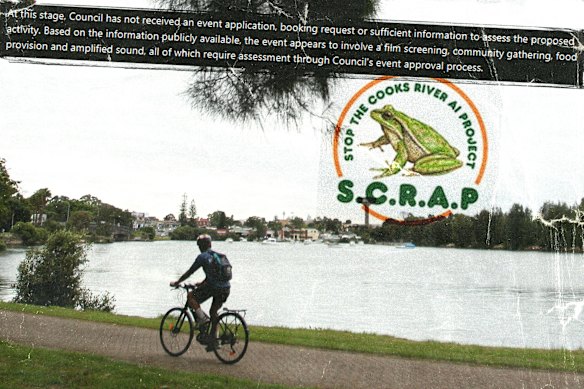

When is a protest not a protest? According to Bayside Council, in Sydney’s south, when it’s a “community gathering”.
A group campaigning against developer Stockland’s proposed $2.9 billion, 25,400-square-metre data centre at the former Kogarah Golf Club site on the banks of the Cooks River was left bemused after the council wrote to it this week informing them they would not be allowed to hold a protest in a park on Friday evening.
Despite submitting a “Form 1” notice informing the NSW Police about their intent to hold the gathering – billed on social media as a “no AI data centres” event featuring speakers, a community barbeque and 15-minute film screening at Cahill Park in Wolli Creek – Bayside Council has told the group no.
In correspondence seen by the Herald, the council wrote to the group saying it had “not received an event application, booking request or sufficient information to assess the proposed activity”.
The group required approval, council said, because it was holding a “community gathering” involving food, a film screening and “amplified sound”.
“As council has not been provided with the information necessary to undertake a proper assessment, including consideration of the proposed activities, infrastructure, venue availability, park capacity, operational impacts and any other event scheduled at the site, council is unable to support the event proceeding on the advertised date,” the council staffer wrote.
Despite the warning, the group, called Stop the Cooks River AI Project, or SCRAP, insists it will proceed with the demonstration, saying councils do not have the power to ban protests.
“Their initial correspondence just said well we don’t support this going ahead, you can apply to hold an event, but it’ll take a minimum of eight weeks to assess. We haven’t existed for eight weeks,” one of the group’s members, Caitlin Boyce, said.
“We’ve told them we’re happy to work with them on any reasonable requests, and that we’re more than happy to comply with things like not putting posters up on trees and staying off the sporting fields.”
But the council was not satisfied. On Thursday, Bayside Council wrote to the group again insisting they would need public liability insurance to hold a protest, which SCRAP estimates could attract up to 100 people.
The council is opposed to the proposed data centre, and lodged a submission to a NSW parliamentary inquiry warning the glut of controversial proposals under assessment in the state were consuming scarce industrial land near Sydney Airport and Port Botany.
It has not said whether it plans to issue fines to the group, or attempt to block the protest from proceeding. It did not respond to a request for comment from the Herald.
The stand-off exposes a tension between local council regulations, which often require permission for events, and the broader implied freedom of political expression. The attempt to restrict the community group’s demonstration has drawn the ire of other groups, with Anastasia Radievska, the protest rights campaigner at the Australian Democracy Network, saying the attempt to impose “red tape” on protests could deter smaller community organisations from organising.
“When councils have the power to say yes or no to a protest, a democratic right turns into a permission slip,” she said.
It is not the first time the nascent group has faced restrictions on its campaign against the proposed data centre.
Last month, SCRAP members were moved on by security while attempting to hand out leaflets on the village green at Wolli Creek.
After relocating to a footpath across the road from Wolli Creek train station, the group were told that land was also privately owned.
The group complied with the request, but one of its members, University of Sydney academic and long-time activist Paddy Gibson, wrote to the company that owns the Wolli Creek development, Discovery Point, to insist on its “statutory and constitutional rights to engage in public political activities in NSW”.
The company – which is owned by the Australian arm of Singaporean property developer Frasers – replied that it did not allow “political campaigning, protest activity, distribution of campaign material or associated signage anywhere within the privately owned Discovery Point property”.
That ban extended to the “privately owned roads, common areas and other areas forming part of the Discovery Point property”, the company wrote in correspondence seen by the Herald.
Gibson said he was “incredulous” at the email. “I just wrote to them saying, like, mate, there’s an implied freedom to political communication in this country,” he said. “We’ve got rights, mate.”
“It’s not as if we were setting up a stall trying to sell mobile phones or something, we’re handing out leaflets.”
A representative from Discovery Point said he was unable to comment, but confirmed the “Discovery Point precinct is privately owned and managed land”.
Start the day with a summary of the day’s most important and interesting stories, analysis and insights. Sign up for our Morning Edition newsletter.
From our partners
Disclaimer : This story is auto aggregated by a computer programme and has not been created or edited by DOWNTHENEWS. Publisher: www.smh.com.au