
TEHRAN – In the historic Iranian city of Isfahan, where centuries of artistic ingenuity have shaped one of the country’s richest cultural landscapes, an age-old craft continues to bring colour, patterns and stories to life on fabric. Known as Qalamkari, this traditional textile art combines hand-carved wooden stamps, carefully prepared dyes and intricate Persian designs to produce decorative fabrics that are both functional and artistic.
Rooted in Iran’s long tradition of craftsmanship, Qalamkari became particularly prominent in Isfahan, especially during the Qajar era, when its printed textiles developed into some of the city’s best-known artistic products. Beyond their decorative appeal, some of these fabrics served as visual narratives, portraying episodes from Persian epics, historical events and religious traditions.
Isfahan, nicknamed Nesf-e Jahan, meaning “Half the World”, was the capital of Persia during the Safavid era and a major crossroads of international trade, diplomacy and artistic exchange. Under the Safavid monarch Shah Abbas I, the city experienced a remarkable cultural and architectural flourishing, helping establish its reputation as one of the most important centers of Persian art and craftsmanship. Today, it remains one of Iran’s leading tourist destinations and a prominent hub of traditional handicrafts.
An art shaped by wood, color and fabric
Qalamkari, also known as Kalamkari in some transliterations, is a traditional method of decorating textiles through printing with hand-carved wooden blocks. Artisans use these stamps to transfer elaborate patterns onto fabric, often combining several colors and motifs to create richly detailed compositions.
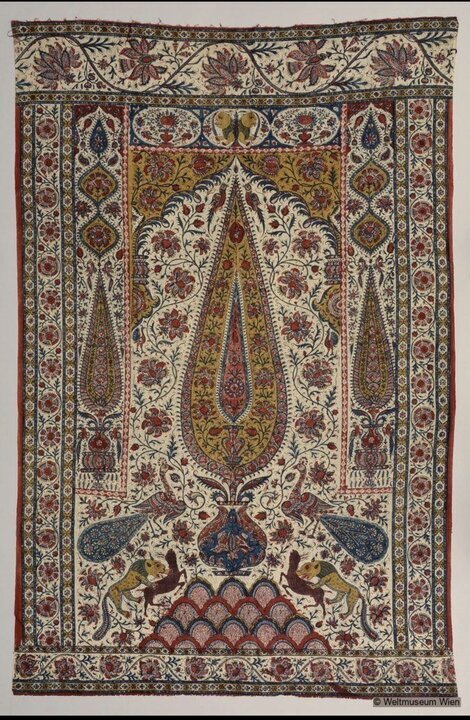
The designs draw inspiration from a broad range of Iranian artistic traditions, including Persian carpets, architectural ornamentation and the elaborate tilework of historic mosques. Floral and botanical patterns, animals, arabesques, geometric arrangements, hunting scenes and Persian calligraphy are among the recurring motifs.
Flowers, cypress trees and other elements of nature feature prominently, often evoking the visual richness of traditional Persian gardens. The resulting compositions reflect a distinctive aesthetic in which symmetry, repetition and a harmonious combination of colors play central roles.
Cotton is among the most widely used materials for Qalamkari because of its ability to absorb dyes. Silk, canvas and fustian have also been used, depending on the intended purpose and desired finish.
The traditional production process requires considerable precision. First, an artisan prepares the design and selects the appropriate wooden stamps, each carved with a particular section of the intended pattern. The raised surfaces of the blocks are coated with dye and pressed onto the fabric to transfer the design.
Producing multicolored patterns requires several stamps, each corresponding to a different color or part of the composition. Their placement must be carefully coordinated so that the separate elements align correctly. Even a slight misalignment can disrupt the overall design.
The craft therefore involves much more than simply pressing a wooden block onto cloth. Knowledge of dyes, fabric preparation, pressure, spacing and the precise registration of patterns is essential. In some examples, hand painting is also combined with block printing to achieve more elaborate effects.
A craft with a long history
The precise origins of Qalamkari in Iran remain uncertain, and no definitive historical reference establishes when the craft first emerged. However, according to the renowned art historian Arthur Upham Pope, the art was already practiced in Iran during the Ghaznavid period.
It subsequently developed through different historical periods, reaching particular prominence under the Safavids. The reign of Shah Abbas I was especially significant for Isfahan’s artistic and commercial development, as the city became an important center for the production and exchange of Persian handicrafts.
Although Qalamkari flourished under the Safavids, it was during the Qajar period that Isfahan’s printed textiles became especially well known. Their popularity extended beyond decorative applications, with different fabrics serving as garments, tablecloths, curtains and large wall hangings.
Some pieces featured repeating floral and geometric patterns, while others incorporated elaborate figurative compositions. In the latter, the fabric became a surface for storytelling, bringing together characters, landscapes and historical or religious episodes.
When fabric became a storytelling medium
One particularly interesting aspect of Iranian Qalamkari is its ability to communicate narratives through images.
A number of historical examples preserved in international museum collections demonstrate that these textiles were not always intended merely as household decorations. Some depicted scenes from Persian heroic literature, while others illustrated religious beliefs and historical events.
The Weltmuseum Wien (Vienna’s World Museum), for instance, houses several examples of Iranian printed and painted textiles attributed to Isfahan and dating from the 19th century.
One of them is a cotton wall hanging from the mid-19th century, during the Qajar period, measuring 176 centimeters in height and 116 centimeters in width. Originally part of the collection of Austria’s Museum of Trade, the piece features a variety of traditional Iranian motifs, including scenes inspired by Persian epic stories, floral compositions, cypress trees emerging from vases and animal figures.
Another notable example, titled The Day of Judgment, is a late-19th-century cotton wall hanging attributed to Isfahan. Combining printing and hand painting, it depicts scenes associated with the Day of Resurrection from a Shiite religious perspective, including references to the Battle of Karbala and the fate of its martyrs and opponents.
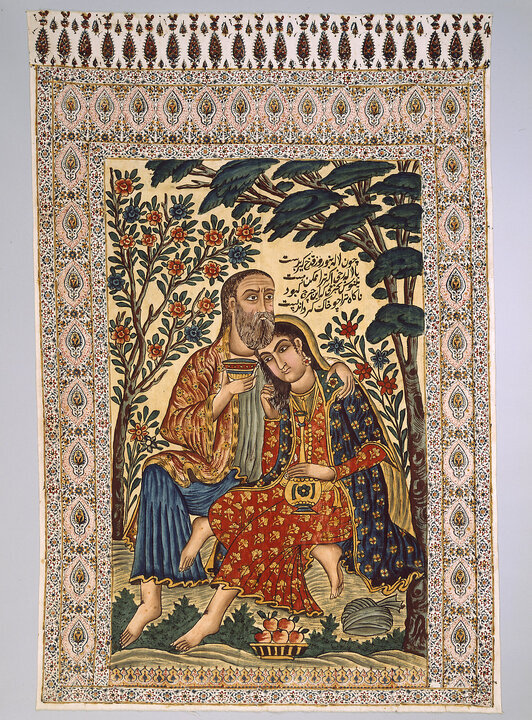
The museum also preserves another late-Qajar textile, catalogued as a pictorial Qalamkari, which incorporates verses attributed to the Persian poet Omar Khayyam. Its message reflects on the passage of time and the importance of appreciating life’s fleeting moments.
Together, these works illustrate the remarkable range of subjects that Iranian textile artisans could accommodate within a single piece of fabric. They also demonstrate how Qalamkari could preserve aspects of Persian literary, historical and religious culture through visual storytelling.
Challenges, decline and revival
Like many traditional Iranian crafts, Qalamkari experienced significant challenges as economic conditions and international markets changed.
During the 19th century, the arrival of cheaper and, in some cases, higher-quality textiles from Britain and Russia made competition increasingly difficult for Isfahan’s producers. According to Encyclopaedia Iranica, the quality and price of locally produced Qalamkari fabrics were not always competitive with imported alternatives.
To maintain production, some manufacturers began importing unfinished white textiles and printing their designs in Iran before selling the finished products. Although this helped sustain the industry for a time, it could not fully address its underlying difficulties.
Keeping a living heritage alive
Today, Qalamkari continues to be produced in Isfahan, where generations of artisans have worked to preserve the techniques and knowledge associated with the craft.
Its products include tablecloths, curtains, decorative wall hangings and other household textiles. While traditional floral, geometric and figurative designs remain popular, contemporary producers have also adapted their products to changing tastes and practical uses.
In 2023, Isfahan’s Qalamkari received international recognition from the World Crafts Council, reflecting the craft’s cultural significance and the city’s continuing contribution to traditional textile production.
Isfahan is widely regarded as one of the crown jewels of Iran’s handicraft industry, with artisans working to safeguard skills passed down from one generation to the next. Qalamkari represents an important part of this heritage, bringing together textile production, wood carving, color-making and visual design in a single artistic tradition.
For visitors to Isfahan, discovering Qalamkari offers an opportunity to look beyond the city’s celebrated mosques, palaces, bridges and historic squares and explore another dimension of its cultural identity.
AM
Disclaimer : This story is auto aggregated by a computer programme and has not been created or edited by DOWNTHENEWS. Publisher: tehrantimes.com




