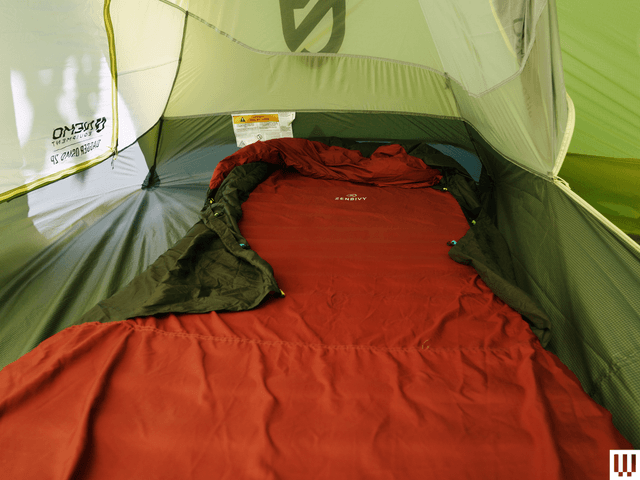
I used to say that all my best days started with waking up in a sleeping bag. Waking up in a sleeping bag usually means you’re out there somewhere, doing something interesting. In the past couple of years, though, I’ve found myself waking up out there to wonderful days spent doing interesting things, but without a sleeping bag in sight. Instead, I’m sleeping in what thru-hikers and ultralight redditors call a quilt.
This is not a quilt like the one your grandmother gave you. Backpacking quilts are made of nylon and filled with down like a traditional sleeping bag. The difference is that they lay over you like, well, a quilt, rather than wrapping all the way around you like a sleeping bag. The benefit is twofold: A quilt is lighter, meaning less weight to carry in your pack, and, as an added bonus, I sleep better than I ever have in the backcountry.
Mummified
Let’s face it, there’s a reason backpackers have nicknamed sleeping bags “mummy bags.” They’re constricting at the best of times, suffocating at the worst. I don’t know about you, but for me, there’s nothing about a mummy that I want to emulate, not even when I’m sleeping. I was, therefore, as well primed as anyone to jump on the quilt bandwagon when it really began to take off a few years ago. And yet, I didn’t. Perhaps it was something like Stockholm Syndrome; I’d finally accepted the mummy thing and was, honestly, a little nervous to give up my sleeping bag for a quilt. But then I did, and I’m never coming back. Or mostly never coming back.
But first, what’s the difference between a sleeping bag and a quilt? As briefly noted above, the quilt goes on top of you, rather than all around you like a sleeping bag. Consider the burrito vs. the taco. In this case, the sleeping bag/quilt is the tortilla and you are the filling. Would you rather be wrapped up like a burrito? Sleeping bag. Prefer the obviously superior experience of the taco, with its warm, soft tortilla lying on top of you? You’re (potentially) a quilt person.
The science here is that when you lie down in your traditional sleeping bag, the weight of your body forces most of the down fill off to the sides. The down left under you is so compacted you’re not getting any real insulation from it anyway—so why carry that extra nylon and down around? Enter the quilt. Quilts get rid of the bottom layer of useless nylon and down, and lay over you like the quilt on your bed at home. Quilts typically weigh less than sleeping bags and pack down smaller, making them very popular with backpackers trying to reduce weight and save space.
While I think the weight savings make quilts a great choice for anyone looking to carry a lighter load, how much you love a quilt over a sleeping bag will depend somewhat on how you sleep. If you’re a taco person, and the thought of having a sleeping bag wrapped up like burrito gives you the sweats just thinking it, the quilt is your happy, happy future. Or, if you like to curl up in a ball, move around a lot at night, are a side sleeper, or want to share covers with your tent mate, then again, the quilt is for you.
If you rarely move around at night, sleeping somewhat like a mummy, then you might not mind a traditional sleeping bag and wouldn’t share my enthusiasm for the quilt.
I sleep very warm, enjoy sprawling out, hate having my feet trapped (no matter how cold it is), and am generally not bothered by drafts. Do I bring a quilt on winter ski trips with temps below 0 degrees Fahrenheit? No, but the rest of the time, I have been using quilts exclusively for quite a few years now. So much so that I recommend trying it. I understand the hesitation; the sleeping bag is an institution. If you’re worried about it, go rent a quilt from REI and try it out car camping, with your trusty sleeping bag as a backup.
What You Need to Know About Using a Quilt
Sleeping directly on a sleeping pad, with no sleeping bag beneath you, places greater emphasis on the pad’s insulation and texture. You might not get much insulation from a sleeping bag, but you do get a little, so overall, I would say quilts sleep a bit colder on the same sleeping pad.
There’s also the pad’s texture to consider. Bare skin on something like the ultralighter pad of choice, the Therm-a-Rest NeoAir XLite NXT, is an unpleasant experience. Many people, myself included, get around this by sleeping in a base layer (or more if it’s cold), but this is something to bear in mind on warmer nights when even a base layer is unnecessary.
For summertime camping with a quilt, I use the luxurious Therm-a-Rest Neoloft, which has an R-value of 3. When paired with a quilt rated to about 20 to 30 degrees Fahrenheit, I find it plenty for temps down to about 40 degrees. I always have a puffer jacket as well, and could sleep in it if I need to, which would take me down to freezing without being too cold.
For shoulder-season trips in my neck of the woods (where freezing temps in May are not uncommon), I go with a more insulating sleeping pad. Lately I’ve really been loving Exped’s Ultra 6.5R, which has an R-value of 6.5 and, paired with a 20-degree quilt and sleeping in my puffer, I’ve been downright toasty to 30 degrees Fahrenheit.
I have paired those two pads with many different quilts from both big names like Therm-a-Rest, Nemo, and REI to smaller quilt makers like Katabatic Gear, Enlightened Equipment, Feathered Friends, and Zenbivy, though the latter is a bit different. More on Zenbivy below. In all that testing, I’ve discovered a handful of things to look for in a quilt.
There are two basic styles of quilt: Those with a closed footbox that resembles a traditional sleeping bag, and my favorite, those that open up completely to lie flat (and usually offer some way to close up the footbox area with a draw string and fasteners). I prefer the latter, which is why my favorite quilts are the Enlightened Equipment Revelation 40-degree quilt and the REI Magma 30 Down Trail Quilt.
The Enlightened Equipment Revelation is hugely popular with thru-hikers thanks to its excellent warmth-to-weight ratio, and can act as a blanket on warmer nights, or you can close up the footbox with the 20-inch zipper and drawstring on cooler nights. You can also cinch down the elastic straps to hold it snugger around you when you want to stop drafts and trap warmth.
The basic 40-degree Revelation quilt features 850-fill-power duck down and weighs 22.5 ounces; it’s also made in the USA. That said, there are all sorts of options for the Revelation. You can get it bigger, wider, or with or without a draft collar, or you can go for the custom option, which allows you to fine-tune the length and width, as well as the fill, color, and other options exactly the way you want them. That version starts at $350.
The REI Magma Trail Quilt is possibly the best deal around. It offers 90 percent of what the Revelation does, and is on sale several times a year for less than $250. The straps aren’t as nice (they’re more like shoelaces), but it’s just as warm and does a respectable job of keeping out drafts. The zippered footbox with a drawstring makes it easy to convert between quilt mode and something more like a sleeping bag, and at 24 ounces for the long, wide version I have, it’s competitive in terms of weight.
Zenbivy: The Best of Both Worlds?


Much as I love the Revelation and Magma quilts, for anything but mid-summer, I tend to favor the Zenbivy quilt, which isn’t just a quilt (though you can use it that way) but a sleep system consisting of a quilt and a “sheet” with a built-in hood. The sheet has little wings that come up and clip to the quilt to stop drafts. This feature makes the Zenbivy warmer than any other quilt I’ve tested. It just stops drafts better than any strap system can. In some ways, the Zenbivy strikes a balance between quilt and sleeping bag, with most of the benefits of both.
The 25-degree Convertible Light Quilt uses 800+ HyperDRY Duck Down and weighs 24 ounces. Add the sheet with 25-degree hood and the total weight is 33 ounces. That’s on the heavy side, but the versatility and ability to use it in cooler temperatures justify the higher cost in my view. And in mid-summer, when you don’t need the sheet, don’t bring it, which brings the weight down to 24 ounces. I should also note that Zenbivy does make an Ultralight quilt that has a slightly different footbox that doesn’t open up flat. This does bring the weight down to 17 ounces, but the price is a bit higher for the quilt and for the 5-ounce sheet (which is only half the length of a sleeping pad). I have not tested the Ultralight quilt, but it does look like a nice weight savings without giving up many of the features. Another option is to just buy the sheet and convert your current quilt to work with Zenbivy‘s attachment system.
I’ve said it before in my Zenbivy reviews, but I have never slept better in the backcountry than in a Zenbivy bed. Years later, this continues to be true, though in midsummer when I’m not worried about staying warm, I do favor the Revelation.


What about winter? Most people, even those who love quilts, will back off that love a bit when it comes to winter. Much of the reason is the lack of a hood. In winter, you want a hood and a good draft collar to cinch down around you. But the Zenbivy system does have a hood, and this winter I tested Zenbivy’s -5 degree Light Bed, which is comfort rated to -5 degrees Fahrenheit. I took it on two trips, one where temps never dropped below 15 degrees and it was plenty, and then a second trip that happened to coincide with the coldest night of the year in my neck of the woods (-25 degreews Fahrenheit, with a wind chill well below that), in which I used the Zenbivy as a blanket over a 20-degree sleeping bag. The combo was great; I stayed toasty. Which is all to say that you can use a quilt in winter too, up to a point. I think my cutoff for a quilt will probably be 15 degrees, and even then, only with a quilt that has a hood.
In the end, while I love quilts, there are, as with any gear, limitations and trade-offs. The biggest being that quilts can be drafty since they lack a hood, and are probably colder than a sleeping bag under the same conditions. The point here isn’t to say that quilts are always the best choice, rather that sometimes they absolutely are the best choice and you should give them a try, especially if you’re the sort of sleeper who finds a traditional mummy bag stifling. I, for one, will never be bringing a sleeping bag on a summer trip again. At the same time, there are limits. Any trip where I expect temps below 15 degrees Fahrenheit, I will submit to being a burrito.
Disclaimer : This story is auto aggregated by a computer programme and has not been created or edited by DOWNTHENEWS. Publisher: wired.com