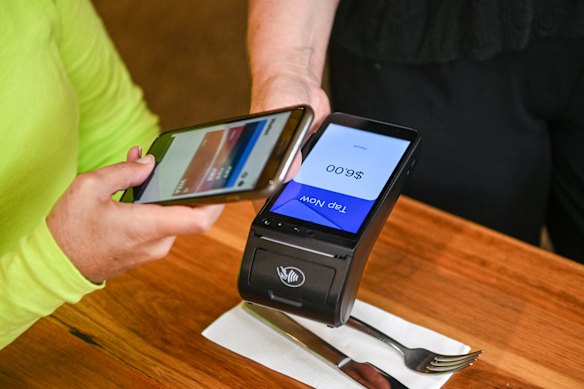
Some Australians will likely still encounter card payment surcharges at the checkout despite a ban on the practice coming into effect on Thursday as business lobby groups warn that many smaller shops, especially those run by migrants, are still in the dark on how the new payment rules work.
Since the Reserve Bank confirmed in March it would ban credit and debit card surcharges from the beginning of October, small business owners have expressed concern that the sweeping reforms – estimated to save consumers $1.6 billion annually – will leave them financially worse off and forced to increase product and menu prices.
Different parts of the economy have scrambled to prepare in the six-month window between the changes to Australia’s payments ecosystem being confirmed and the changes taking effect.
Major banks have already wound back the generosity of credit card sign-on bonuses and rewards points earning rates, due to a lower cap on “interchange fees” – which merchants must pay to a customer’s bank to accept a card transaction and which have traditionally funded rewards perks.
The changes have also prompted the Australian Taxation Office to remove credit cards as a payment method, which it said would not affect most taxpayers. Only 2.3 per cent of tax payments in the 2024 financial year were made through a credit card, with the majority made by high net worth individuals or major organisations.
“As a government agency, the ATO has decided it would not be appropriate for the cost of credit card merchant fees to be transferred to the community,” it said in a statement.
While larger firms and national chains appear to have adjusted to the changes, smaller businesses are less prepared for the new regime, or aren’t seeing its upsides.
Jewellery maker Iris Isaacs has spent months mulling different payment options for her online store, inSync design, in the post-surcharge era.
“It’s getting tougher and tougher,” she said. “It’s not enough to be creative. You have to be really creative in the way you run your business to keep it profitable.”
Lifting the price of the earrings, necklaces, rings and brooches she sells isn’t an option, with customers more sensitive to price rises than ever, she says. Other input costs, including gold prices, local manufacturing and shipping have increased, forcing her to find savings elsewhere by looking at different suppliers.
She currently offers Paypal as well as the payment option offered by her webstore’s host Shopify. While rivals Square and Revolut’s fees appear more competitive, she will most likely stick with her current options as that’s what her customers prefer to use. Unlike the ATO, Isaacs is not moving to stop accepting credit card payments.
“At the end of the day, you have to supply all options the client actually wants,” she said. “But that costs me more.”
Brian Laul, founder of the newly-launched Australian Multicultural Community and Business Chamber, said shops run by migrants and those who don’t speak English as a first language are at particular risk of unwittingly being in breach of the surcharge ban.
“A lot of businesses are quite ill-prepared, from what I’m hearing. There are still lots of queries about how it will work at the checkout,” Laul said.
“A small business doesn’t necessarily have the infrastructure to make these changes quickly, and they might need help.”
Laul urged customers to be patient at shops if they believe they have been charged a surcharge. “It may not be them trying to do the wrong thing, they may just not understand,” he said.
He also called for leniency from authorities for any breaches of the rules. “The government needs to be kind and allow these businesses the latitude to get their house in order,” Laul said.
Ensuring compliance with the surcharge ban will be tricky due to the lack of uniformity in the various payment processing systems and deals small businesses have in place.
The surcharge ban will not be enforced by the Reserve Bank or the ACCC; rather, card networks (like Visa, Mastercard and Eftpos) and payment providers (including Square, Tyro, Stripe and some banks) are responsible for enforcing it, and will be held responsible if surcharges continue. These providers and banks will have disabled the surcharge function on terminals they control by Thursday.
Major card networks Visa, Mastercard and Eftpos have implemented a “no surcharge” rule, along with American Express, UnionPay and PayPal.
Shopify, which is increasing fees for some merchants from 1.6 per cent to 1.7 per cent on Thursday, has been called out by the Reserve Bank as appearing to steer shoppers towards its own payment option by “charging their merchant customers a third-party transaction fee for using a payment service provider other than Shopify Payments”. Shopify has been contacted for comment.
Wes Lambert, CEO at the Australian Restaurant & Cafe Association and a board director at the Council of Small Business Organisations Australia, said businesses with more modern card terminals that are integrated with point-of-sale systems might see their surcharge line item vanish automatically, and could be caught off-guard when their accounts are settled in coming weeks.
“For many, especially where English is not a first language, the surcharge ban will actually come as quite a surprise when it is just turned off at the terminal, and they receive less money,” Lambert said.
However, businesses using older terminals, especially where a salesperson manually keys in a total amount into a machine, are unlikely to undergo an automatic update that would make it compliant with the surcharge ban.
“In those instances, businesses may unwittingly continue to charge a surcharge,” he said. “Many haven’t received a ton of communications from their bank or services provider about this.”
The Business Briefing newsletter delivers major stories, exclusive coverage and expert opinion. Sign up to get it every weekday morning.
 Elias Visontay is a National Consumer Affairs Reporter at The Sydney Morning Herald and The Age.Connect via email.
 Jessica Yun is a business reporter covering retail and food for The Sydney Morning Herald and The Age.Connect via X or email.
From our partners
Disclaimer : This story is auto aggregated by a computer programme and has not been created or edited by DOWNTHENEWS. Publisher: www.smh.com.au