

Rugby Australia’s revenue of $262 million for the 2025 British and Irish Lions year is a significant number for several reasons.
It allowed RA to announce a massive surplus of $70.6 million and wipe out its large debt, but it is also a useful comparison tool with their Bledisloe Cup rivals across the ditch.
Coincidentally, that $262 million is in the same neighbourhood as New Zealand Rugby’s annual income. But when the Kiwis announce their annual results next week, they will likely only break even (or possibly show a small surplus) after pouring it all back into the game.
So, there is a $70 million funding gap between the two countries, and New Zealand again capitalised on that investment advantage this week.
The Australian Super Rugby teams were 0-3 during Super Round in Christchurch, and the Junior Wallabies lost 34-29 to the New Zealand under-20s in their opening match of the Rugby Championship under-20s tournament in South Africa.
These two events are connected: an example of how systems beat natural talent or, more accurately, how natural talent is not Australian rugby’s problem – but it is also not enough on its own to produce winning Wallabies and Wallaroos teams.
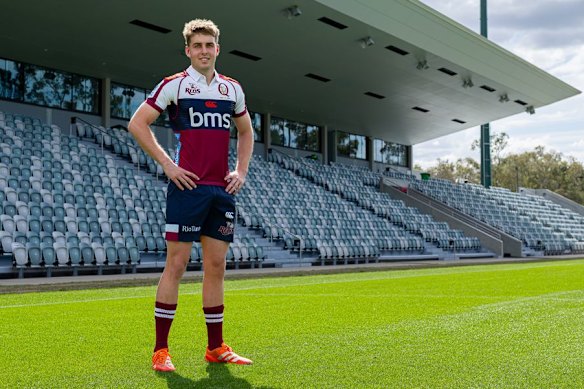
The natural talent referred to here is Junior Wallabies No.10 Finn Mackay, also of the Queensland Reds.
The tall Mackay invites easy comparisons with Stephen Larkham, and those comparisons are justified. He has an eye for a gap, an almost languid running style and excellent pass selection at the line. So, celebration time for Wallabies fans?
Not quite. When Mackay leaves the under-20s program his next few years will be in a spotty development system that could fail him, as it has others, unless serious dollars are invested in it.
In fact, Mackay may already be a half-step behind his New Zealand counterpart, Mika Muliaina. Muliaina, the nephew of All Blacks centurion Mils Muliaina, probably doesn’t have Mackay’s God-given abilities, but his game management was exemplary when the young Australians were shown a 20-minute red card.
In fact, when Mackay threw a risky pass that was intercepted on the hour mark with his side leading 29-17, Muliaina identified space and executed a perfect cross-field kick deep in his own half during the play that turned the game on its head.
The Kiwis went upfield, Junior Wallabies halfback Angus Grover received a yellow card for a supposedly cynical ruck infringement, and the New Zealanders scored 17 unanswered points.
Muliaina showed the benefits of already playing at a higher level among men. Last year, he featured eight times for Southland in New Zealand’s National Provincial Championship, starting most of those games in the No.10 jersey.
He’ll likely do the same this year, and by the time he makes his Super Rugby debut for the Highlanders, Muliaina could have more than 20 NPC games under his belt.
Mackay won’t get that schooling or the opportunity to make mistakes in a competition less intense than Super Rugby but still far harder than the under-20s.
Instead, he’ll likely be fast-tracked into Super Rugby with high expectations. That’s not the Reds’ fault – and they have been good at creating more game time for their younger players – but they are working within the constraints of the current structure.
This all came to mind when listening to a recent Rugby Unity podcast featuring Eddie Jones and Ewen McKenzie (incidentally, the passion and knowledge shown by both men strongly suggest neither is finished with Australian rugby and has plenty to offer, if bygones can be bygones).
They observed that Australian rugby needed heavy investment in development. That has two parts: first, talented young players must be secured; second, they need a meaningful competition to play more games in.
Waratahs coach Dan McKellar recently pleaded for more rugby, a theme that resonates among the players. The Herald understands Brumbies flanker Rory Scott will be the next Australian to spend the Super Rugby off-season in the NPC, signing for Tasman.
NZ Rugby can afford to invest much more heavily in the game as a whole because its yearly revenue, excluding World Cup years, equates to what RA enjoyed in a Lions year.
However, another windfall is coming to Australia next year with the World Cup. At that point, the funds will be so significant that RA will have to make some investment decisions; simply saving them for a proverbial rainy day won’t suffice.
The past week has emphatically shown where the money must go, so that players such as Finn Mackay are given as much chance to succeed as the New Zealand players they clearly match in talent.
 Paul Cully is a rugby columnist for The Sydney Morning Herald.Connect via X or email.
From our partners
Disclaimer : This story is auto aggregated by a computer programme and has not been created or edited by DOWNTHENEWS. Publisher: www.smh.com.au


