Wide swaths of the Southwest were deluged Sunday as the remnants of Tropical Storm Rachel weakened and moved inland, but coastal communities already battered by high surf emerged with less damage than some officials feared.
The National Weather Service said Sunday morning that Rachel was no longer a tropical storm. But danger remained as waves crashed into beachfront homes in Long Beach, large rocks and mud hurtled down a mountain onto a highway south of Palm Desert, and flood water submerged the parking lot of a casino on the Las Vegas Strip.
While the downgrading of Sunday’s storms brought some relief, risks continue across the California coast until Tuesday, and there is the longer-term concern of what is expected to be an active El Niño season.
“We’re not out of the woods yet,” National Weather Service meteorologist Daniel Berc said Sunday morning. Although the heaviest rain is over, according to meteorologists with the National Weather Service, people across the Southwest can expect spotty rain and high tides for the next couple of days.
On Sunday, some of the worst damage on the California coast was on the Long Beach Peninsula.
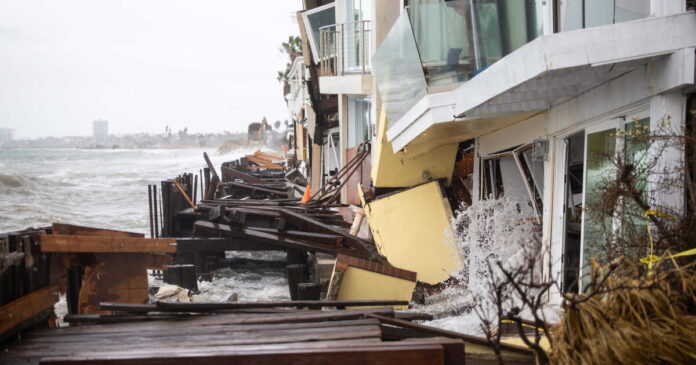
After tides swept away Long Beach’s historic wooden boardwalk Saturday, waves of saltwater rolled into a yellow two-story oceanfront house on Seaside Walk on Sunday.
The ocean completely engulfed the house’s wooden deck. A balcony had broken off and hung at a 30-degree angle toward the water. Yellow caution tape fluttered in the wind as water poured into a room strewn with wooden debris, an upturned refrigerator and a television.
The yellow house on Seaside Walk began to collapse Sunday morning, according to two Long Beach Fire Department lifeguards. A house next door had cracks in its side, and others had wooden decks falling into or submerged in the water.
Coastal flooding is expected to remain a threat on beaches in San Diego, Orange, Los Angeles, Ventura, Santa Barbara and San Luis Obispo counties through Tuesday, according to the National Weather Service.
Flood warnings are in effect along the L.A. County coast due to high tides driven by warm ocean water and lower atmospheric pressure with the arrival of the remnants of Tropical Storm Rachel, said Joe Sirard, a meteorologist at the National Weather Service in Oxnard. South-facing beaches, he said, were particularly vulnerable.
Early Sunday morning, as Rachel was about 255 miles north-northeast of San Diego, moving with maximum sustained winds of 35 mph, the National Hurricane Center said it was winding down its coverage and that its 8 a.m. update would be its last. But it also warned that seawater would continue to batter the Southern California coast.
These waves, combined with an incoming long-period southerly swell, will cause life-threatening surf and rip current conditions.
— National Hurricane Center
“These waves, combined with an incoming long-period southerly swell, will cause life-threatening surf and rip current conditions,” the National Hurricane Center said. “Coastal flooding and erosion are expected to worsen this morning as the highest waves coincide with the high tides and water levels that are already running well above predicted levels.”
Hazardous coastal conditions could continue for the next few days, the National Hurricane Center said, and Rachel could bring a total rainfall of 1 to 3 inches, with maximum amounts in some areas of 5 inches, from Southern California into the Great Basin and the U.S. Southwest.
At a 10 a.m. briefing on Sunday morning, the National Weather Service said Las Vegas recorded 1.08 inches of rain since midnight, which ties the daily record for Oct. 11.
“And we still got 14 hours left to go,” Berc said.
Six miles south of Palm Desert in the Coachella Valley, rainfall caused flooding and a flow of rocks, mud and debris that blanketed the eastbound and westbound lanes of California 74 near Mile Marker 89, said weather service meteorologist Kyle Wheeler.
The National Weather Service in San Diego warned Sunday that elevated high tides and surf would cause coastal flooding and beach erosion through midweek, and showers and winds will linger from the coast to the mountains through Monday.
In Long Beach, with less than two hours before high tide, workers on the Peninsula raced early Sunday morning to build a sand berm stretching westward from 62nd Place.
City groundskeeper Robert Quinonez, who was working with the track hoe operator, said he didn’t believe they could build the berm high enough in time to prevent water from spilling into the street like it did Saturday.
The track hoe operator repeatedly spun the machine to the west, dug into a mound of sand, spun 180 degrees and dropped the sand.
“We build as much as we can up, and just…” Quinonez said, trailing off.
Alphonso Tubbs, 56, chatted with Quinonez while looking at the work. Tubbs and his girlfriend had recently bought a condo on the street and planned to move in a week.
Tubbs said he was grateful that the condo he bought was on the side of the street where the city was building a sandbar.
“Just imagine if I was just on that side,” he said, pointing east. “They’re about to get smashed.”
Long Beach residents appeared divided on the city’s attempts to protect the oceanfront from water damage.
Long Beach resident Marianna Messina, who has lived in the community for 23 years, said the city’s work had been “excellent” as it worked to pump out water that had spilled into the street Saturday and removed a foot-thick layer of sand the water had deposited.
But another resident, Kellie Canning, complained the city had not done enough to prevent water damage. If steps aren’t taken immediately, she said, the damage would likely be far worse as winter progresses.
“Right now, you have a situation where the water is undermining the foundations of homes and streets,” she said. “I’m worried that 66th Place will rip up. Because there’s nothing to stop the water.”
Jon Cortez, 65, said he believed his house would probably be safe this season, but he expressed concern for his neighbors as the historic El Niño is expected to bring much worse in the coming weeks and months.
“With the El Niño coming, this is only the beginning, as far as I can say,” he said, watching the track hoe operator shovel sand on top of the ever-growing sand berm.
Cortez blamed the city for not taking any permanent or lasting measures to prevent the ocean from spilling into the streets, such as putting in place a concrete barrier or reinforcing the seawall.
“I think it’s going to be a mess,” he said.
In Newport Beach, there was a sigh of relief as the high tide began to recede Sunday..
On Friday and Saturday, super high tides caused widespread seawater flooding in the Balboa Peninsula in Newport Beach, the National Weather Service said, flooding roads, closing the world-famous surf and bodyboarding spot the Wedge, and shuttering the Balboa Pier and Newport Pier.
But the streets along the Balboa Peninsula were dry Sunday. Residents walked and rode bicycles along the boardwalk as dozers and excavators moved along the beach, reinforcing the several-foot-high berms built to protect homes from the ocean waves.
Standing barefoot outside his home at 8th Street and Balboa Boulevard, holding a cup of coffee, Ross Stewart, 79, stared at the gray sky and at the berms.
“I think we’re going to be OK,” he said. “The waves haven’t breached our walls.”
Stewart, who has lived in the beach community since he was born, said the city had been working around the clock to build the massive sand berm, the biggest Stewart had seen in years.
“I’d say it’s probably 10 to 12 feet high,” he said, gazing at the wall of sand.
His neighborhood last flooded about five years ago, he said, and the city’s constant maintenance helped protect homes.
Shauna Parisi, 37, praised the city’s recovery from Friday’s flooding, noting that city crews had worked as late as 10 p.m. Saturday and as early as 6:30 a.m. Sunday to build large berms.
“I think any time there’s a little breakthrough they kind of go back over and push some more sand up,” she said. “We were worried about that today.”
Times Staff Writer Rong-Gong Lin II contributed to this report.
More to Read
Disclaimer : This story is auto aggregated by a computer programme and has not been created or edited by DOWNTHENEWS. Publisher: latimes.com