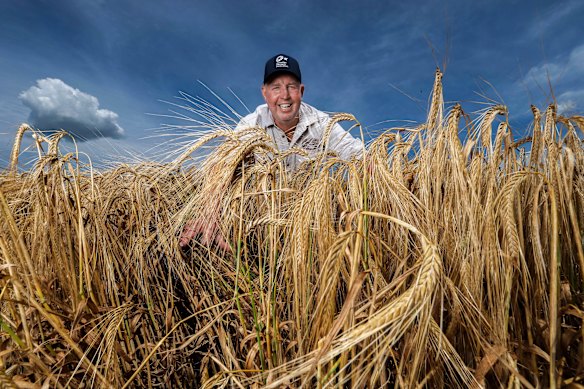

If all goes to plan and the conditions remain right, Scott Young will soon kick back and enjoy the fizzy rewards from the fruits of his labour.
Young’s barley crop is shaping up exceptionally well this season at his farm in Fiskville, near Ballarat.
Plentiful winter and spring rain is promising to deliver a bumper crop. After the rain on Friday, Young just needs the weather to remain dry long enough to harvest his barley, and it can be delivered to Asahi Beverages and brewed into beer.
Getting it right requires planning and luck.
“It’s hard to hit the window that’s perfect for the maltsters,” Young said.
If it rains too much between now and the anticipated harvest, about Christmas time, the barley will absorb the moisture and swell, rendering it unusable for beer brewing. That means a price downgrade from up to $340 a tonne for brewing down to about $200, and the barley becomes livestock feed.
Farmers across much of Victoria are anticipating excellent crop yields this harvesting season, although recent heavy rain and even hail damage has complicated the process.
As well as barley, Young is also growing wheat, canola, oats and lupins. He is a third-generation farmer whose father and grandfather ran sheep on the Fiskville farm.
About 25 years ago, Young persuaded his father they needed to move from fine wool into meat and grain.
They based their decision on the necessity for food, whereas wool is more discretionary.
But high yields do not necessarily translate to high profits. Input costs have soared this year. Ukraine is among the world’s biggest fertiliser exporters, so the Russian invasion and subsequent war have driven up that cost.
It’s a similar situation with diesel prices, following the United States’ war with Iran. Geopolitics can wreak havoc on careful preparation.
“You take an educated gamble,” Young said. “But if a bomb gets dropped in the Middle East, or we get 80 millimetres of rain on this barley, it all changes.”
Despite the rain throughout spring and Friday’s drenching across much of the state, authorities are still warning of dangerous bushfire conditions this summer.
This week the Country Fire Authority reported rain had stimulated crop growth in northern and western Victoria, but crops would dry out in the forecast high temperatures and create fuel loads that could start and spread fires.
The increased fire risk will come in January, and there is potential for fast-running grassfires to extend beyond summer.
Victoria’s south-west and East Gippsland are facing an elevated bushfire risk this summer, while the risk across the rest of the state is normal.
The fire danger period will begin on December 7 in the Geelong, Surf Coast, Golden Plains and Queenscliff council areas.
Beef farmer Elise McKinnon, who is based in Bushfield in south-west Victoria, said this year’s rain was a great relief after record-breaking drought in the region.
“Every time it rains it buoys everybody’s spirits further,” she said. “We’re always living in fear of an extended dry period.”
McKinnon said the rain had allowed her to grow plenty of grass.
“But we’re looking at another dry summer, so we have to make that grass last.”
In north-west Victoria, at Manangatang, grain farmer Christine Plant said yields were shaping as her best this year, but lower protein levels might suppress the prices she could get for her crops.
“It’s been an exceptional year with rainfall and the yields have been above our expectations,” she said.
Plant has finished harvesting lentils as well as some barley and wheat and will also harvest some chickpeas this year. As with farmers across the state, Plant is hoping Friday’s rain will not be so heavy that it damages her crops.
Too much rain and the crop quality will be downgraded. In addition, farmers cannot harvest wet grain.
“We’re just hoping we can get as much off that’s undamaged as possible,” Plant said.
Fellow grain farmer Tony Fox, who is near Swan Hill, said his yields were also looking exceptional this year. On Friday, he was waiting to see how much rain would fall in the region.
Forecasts predicted up to 55 millimetres of rain, but by midday less than a millimetre had fallen at his property.
Start the day with a summary of the day’s most important and interesting stories, analysis and insights. Sign up for our Morning Edition newsletter.
 Benjamin Preiss is The Age’s regional editor. He was previously state rounds reporter and has also covered education for The Age.Connect via X or email.
From our partners
Disclaimer : This story is auto aggregated by a computer programme and has not been created or edited by DOWNTHENEWS. Publisher: www.smh.com.au