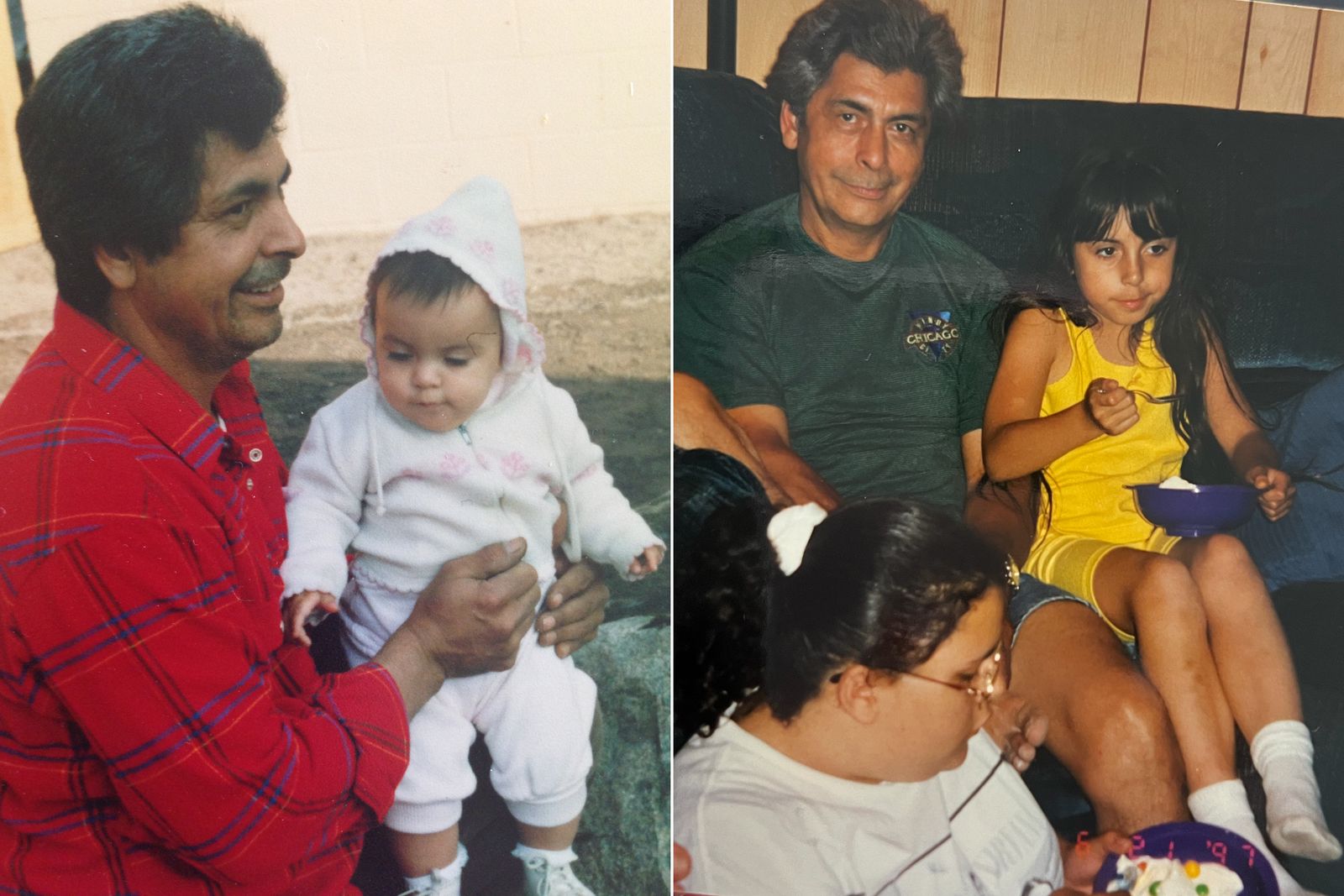
All my life, I’ve been conscious of identity. Growing up in a mixed-race and mixed-ethnicity household, I learned early how to navigate the gaps and overlaps of belonging the way other people learn directions: instinctively, constantly recalibrating. My dad, a Mexican American man with brown skin that darkened even further in the sun—somewhere my family spent a lot of time as farm laborers—embodied a version of masculinity and resilience that felt distinctly American to me, even if the country did not always treat him that way. Raised in Texas before eventually making his way to Indiana, he settled into a neighborhood that was largely Black and Latino. My mom, meanwhile, is a white woman from Indiana with Southern roots.
Growing up, the spaces I inhabited never felt particularly confusing. My classmates came from different racial and cultural backgrounds, and my identity simply existed alongside theirs. But when I left for college in 2006—to attend a predominantly white institution with meaningful Asian and Black student populations, a smaller Latine community, and a notable international presence—I found myself experiencing a different kind of visibility. As one of relatively few Mexican American students in rooms where identity was suddenly more categorized, more legible, and more discussed, I suddenly felt acutely aware of my background.
It wasn’t that I didn’t belong. It was that belonging came with language—labels, explanations, shorthand for who you were supposed to be on paper. For the first time, I wasn’t just living my identity; I was expected to translate it. “South Bend, Indiana” was no longer the right answer to “Where are you from?” The askers were requesting I explain my face, my last name, and my ethnicity in a way I never had before.
That education continued when I interned at Latina in New York City under then-editor-in-chief Mimi Valdés, where conversations around Afro-Latina identity, colorism, language, and diaspora weren’t theoretical; they were foundational. It was one of the first times I saw Latinidad treated not as a monolith, but as an ecosystem of histories, contradictions, and migrations. Later, when I returned to the publication as deputy editor, I was for a long stretch the only Mexican American staffer—and the only one from a Mexican background, period—until an editorial assistant from my alma mater joined the team.
And yet, despite all these experiences that helped me grow confident as a Latina, I still carried a quiet insecurity: I never spoke Spanish. My father, like many Mexican Americans of his generation, had been punished for speaking it in school. Assimilation wasn’t framed as a choice for families like his; it was survival. The language stopped with him, even though the culture did not. Growing up, that absence often felt like a hole people expected me to apologize for, proof that I was somehow diluted or incomplete.
Disclaimer : This story is auto aggregated by a computer programme and has not been created or edited by DOWNTHENEWS. Publisher: www.allure.com