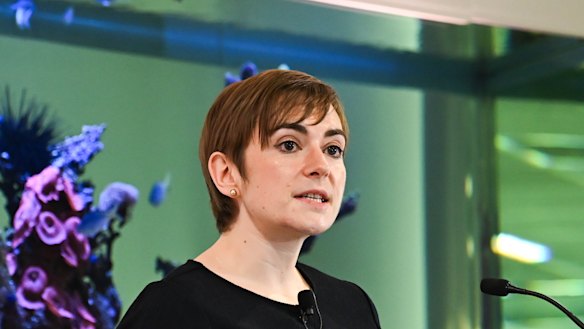
The federal government’s tax changes will combine with higher interest rates to take steam out of the nation’s housing market, the Reserve Bank’s chief economist has signalled, while warning that businesses are likely to keep lifting prices as the war against Iran drags on.
As investors downgraded expectations of another interest rate rise, Sarah Hunter used an address in Sydney to caution that if Australians believe inflation pressures will keep growing, then the bank may have to engineer an economic slowdown akin to the recession of the early 1990s.
The bank has increased interest rates at its past three consecutive meetings as it attempts to tame inflation, which has reached 4.6 per cent and expected to nudge 5 per cent by the middle of the year. Since it started lifting rates, housing price growth has eased across the country, with outright falls in both Melbourne and Sydney.
In the federal budget, the government revealed plans to restrict negative gearing to new builds and overhaul capital gains tax in a move that supporters argue will take some pressure off house prices.
Hunter, pressed on the impact of interest rates and tax on the housing market, said price growth was likely to ease.
“We know when you increase the cash rate, as we have just over the last few meetings, that that will dampen down activity in that market,” she told the conference.
“So we’re not surprised to see that response. And then … we’ve also got tax changes coming through as well. That’s always a risk.”
Westpac’s closely watched consumer sentiment survey suggests Australians are also expecting the property market to ease, with a near 2 per cent drop in its measure of house prices.
There was a 16 per cent drop in the survey’s question on whether it is a good time to buy a dwelling. It is now at an 18-month low and 50 points below its long-term average.
The sharp fall was driven by older Australians, with sentiment nosediving among those over the age of 60. Sentiment actually improved slightly among those aged between 18 and 34.
House prices are not included in the official measure of inflation, which has been pushed up sharply since the war against Iran started 11 weeks ago.
Hunter said the surge in oil prices had been “particularly challenging to navigate”, noting there was a real risk that inflation expectations among consumers and businesses could be pushed higher.
“If expectations rise persistently, it becomes harder for the central bank to bring inflation back to target, as it must both bring expectations back down and restore the balance between supply and demand,” she said.
“Doing so may require a more substantial slowing of economic activity, as we saw during the early 1990s recession.”
Despite her hawkish outlook, minutes of the RBA’s May meeting suggested the bank wants to see the fallout from its three previous rate hikes before it tightens monetary policy any further.
The ASX200 lifted after the minutes were released, while the Australian dollar shed almost half a cent against its US counterpart on expectations by investors that the bank would leave interest rates steady at its June meeting.
Inflationary pressures are growing globally, with concerns that many countries will struggle to deal with fuel shortages that are affecting key industries including manufacturing, tourism and agriculture.
On Tuesday, Prime Minister Anthony Albanese said the government had helped to secure importation of an additional shipment of 38,500 tonnes of urea.
He said three shipments totalling 100 million litres of jet fuel, equivalent to three to four days of national usage, had been secured as a “a direct result of the discussions” he had conducted with Chinese Premier Li Qiang.
The government is also working to address looming shortages in another critical supply chain, plastics, with Environment Minister Murray Watt convening a roundtable discussion with industry.
Around 25 per cent of the global plastics supply chain is shipped via the Strait of Hormuz, which has been blocked since the conflict began on February 28.
Since then, the price of plastics has soared. The cost of plastic pipes used in plumbing and construction has soared by 35 per cent.
The Reserve Bank has been told by business contacts they are reviewing their construction contracts due to the lift in prices.
Meanwhile, stockpiles of medical grade sanitary plastics are running low, including syringes, gloves, gowns and other laboratory equipment, as well as vials and medication containers.
The roundtable included talks about increasing recycling of food packaging to reduce Australia’s reliance on imported plastics, which are expected to increase in price the longer the war drags on.
Cut through the noise of federal politics with news, views and expert analysis. Subscribers can sign up to our weekly Inside Politics newsletter.
 Shane Wright is a senior economics correspondent for The Sydney Morning Herald and The Age.Connect via X or email.
 Mike Foley is the climate and energy correspondent for The Age and The Sydney Morning Herald.Connect via email.
From our partners
Disclaimer : This story is auto aggregated by a computer programme and has not been created or edited by DOWNTHENEWS. Publisher: www.smh.com.au