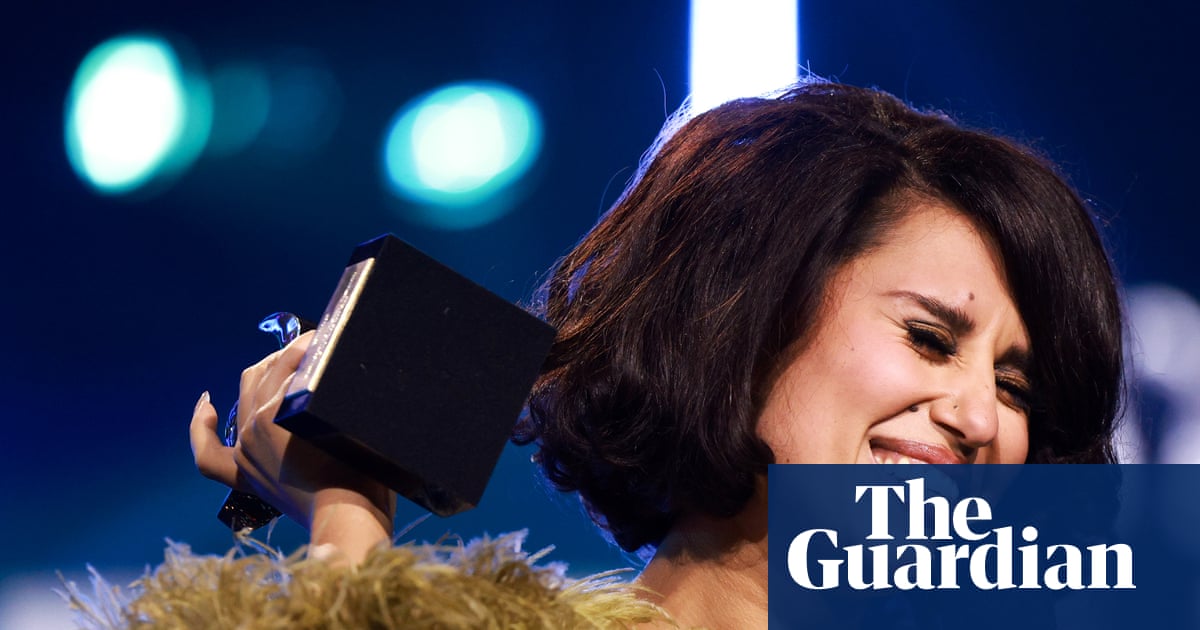
Raye is the winner of the 2026 Mercury prize, for her second studio album, This Music May Contain Hope.
Rewarded for a hugely ambitious 73-minute record that spanned big band jazz, power balladry, funk and more, her win caps an ongoing renaissance for a British singer who at one point was in the doldrums, lashing out publicly at her record label for not letting her release a studio album.
Since that low in 2021, she split from that former label and found huge success with two studio albums: My 21st Century Blues, which won her six Brit awards – still the record for a single Brits ceremony – and This Music May Contain Hope, which topped the UK charts and contains the global hit Where is My Husband?
The judging panel said: “Raye displays real imagination and scope in showing what an album can be, going beyond any one style or genre to realise her vision. The judges agreed that Raye’s superb album will serve as a huge inspiration for years to come.”
The award, handed out yearly to the best British or Irish album as voted for by a panel of music industry figures, comes with a £25,000 prize.
Elsewhere on the shortlist, Paul McCartney missed out in the first year he was nominated for the prize, for his reflective album The Boys of Dungeon Lane. In a video message, he said he was “chuffed” and “surprised” to be nominated on a shortlist alongside “such a group of really amazing artists”.
Suede, who opened the ceremony by performing their stridently pro-European anthem Dancing With the Europeans, weren’t able to add a second Mercury win to their trophy cabinet, after winning for their self-titled debut in 1993, the second year the award ran. Nor could Dave, who won for his own debut album Psychodrama, in 2019; he and McCartney were the only artists not to perform at the ceremony.
1996 winners Pulp performed for the second year in a row: last year for their nominated album More, and this year representing the all-star compilation album Help, created to raise funds for the charity War Child.
Florence + the Machine now have the ignominious honour of being the Mercury’s joint highest nominee without winning, tying with Radiohead on five unconverted nominations.
After losing its sponsor in 2024 and taking place in a rather low-key ceremony, the Mercury prize has repositioned itself, moving away from London to Newcastle in 2025 and scaling up in size to the city’s Utilita Arena. In its inaugural year in its new home, the Mercury was awarded to local boy Sam Fender – though Newcastle jazz band Knats, who wowed the arena crowd with virtuosic bass soloing and spoken word poetry, weren’t able to secure back-to-back Tyneside wins this year.
There has been some consternation, though, that its focus is becoming more commercial than in the past – and not distinct enough from the Brit awards.
In 2025, seven of the 12 nominated albums reached the UK Top 3, while this year six of the nominations reached No 1, and another two were Top 3 hits. All but two of the albums (Suede’s Antidepressants and the Help charity compilation) were released by or in partnership with the three major labels: Universal, Warner and Sony. Previously the UK’s independent music scene has been better represented, including in winners such as Arctic Monkeys, Dizzee Rascal, Sampha and Ezra Collective.
This year’s judging panel featured musicians, broadcasters, journalists and consultants: Afrodeutsche, Danielle Perry, Jamie Cullum, Lea Stonhill, Mistajam, Phil Alexander, Sian Eleri, Sophie Williams and Will Hodgkinson, with Jeff Smith as chair.
Disclaimer : This story is auto aggregated by a computer programme and has not been created or edited by DOWNTHENEWS. Publisher: theguardian.com