
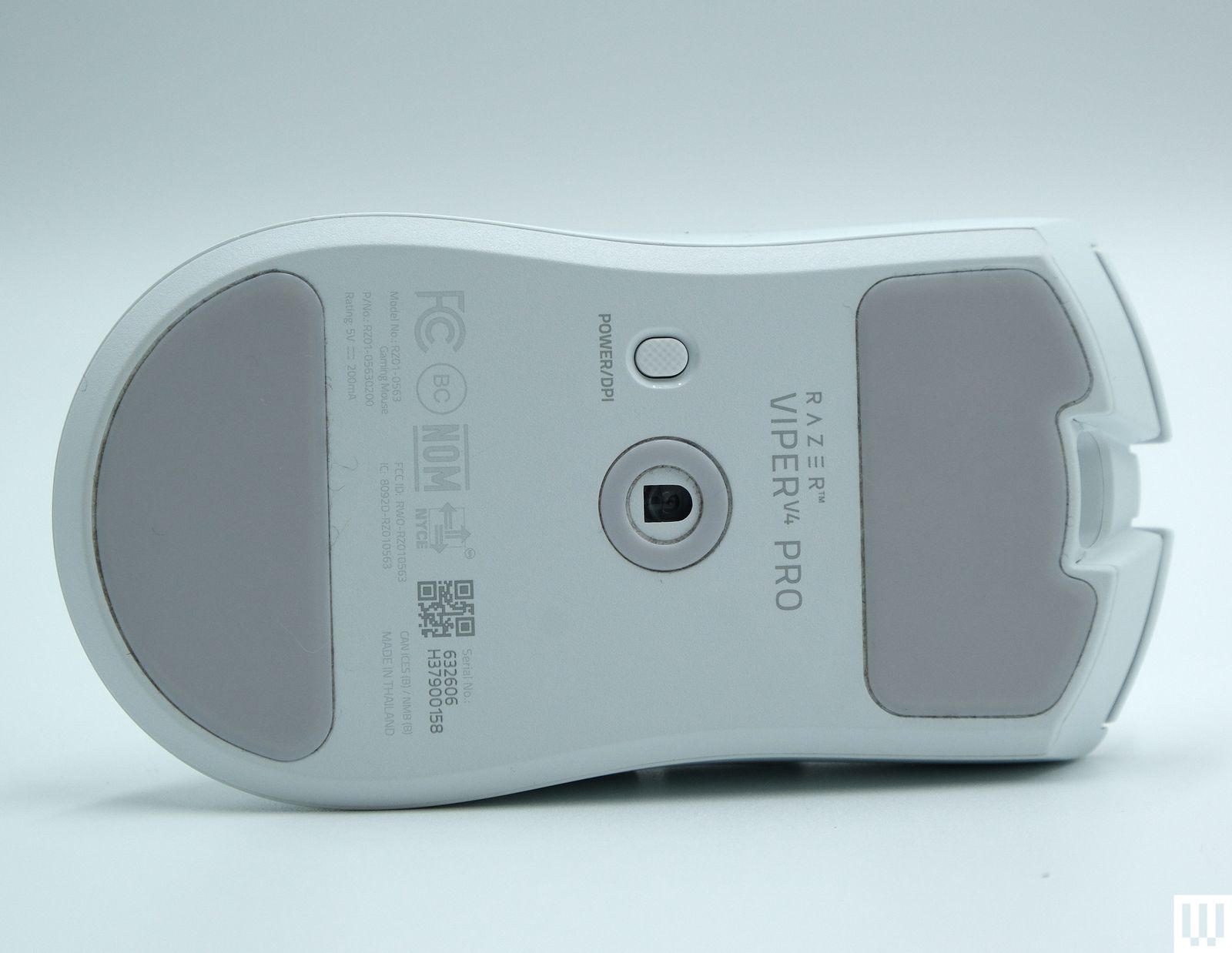
While a 5-gram reduction in weight may sound minor, the improvements were immediately noticeable, leading to quick, snappy movements and flicks required in first-person shooters. In precision-focused games like Counter-Strike 2, the weight felt perfectly balanced to throw around without being so light that I lost control, and in fast-paced titles like Helldivers 2, the added agility gave me the ability to contend with multiple enemies at once (or, more accurately, easily turn around and flee from them).
Instead of the singular RGB indicator of the V3’s hyperpolling dongle, the desktop bio-dome has three programmable RGB indicators to display one of four different settings: connection quality, battery level, polling rate, and current DPI stage. The first two are indicated by a red-to-green gradient, and the last two will correspond with the predetermined colors for each stage. While all of these have their use, I found the indicators for connection quality and battery level to be the most practical.
Comfortable for Competition
The biggest improvement on the V4 is the introduction of Frame Sync. This system synchronizes the Viper’s optical sensor with your computer’s polling rate to eliminate the latency created by mismatches between the two. The V4 is rated for an average click latency of 0.204 millisecond and a motion latency of 0.36 millisecond. Such small margins are practically imperceptible to the average player (even the highest level of competitive players have reaction times above 100 milliseconds), but cutting down this number serves to reduce the already low potential for errors or mis-inputs. Even when testing the mouse for consistency in aim trainers, the level of error was imperceptible—human error will have a much larger impact on performance.
One of the most compelling aspects of Razer’s pro-level mice is the granular levels of customization offered through the Razer Synapse software (and the in-browser Synapse Web beta). Alongside typical adjustments for DPI and polling rates, the V4 also includes settings for sensor tracking distance, dynamic sensitivity with customizable curves, and mouse rotation.
These customizations allow the mouse to be tracked on frosted or transparent glass surfaces, for example. My favorite setting is the dynamic sensitivity adjustment, which allows for a more precise response from the mouse. While it will take some patience and time to fine-tune this setting, the benefits on tactical shooters like Counter-Strike and Valorant were immediate. This setting allows me to use rapid flick shots with precise aiming in those games.
Photograph: Henri Robbins
Disclaimer : This story is auto aggregated by a computer programme and has not been created or edited by DOWNTHENEWS. Publisher: wired.com



