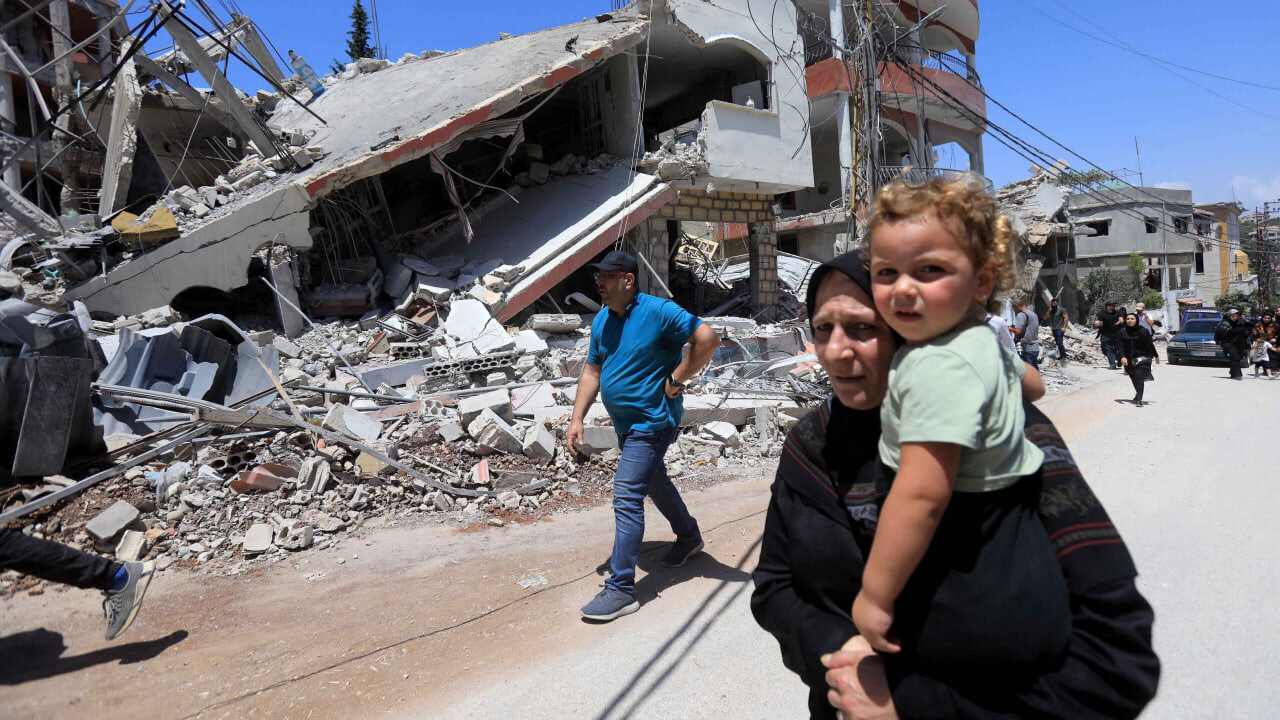
BEIRUT — The announcement by Hezbollah’s Executive Council chairman, Sheikh Ali Damoush, of a new housing assistance program for Lebanese families displaced by the ongoing U.S.–led Israeli attacks comes amid a wider struggle over reconstruction, state authority, and the future of Lebanon.
Damoush declared that “the occupation of some positions by the enemy does not mean that it can establish itself on our land,” arguing that resistance operates differently from conventional armies by exhausting an occupying force until its withdrawal.
He also stressed that changing circumstances do not require surrender, since balances of power can change.
Addressing the humanitarian consequences of the destruction, Hezbollah’s Executive Council chairman announced assistance for families whose homes had been destroyed or rendered uninhabitable: $14,000 for eligible housing units in Beirut and its southern suburbs, and $12,000 elsewhere, including rental and furniture allowances. Initial payments were set at $3,500 and $3,000, respectively.
Damoush described the program as an ethical commitment rather than a substitute for the state’s responsibilities, insisting that assistance should reach affected Lebanese regardless of political affiliation.
“We remain committed to serving our people and doing everything possible for their dignity and honor,” Damoush said, acknowledging that no assistance could fully repay the sacrifices of families who had endured displacement and loss.
The significance of this initiative extends beyond financial assistance; it challenges the narrative that Hezbollah’s political and social capacity was irreversibly diminished.
By organizing housing assessments, establishing specialized committees, and announcing a structured compensation mechanism, the resistance is demonstrating an ability to mobilize resources and maintain a relationship with communities facing prolonged hardship.
This does not resolve the enormous material and economic costs of reconstruction, nor does it remove questions about the program’s funding, coverage, and implementation.
Nevertheless, the initiative illustrates how social organization can remain politically consequential even under military pressure and economic constraints.
The contrast with the Lebanese state is central to the debate; Damoush criticized the Lebanese government for failing to establish a direct assistance program for affected households, distinguishing infrastructure rehabilitation from compensation that enables displaced families to secure housing.
He called on the authorities to stop making concessions, respect constitutional obligations, and return to dialogue with their own citizens.
For devastated southern communities, the central question is not merely who promises reconstruction, but who can deliver it, transparently and equitably.
A state that seeks legitimacy must protect its citizens, restore essential services, and ensure that reconstruction is not conditional on political allegiance.
At the same time, non-state assistance cannot permanently replace public institutions or relieve the government of its obligations.
Damoush also urged solidarity across Lebanon, warning against sectarian hostility and landlords raising rents in response to housing allowances.
His appeal highlights a broader reality: displacement on this scale requires collective responsibility, effective public administration, and safeguards against exploitation.
Four reports recently published by Al-Akhbar in late September and early October 2026 describe a reported US National Security Council proposal linking an internationally supervised reconstruction framework, estimated at $40 billion, with efforts to weaken Hezbollah’s military and political influence.
The proposal envisages a Lebanese reconstruction authority, international oversight, and parallel security and political measures; as presented in these reports, reconstruction is not simply a humanitarian undertaking; it is also conceived as an instrument of political pressure.
The proposed framework seeks to make state-provided services and security alternatives to Hezbollah’s established social networks; its implications therefore extend beyond rebuilding homes to questions of sovereignty, international supervision, and the political conditions attached to financial assistance.
Against this backdrop, Hezbollah’s housing initiative represents a competing approach to reconstruction and community support; its longer-term significance will depend on whether assistance reaches eligible families, whether funding proves sustainable, and whether Lebanon can develop strong institutions capable of protecting all its citizens.
The fundamental challenge remains clear: rebuilding Lebanon must mean more than repairing damaged buildings; it must restore dignity, secure the right of displaced families to return, and establish a state accountable to its people rather than to competing domestic or foreign agendas.
Disclaimer : This story is auto aggregated by a computer programme and has not been created or edited by DOWNTHENEWS. Publisher: tehrantimes.com