Reggie Burrows Hodges is only a little worried that the bass will shake his paintings off the gallery walls.
“That’s what it’s designed to do,” he said of the traditional dub sound system he had installed at Art + Practice in Leimert Park for his current show “A Theater of Dreams,” which runs through Feb. 27. “We’ve got to get a limiter or something,” he added, laughing, before imagining the visitors who will surely request that the volume be turned down.
The collision of music and painting is part of a larger homecoming. Born in Compton in 1965 and now based in the Bay Area, Hodges has exhibited internationally, with work held in the collections of the Met, the Whitney and the Los Angeles County Museum of Art. Yet he has never had an institutional solo show in L.A., until now.
This week, three exhibitions opened across the city. At the Getty, “A Theater of Passions” riffs on compositions by the 17th century Baroque painters Orazio Gentileschi and his daughter Artemisia; at the California African American Museum, “A Theater of Miracles” imbues intimate encounters with the high drama of the Old Masters; and “A Theater of Dreams” draws on childhood memories, the city’s Black artistic legacy and Hodges’ travels in Europe.
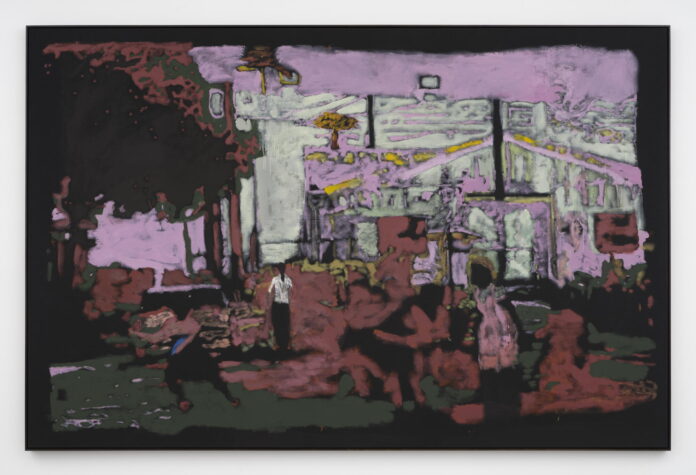
Reggie Burrows Hodges, “Magic Eraser,” 2026, featured in “A Theater of Dreams” at Art + Practice.
(Reggie Burrows Hodges / Karma)
While his paintings now fill galleries, Hodges himself would rather remain out of view. He rarely grants interviews and declines to be photographed. Once in conversation, however, he is generous and deeply feeling, willing to engage in the messy project of shared meaning-making so long as it’s not the meaning of a particular reference, form or setting. He wants viewers, he said again and again, to “find a way into the work” without him standing in the way.
Asked about music, the artist somewhat reluctantly traces his affinity back to childhood. The youngest of his siblings, he grew up surrounded by his parents’ records, an older brother’s guitar and aunties who played piano. Music, he recalled, “filled the house with a rhythm and a spirit.” He went on to co-own a recording studio and tour with the reggae-dub band Trumystic before finding recognition as a painter in his 50s. For years, he considered the two pursuits “apples and oranges.”
“I wasn’t a multidisciplinary artist,” he said. “I put songwriting away, and thought that maybe in my need for expression, painting could come forward.”
Still, walk into the gallery thrumming with one of his reggae-inflected tracks, and the correspondence becomes difficult to deny. While the paintings may not be physically vibrating, their compositions resonate with a similar intensity. Figures emerge from his signature black background, their silhouettes resolving and dissolving amid legato drips and vigorous brushwork. Shifting between precision and improvisation, each rhythmic mark registers its own time signature.
“I’m never concerned with how something looks,” he said. “I’m only concerned with how it feels.”

“Aida the Homegirl” by Reggie Burrows Hodges hangs at the Getty as part of the artist’s first hometown solo exhibition.
(Ariana Drehsler / For The Times)
That visceral quality is what struck Getty curator Davide Gasparotto when he first encountered Hodges’ work in Florence in 2022. He immediately recognized echoes of Baroque painting in Hodges’ loose, expressive brushwork, his agile handling of shadow and light.
“My response was not only mental,” Gasparotto said. “It was physical; they were very powerful but at the same time refined.”
The two men met in L.A. the following year and spent a day walking through the Getty. Hodges went on to study works by Caravaggio and Rembrandt in Europe, with Gasparotto joining him in museums like the Gemäldegalerie in Berlin along the way.
“Every human being should get to do a tour of these works,” Hodges said.
But for all his admiration of their technical virtuosity, Hodges found himself preoccupied with the violence that pervades Baroque imagery: beheadings, assaults, martyrdom, tortured bodies suspended between life and death. He joked that Gasparotto, at least partly inured to their brutality, ought to send him flowers to paint next. What stayed with Hodges was the spectacle of public punishment and its resonance with the violence broadcast across screens today.
“It has a way,” he said, “of getting hold of you.”
For Hodges, the question became how to convey that force without depicting it explicitly. He found precedent in paintings where bloodshed is latent or occurs just beyond the frame. In Orazio’s “Lot and His Daughters” (c. 1622), two women cradle their incapacitated father and gaze off toward Sodom as it erupts in flames. In Hodges’ monumental “The System of Shannon’s Discontent 3” (2023), the daughters’ silhouettes appear before a heavy crimson curtain. The red, as startling as a cymbal clap, strikes the eye, but the impending drama remains out of sight. Hodges reprises Orazio’s chiaroscuro — the interplay of light and shade — in the sculptural folds of the drapery to equally foreboding effect.

“Lot and His Daughters,” left, and “Danae and the Shower of Gold” by Orazio Gentileschi hang at the Getty, and served as inspiration for the work of Reggie Burrows Hodges.
(Ariana Drehsler / For The Times)
“Hodges’ use of darkness is as important as light,” Gasparotto said. “That tension creates the charged space of the unknown and the emotion.”
Moving between Hodges’ five paintings at the Getty and the 17th century works that inspired them in the next room, it’s clear the contemporary canvases are neither copies nor straightforward homages. Rather, he borrows discrete aspects of their structures or narratives and transforms them into something entirely distinct. The process recalls versioning in dub, where an existing recording is stripped down and reconstructed, its individual elements isolated, amplified or faded out entirely. What is withheld becomes as important as what remains.
“I’ve been after that spatial relationship,” Hodges said, describing dub as a “dance of what is absent.” “Dub is about what’s not playing.”
At CAAM, Hodges distills violence and its consequences into intimate gestures of human vulnerability, albeit on a monumental scale. “A Discarding of Self” (2023), a triptych stretching more than 13 feet, shows amorphous bodies, stripped of their sensuous detail, bending, reaching, touching and carrying obscured burdens against a barren pink and ochre landscape beneath a marbled sky. Though the tableaux depict hardships endured by a painter born in 1593, Artemisia, the impressions convey yearning, grief, suffering and resilience that transcend centuries. The blank, black planes, devoid of facial features, create space for viewers to imagine themselves in their place.

Reggie Burrows Hodges, “Two Handled Wand,” 2023, featured in “A Theater of Miracles” at CAAM.
(Reggie Burrows Hodges / Karma)
“I really respect the restraint of his work,” Bridget R. Cooks, curator of the CAAM and Art+Practice exhibitions, said of the concealed faces, the expanses of negative space. “I find a lot of the restraint changes my breathing when I look at it.”
Elsewhere at CAAM, “Movement Play” documents Hodges drawing from live models. Featuring young performers of color in custom costumes and his own dub soundtrack, the short process film offers “another way to bridge that gap” between past and present, one culture and another, Cooks said.
The expansion from CAAM to Art + Practice allowed Hodges to carry the conversation even closer to home. In July, he called Cooks proposing an entirely new series, this time looking beyond a European lineage to one rooted in L.A.
“So, yes, these Old Masters,” Hodges said. “These 16th century titans, yada, yada, yes, unbelievable. But what about us? This is us now in this moment.”
He turned to Noah Davis, Henry Taylor, Lauren Halsey, Mark Bradford — who co-founded Art + Practice — and others he considers “masters in every way,” as his guides from the past into today. In the adumbrated cityscapes and sunlit garden plots, he might remix an inherited gesture, shade or style of line with hazy neighborhood memories of Bursch Elementary or Burke Park. In “Shadow Swing” (2026), quivering, spectral silhouettes bleed into the leafy foliage and dusky sky, at once present and elusive.
“There’s some point in which memories become dreams,” Cooks said of the forms that gradually cohere, shimmering, like film in a developing tray.

From left: “The System of Shannon’s Discontent 3,” “The System of Shannon’s Discontent 1” and “The System of Shannon’s Discontent 2” by Reggie Burrows Hodges at the Getty as part of his solo show, “A Theater of Passions.”
(Ariana Drehsler / For The Times)
For Hodges, painting has long been a refuge. “It’s always been a good friend to me,” he said, something that quelled his “worry hours.” He never imagined his private solace bringing such public recognition.
Days before the openings, the prospect of showing across his hometown still seemed to Hodges about as incomprehensible as a dream. He described the experience as “daunting, terrifying, humbling, nerve-racking” and admitted to feeling undeserving. He joked that ordinarily an artist would have to die before being given a gallery at the Getty.
Still, what seemed to move him most was that the celebration would reach beyond the museum on the hill. In a city that is multicultural but also segregated, Cooks said, “there are multiple art worlds,” and this “unprecedented project” puts them all in dialogue.
“It’s hard for me to celebrate me,” Hodges said. He hopes instead his paintings will mean something to others. Asked what that might look like, he returned to the pleasure of people gathering around music, as his family once had.
“You come, you see the paintings,” he said. “You drop the needle on the turntable, play some music … and I’m going to get out of the way.”
More to Read
Disclaimer : This story is auto aggregated by a computer programme and has not been created or edited by DOWNTHENEWS. Publisher: latimes.com