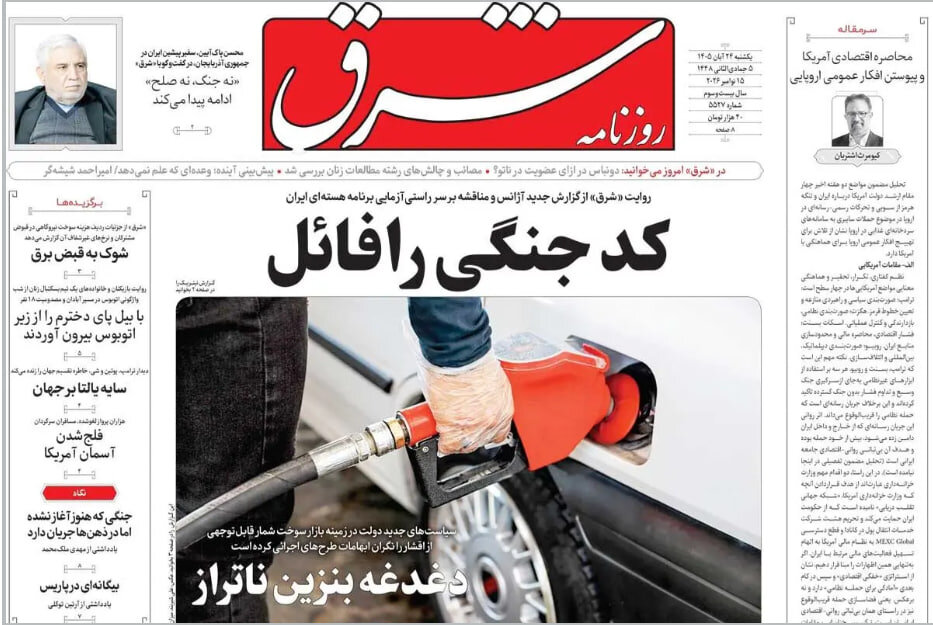
Shargh examined recent regional developments and the growing risk of conflict. According to the paper, new developments in the Iran-US dispute point to rising military tensions and mutual threats. On one side, President Trump reportedly removed JD Vance from a negotiating role related to Iran. On the other, Israeli Prime Minister Netanyahu met with his political rival Gadi Eisenkot
Together with several recent developments, the meeting has fueled speculation about the possibility of renewed hostilities. Developments over the past 48 hours indicate growing distrust and an increased risk of confrontation. However, it remains impossible to identify a clear timeline for any return to war. Tehran continues to insist on its positions, Washington remains divided between pressure and diplomacy, and Tel Aviv is closely monitoring security developments. Under these conditions, military preparedness and the possibility of surprise operations remain among the most important factors that could influence events in the coming days.
Resalat: A war that created a new challenge for Washington
Resalat analyzed how another conflict could further complicate the position of the US. The paper wrote that Qatar s mediation efforts to end tensions are continuing, but Washington has not accepted Iran s ceasefire proposal. Regional and American actors have also expressed doubts about the prospects for a quick agreement. Current developments show that Washington has not succeeded in imposing its political objectives on Iran through military means. If the US seeks an agreement, it may have to discuss issues on which it previously expected no compromise. As a result, the strategic environment has changed. The paper argued that any future military action by the US and Israel against Iran would differ from previous confrontations because Washington can no longer claim ignorance of the costs and consequences of escalation. Having already experienced the impact of confrontation, American policymakers would enter another round of tensions with a clearer understanding of the risks involved.
Hamshahri: No limitations
Hamshahri focused on a directive attributed to the Leader of the Islamic Revolution Ayatollah Mojtaba Khamenei calling for decisive responses to threats. According to the paper, every level and type of threat should be met with an immediate and effective response without geographical restrictions. The article described this as one of the most significant indications of change in the strategic and military thinking of the Islamic Republic since the end of the 1980-1988 Iran-Iraq War. It pointed to developments over the past two years, including conflicts involving the US and Israel and continuing threats of future attacks, as factors that have created a different strategic environment. Within this context, the newspaper interpreted the emphasis on unrestricted responses as evidence of a reassessment of earlier limitations. The discussion is no longer confined to targets in Israeli-controlled territories. Instead, the potential geographical scope of threats and responses is being viewed more broadly.
Arman-e-Melli: War or agreement?
Arman-e-Melli interviewed political analyst Ali Bigdeli to examine possible scenarios in the tensions between Iran and the US. Bigdeli argued that Iran currently possesses a relatively favorable military and political position and should make effective use of it. At the same time, he stressed that growing economic pressure makes it necessary to pursue an agreement. In his view, the most practical approach is to reduce tensions on the ground while giving greater attention to diplomacy. He argued that the time has come for diplomatic efforts to play a more active role. Iran has achieved important successes and should avoid losing those gains. Nevertheless, policymakers must prepare for the possibility of additional pressure in the future. Measures affecting borders and regional trade routes, he suggested, could emerge as part of broader attempts to increase
Ham Mihan: Neither war nor peace
According to Ham Mihan, Trump s strategy toward Iran appears focused on maintaining economic pressure, tightening sanctions, and increasing forms of containment. The newspaper argued that this approach effectively keeps Iran in a prolonged state of neither war nor peace. At the same time, the paper suggested that Iran is waiting for changing circumstances and possible shifts in future political calculations. Yet the greatest burden of this situation falls on ordinary citizens. Economic pressures on society have become increasingly severe and produced wide-ranging consequences. Negotiation and mutual understanding can demonstrate political realism, responsibility, and concern for the country s future. Even if the US continues to rely on economic pressure, diplomatic efforts should not be abandoned. In its view, the most urgent priority is breaking the cycle of threats and pressure, revitalizing diplomacy, and finding a way out of prolonged uncertainty. The paper concluded that no political strategy should treat the ongoing hardships faced by Iranian society as a cost that can simply be ignored.
Disclaimer : This story is auto aggregated by a computer programme and has not been created or edited by DOWNTHENEWS. Publisher: tehrantimes.com