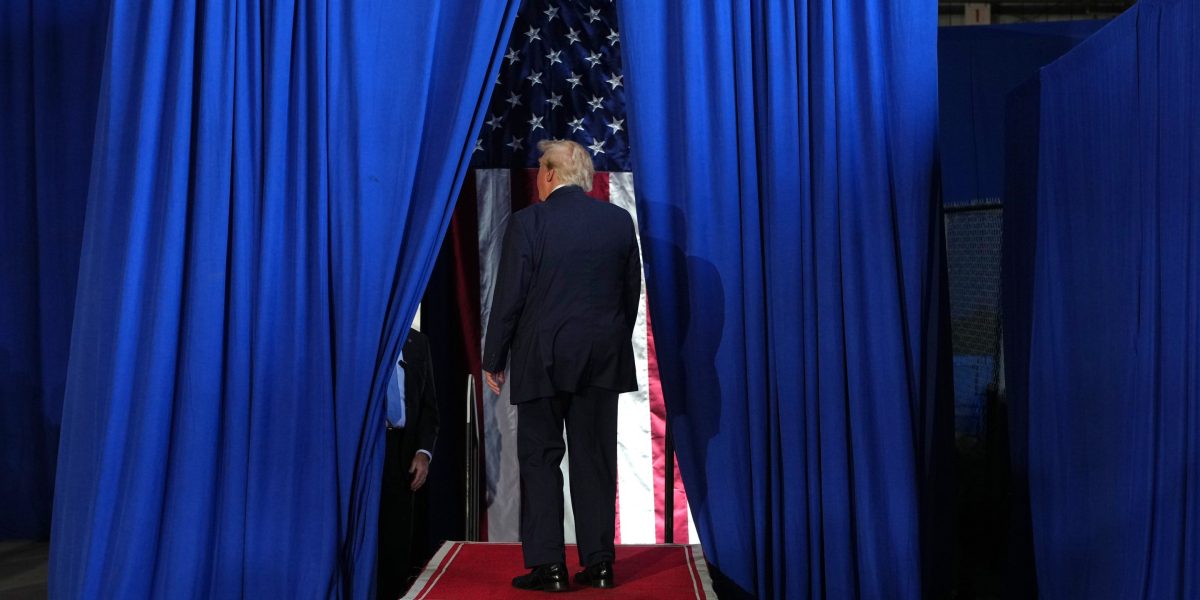
The nation’s major political parties are at a crossroads.
A decade after he began to remake the Republican Party in his image, President Donald Trump is facing the prospect of a voter rebellion Tuesday that could force conservatives to rethink their undying allegiance to the 80-year-old lame-duck leader and his “Make America Great Again” movement. Already, some Republican candidates have begun to distance themselves from him.
And Democrats, who remain unpopular despite midterm momentum, are speeding toward a tug-of-war between establishment leaders and emboldened progressives demanding nothing less than transformative change.
Whether either party wins or loses Tuesday, the end of the 2026 midterms marks the beginning of a high-stakes fight over the country’s political future in the twilight of the Trump era — a fight that will swiftly surge to the forefront of American politics as new members of Congress descend upon Washington and the 2028 presidential contest takes off.
“When President Trump leaves office, it’s going to create a tremendous vacuum. And I ask the question, where does the country go next?” said former Republican Sen. John E. Sununu, who is running for the New Hampshire Senate seat he lost in 2008.
Republicans start to envision a party after Trump
More than any policy or principle, the most powerful unifying force in the modern-day Republican Party has become Trump himself.
And so, as the party looks to the end of the Trump era, major questions loom over who or what will guide it. Trump long ago smashed Ronald Reagan’s three-legged stool of conservatism that defined the GOP for generations: fiscal conservatism favoring small government and free trade, conservative social values and a muscular foreign policy.
What remains today is a fluid populism that changes with the whims of the outgoing president.
The brash businessman helped move the Republican Party away from the country club and toward a much broader coalition of working-class voters, including a growing slice of the traditional Democratic base, including Hispanics, African Americans and young people.
Republican strategist David Urban said he’s closely watching whether the Trump coalition holds up Tuesday.
“When we see that, that’ll tell you a lot about the future,” Urban said. “Look, if all those folks stay home — they’re disaffected because of the economy, or the war, or pick your exit polling issue — that then leaves a lot of questions of who’s going to be the next standard-bearer for the party.”
Most of the Republican Party’s 2028 buzz has focused on Vice President JD Vance. The 42-year-old former Ohio senator went from a Trump critic to a Trump acolyte, and he could face the usual challenges of establishing an independent political identity while serving in the nation’s number two role.
Should Republicans have a bad night Tuesday, Vance’s presidential stock could take a hit. Another popular 2028 prospect, Secretary of State Marco Rubio, could face a similar challenge.
But that could open the door for Texas Sen. Ted Cruz, Florida Gov. Ron DeSantis, or perhaps even a vocal Trump critic like former New Jersey Gov. Chris Christie, who is 64 years old and weighing a comeback.
Democrats can’t agree on what comes next
With few exceptions, Democratic officials are anticipating a good night Tuesday, even if they do not win both chambers of Congress. They do not agree, however, on what comes next.
The establishment is cheering the ascendance of Rep. Hakeem Jeffries, who is poised to become the nation’s first Black House speaker should Democrats win the majority. Frustrated progressives, however, believe Jeffries and Senate Democratic Leader Chuck Schumer are part of the problem. And they’re demanding sweeping change in the people and policies guiding their party.
Such demands are especially pronounced among the Democrats aligned with the Democratic Socialists of America. Currently, just two DSA-backed members serve in the House of Representatives. Their numbers are expected to swell to at least seven in the new Congress thanks to the success of the slate of candidates backed by New York Mayor Zohran Mamdani in the primaries.
Michigan Senate candidate Abdul El-Sayed would give the far left another vocal champion, although he is not endorsed by the DSA, nor does he identify as a democratic socialist.
Maryland Gov. Wes Moore, a Democratic presidential prospect facing reelection next week, declined to say he welcomed DSA into his party when asked directly. Instead, he told The Associated Press that he wanted “commonsense leaders that are prepared to disrupt the status quo and know how to move fast in order to get things done.”
He said over and over that Democratic leaders must act with urgency.
“I don’t want to be a party of no and slow. I want to be a party of yes and now,” Moore said. “I want to be a party that is deeply impatient to be able to deliver the kind of results that we’re hoping for and the things that we’re hoping to see for our families.”
Moore’s rhetoric matches the rhetoric of the Democrats’ energized activist class, but they almost certainly disagree on the tactics needed to fight Trump and his allies in Congress. And the Democratic Party’s left flank could only grow louder after the midterms.
Corbin Trent, a former adviser to Rep. Alexandria Ocasio-Cortez, said Tuesday marks a new beginning that gives Democrats a tremendous opportunity to embrace transformative change on healthcare, housing and infrastructure, among other major issues.
But he’s not optimistic that the Democrats who lead the party in Washington are up to the challenge.
“This election is rejection of the status quo,” Trent said. “The fact is, Chuck Schumer, Hakeem Jeffries and the bulk of Democratic leadership has proven it’s incapable to meet this moment for what it is: a transformational moment to bring us forward.”
Meanwhile, Trump will be in office for two more years, whether his party suffers major losses next week or not. And even a politically wounded Trump would remain a dominant force in Republican politics and the next presidential nomination fight.
“Until the day Donald Trump draws his last breath, he will still loom large like the Colossus of Rhodes over the Republican Party,” Urban said, referencing the ancient Greek statue that depicted the sun god, Helios. “Nobody is going to be more influential, regardless of what happens in this election.”
___
Holly Ramer in Concord, New Hampshire, and Stephen Smith in Biloxi, Mississippi, contributed.
Disclaimer : This story is auto aggregated by a computer programme and has not been created or edited by DOWNTHENEWS. Publisher: fortune.com